
The Stalemate
Both Sides Think They’re Winning. One of Them Is Right.

THE FOURTH TURNING POINT
Strategic Conflict Assessment Series
April 23, 2026
Briefing #12
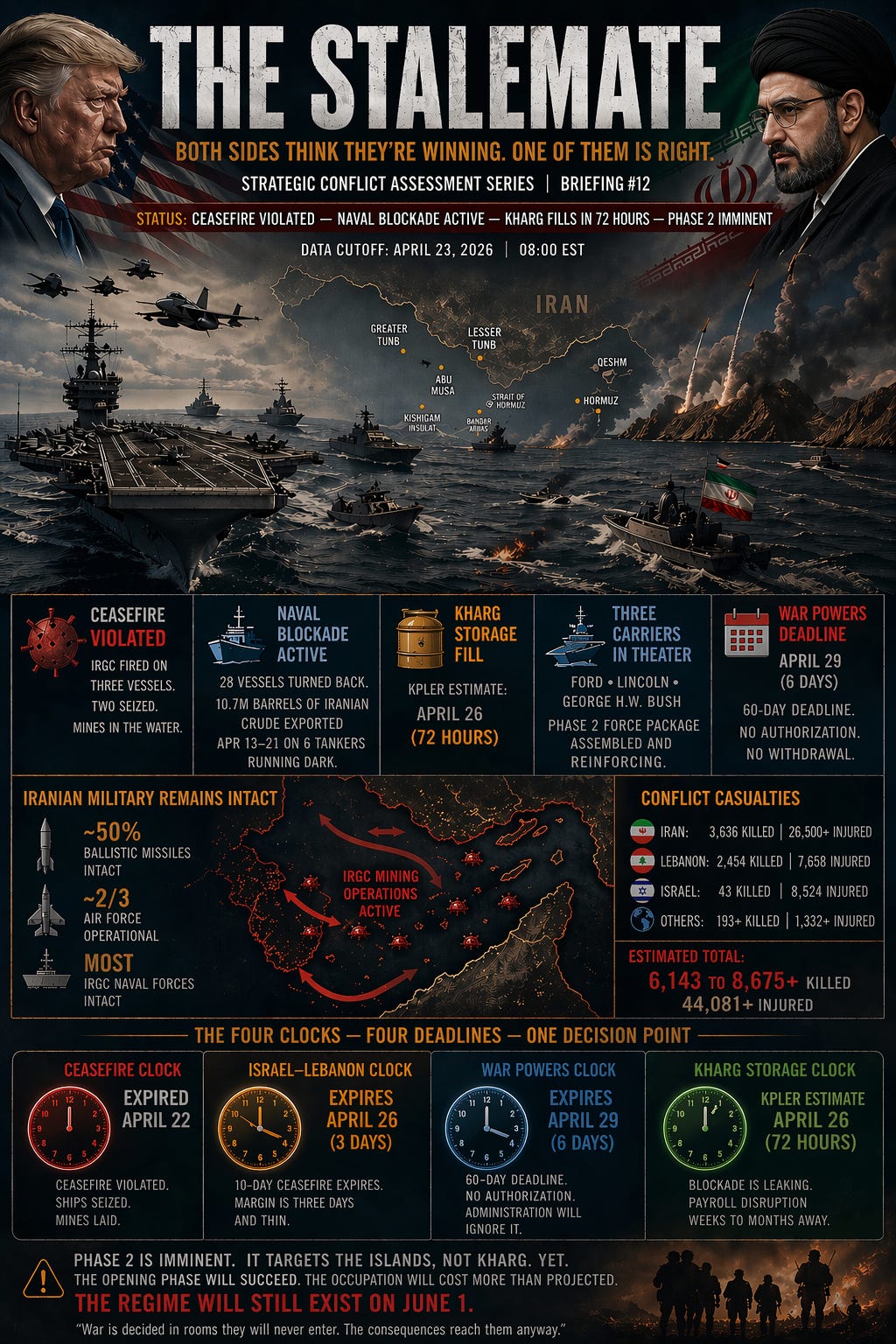
Status: Two-Week Ceasefire Expired — Naval Blockade Active — Kharg Fills in 72 Hours — Phase 2 Imminent
Data Cutoff: April 23, 2026 | 14:00 EST
EXECUTIVE SUMMARY
April 23, 2026
This war is operating on three clocks: military logistics, oil markets, and American politics.
They are not running at the same speed.
Military logistics favors the United States.
Oil markets favor Iran.
American politics favors whoever runs out the clock.
Yesterday the two-week ceasefire expired.
Iran seized two cargo ships hours after Trump extended it.
Satellite imagery confirmed a new IRGC mining operation in the Strait.
The blockade is leaking.
Vortexa confirms 10.7 million barrels exported between April 13 and April 21.
Three carriers are in theater.
The Secretary of the Navy was fired.
A Marine fighter squadron transited from the Azores toward CENTCOM.
Three deadlines converge in the next six days.
The Israel-Lebanon ceasefire expires April 26.
Three days.
The Kpler Kharg storage estimate fills April 26.
Three days.
The War Powers 60-day deadline expires April 29.
Six days.
None of them are producing a framework.
The stalemate broke yesterday.
Phase 2 is imminent.
It targets the islands, not Kharg.
Yet.
The opening phase will succeed.
The occupation will cost more than projected.
The United States is miscalculating Iranian resistance at every level.
The regime will still exist on June 1.
The Strategic Conflict Assessment Series
Briefing #1 — The Death of Khamenei: Decapitation Is Not Collapse

Briefing #2 — Axis Activation

Briefing #3 — The Math of War

Briefing #4 — The Energy Front

Briefing #5 — The Maritime War

Briefing #6 — The Market Is Still Asleep

Briefing #7 — The Regime That Won’t Fall

Briefing #8 Part 1 — The Endgame Problem

Briefing #8 Part 2 — The Reckoning

Briefing #9 — The War That Reached the Dinner Table

Briefing #10 — The Proxy Map

Briefing #11 — The Deal

This briefing examines the stalemate that followed the deal and where it breaks.
WAR CLOCK — THE CEASEFIRE ARC
Mar 21, 2026 — Day 21
Trump issues first Hormuz ultimatum. Iran has 72 hours to fully open the Strait or face power plant strikes.
Deadline: March 23.
Mar 23, 2026 — Day 23
Deadline passes. Iran has not opened the Strait.
Trump announces a five-day delay, citing “very good and productive conversations.”
Iranian officials deny negotiations are occurring.
New deadline: March 28.
Mar 26, 2026 — Day 26
Trump extends again.
Eight more days.
Cites an Iranian government request. Iranian officials say there has only been an exchange of messages.
New deadline: April 6.
Apr 4, 2026 — Day 35
Trump re-ups the deadline. Iran has “72 hours before all Hell will reign down.”
Deadline: April 6.
Apr 6, 2026 — Day 37
Deadline passes. Iran has not opened the Strait. Trump gives it one more day.
Cites Easter.
New deadline: April 7.
Apr 7, 2026 | 18:32 EST — Day 38
Trump announces ceasefire on Truth Social. Ninety minutes before his own deadline. No written document. Iran declares victory.
Pakistan says Lebanon is included. Israel says it is not.
This is the sixth deadline Trump has set and extended without Iran meeting its stated terms.
Apr 8, 2026 — Day 38
Ceasefire takes effect.
Israel launches largest Lebanon strikes since March 2.
357 killed. 1,200+ injured.
Lebanon is not included.
Apr 11–12, 2026 — Days 41–42
Islamabad talks.
The highest-level direct U.S.-Iran meeting since the 1979 revolution.
21 hours. No agreement.
U.S. demands: 20-year enrichment moratorium, all HEU removed from Iran, Hormuz reopened without tolls, end to proxy funding.
Iran’s counter: five-year enrichment pause, downblend the HEU, Hormuz under Iranian coordination, war guarantees before concessions.
Iran’s spokesman says there was agreement on a range of issues with two or three sticking points.
Texts exchanged.
Araghchi says the sides came within inches of an understanding but “encountered maximalism, shifting goalposts, and blockade.”
Vance presents a final and best offer and departs. Pakistani officials remain with the Iranian side for hours after.
Apr 13, 2026 — Day 43
Naval blockade begins.
Iran’s storage clock starts running.
Apr 16, 2026 — Day 46
Israel-Lebanon 10-day ceasefire begins 5:00 PM ET. Expires April 26.
Israeli operations continue under self-defense clause. French UNIFIL peacekeeper killed.
Apr 17–18, 2026 — Days 47–48
Araghchi announces Hormuz “completely open.” Within hours, IRGC contradicts him on Channel 16: “We will open it by the order of our leader… not by the tweets of some idiot.” Iran fires on vessels.
IRGC hardline faction has formally overruled Iran’s foreign minister in real time on the world’s most important energy chokepoint.
Apr 19, 2026 — Day 49
USS Spruance seizes the Touska.
First Iranian vessel seized during the war.
Iran calls it a ceasefire violation.
Apr 21, 2026 — Day 51
Vance’s Pakistan trip cancelled.
Iran has not confirmed attendance at a second round. Trump extends ceasefire indefinitely.
Same morning on CNBC: “I expect to be bombing. The military is raring to go.”
Apr 22, 2026 — Day 53
Ceasefire expires.
Extended indefinitely with no new deadline.
Hours after extension: IRGC fires on three cargo ships. Two seized and taken to Iranian coast.
Satellite imagery confirms major new IRGC speedboat mining operation in the Strait.
House Armed Services briefed: 20+ mines emplaced, some GPS-guided, harder to detect.
Secretary of the Navy John Phelan fired by Hegseth effective immediately. Acting SecNav Hung Cao installed.
USS George H.W. Bush arrives Arabian Sea. Three carriers in CENTCOM simultaneously for the first time.
Vortexa: 10.7 million barrels of Iranian crude exported through the Strait between April 13–21 on six tankers running dark.
Apr 23, 2026 — Day 54 | PUBLICATION DATE
Israeli-Lebanese ceasefire preparatory talks in Washington.
VMFA-312 “Checkerboards” F/A-18C Hornets airborne from Lajes, Azores, toward CENTCOM, supported by nine KC-46A tankers. F-15E Strike Eagles departing RAF Lakenheath for Jordan.
Iranian lawmakers confirm Hormuz transit fee revenue deposited into the central bank. Israeli officials: agreements by Sunday unlikely. “We learn about Trump’s moves from the news.”
Three days until Israel-Lebanon ceasefire expiry.
Three days until Kpler Kharg fill estimate.
Six days until War Powers deadline.
Three deadlines converging inside six days.
No framework. No talks scheduled.
Phase 2 force package fully assembled and reinforcing.
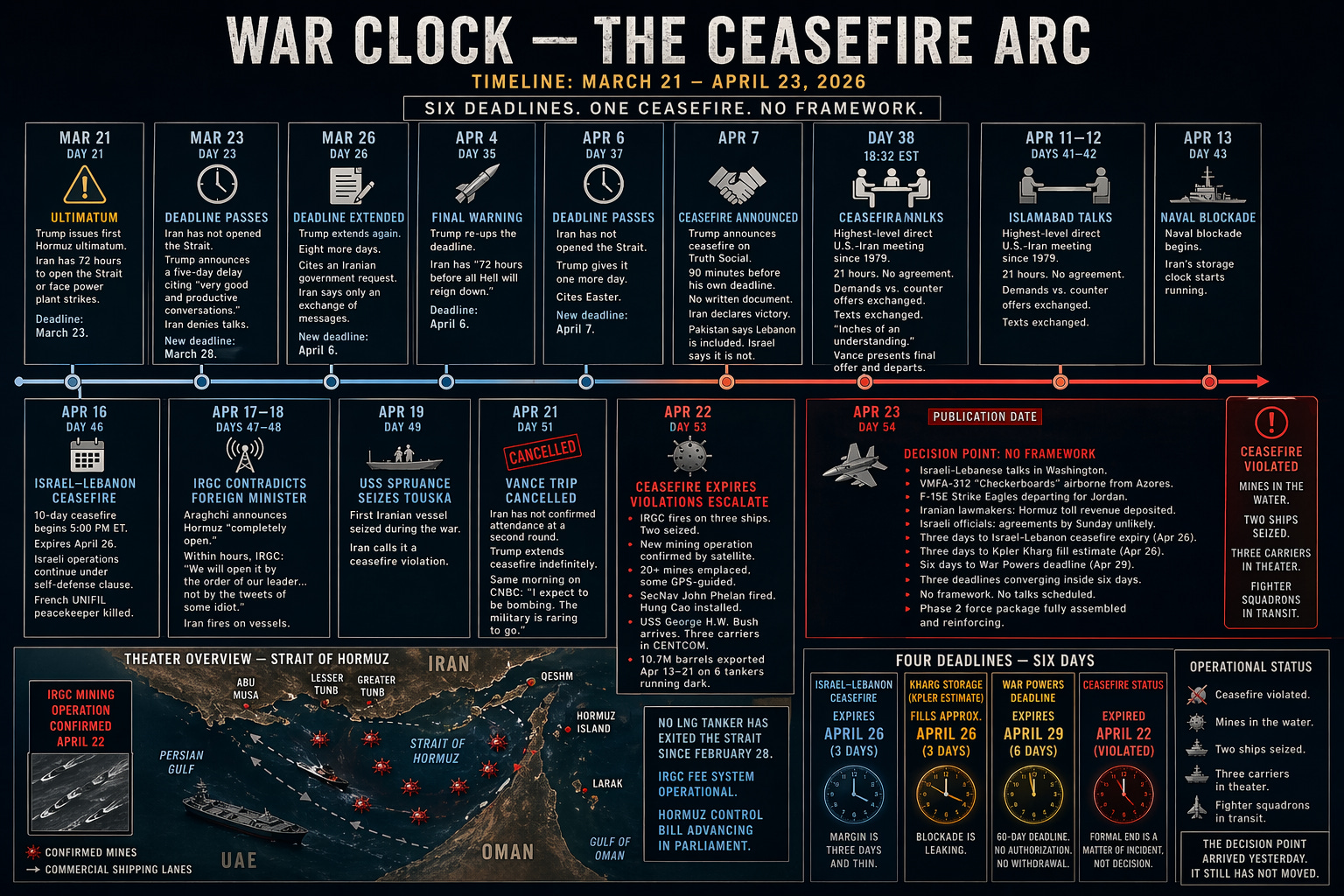
Operational Status:
Ceasefire violated.
Mines in the water. Two ships seized.
Three carriers in theater. Fighter squadrons in transit.
War Powers 60-day deadline: April 29. Six days from publication.
Israel-Lebanon ceasefire expiry: April 26. Three days from publication.
Four deadlines in 6 days. The decision point arrived yesterday.
It still has not moved.
SNAPSHOT — April 23, 2026 | 08:00 EST
Hormuz
IRGC fired on three vessels April 22.
Two seized. New mining operation confirmed by satellite.
20+ mines per classified House Armed Services briefing, some GPS-guided.
No LNG tanker has exited the Strait since February 28. IRGC fee system operational. Iranian lawmakers confirm first Hormuz toll revenues deposited into the central bank. Parliamentary bill codifying Hormuz control as permanent Iranian law advancing.
Naval Blockade
28 vessels turned back per CENTCOM.
Vortexa confirms 10.7 million barrels of Iranian crude exported April 13–21on six tankers running without AIS. The blockade is not airtight.
Mine clearance minimum: May 11.
New active mining operation resets this clock entirely.
Trump just tweeted out “I have ordered the United States Navy to shoot and kill any boat, small boats though they may be (Their naval ships are ALL, 159 of them, at the bottom of the sea!), that is putting mines in the waters of the Strait of Hormuz”.
Kharg Storage
Kpler capacity reached approximately April 26 under full blockade.
Energy Aspects approximately April 29.
FGE NextantECA approximately June 12.
Critical: blockade is leaking.
Vortexa export data confirms Iranian crude is moving. The June timeline is more plausible than the April one.
Gulf Production Shutdown
EIA: Gulf states shut in 9.1 million barrels per day in April, up from 7.5 million in March. 30 percent of combined prewar Gulf production idled.
IEA restart assessment:
Half of Gulf fields can return to pre-war output within two weeks of reopening.
Another 30 percent within six weeks.
The remaining 20 percent roughly 2.5 to 3 million barrels per day face permanent damage.
Some Iraqi and Kuwaiti wells may never recover.
Fujairah Oil Stocks
7 million barrels.
Lowest level in at least nine years.
Oil Markets
WTI $90–100.
Physical cargoes $115–130.
Brent futures $95–105.
Both 35 to 50 percent above pre-war levels.
Goldman Sachs persisting closure scenario:
Q3 $120, Q4 $115.
JPMorgan sustained shutdown scenario:
$150.
Gunvor CEO at FT Global Commodities Summit: traders stress-testing books against $200 to $300 per barrel.
Military Posture
USS Gerald R. Ford: CENTCOM, 326+ days deployed, post-Cold War record.
USS Abraham Lincoln: Arabian Sea, blockade enforcement.
USS George H.W. Bush: arrived April 22, third carrier in theater.
31st MEU / Tripoli ARG: on station since March 27, executed Touska seizure April 19.
11th MEU / Boxer ARG: inbound.
82nd Airborne 1st BCT: Kuwait.
Six B-2 Spirits and KC-135s: Diego Garcia.
Eight B-1Bs and three B-52s: RAF Fairford.
VMFA-312 F/A-18C Hornets: in transit from Azores to CENTCOM now.
F-15E Strike Eagles: departing RAF Lakenheath for Jordan.
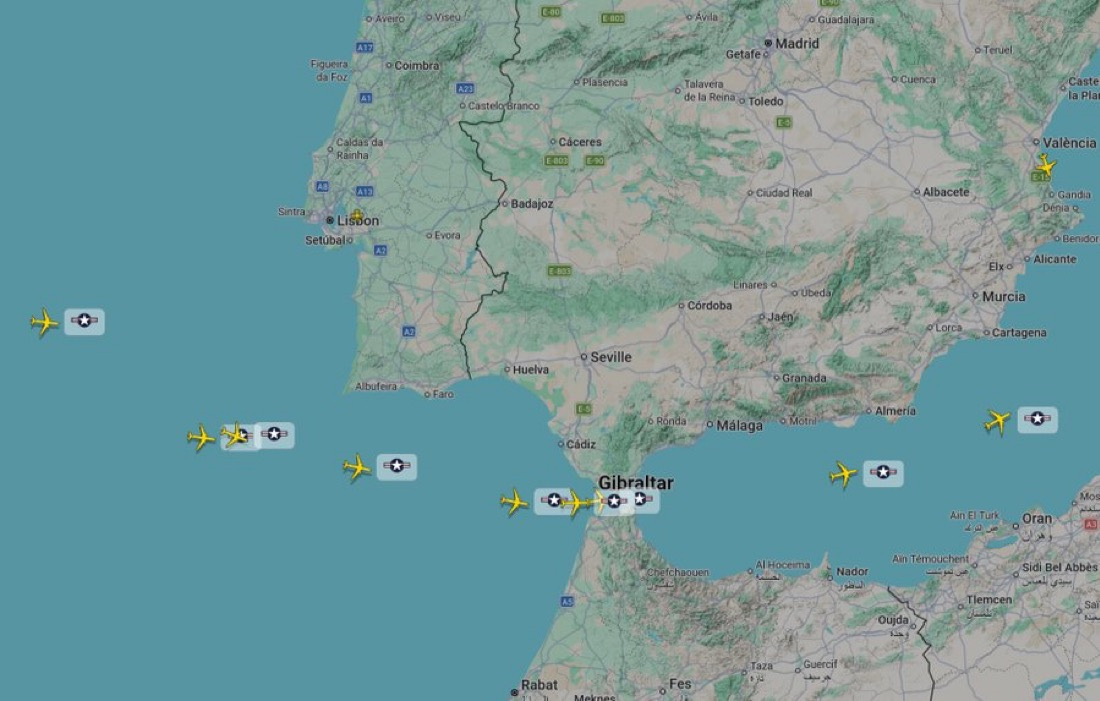
819 logistical transport flights from the United States to the Middle East since the truce began.
Iranian Military
Approximately 50 percent of ballistic missiles intact per U.S. intelligence.
Roughly two-thirds of the air force operational.
IRGC naval forces largely intact.
These figures directly contradict Pentagon public claims of decimation.
Iranian Decision Structure
Iran’s Supreme National Security Council has 12–13 members under Article 176 of the constitution.
Permanent seats include the President, Parliament Speaker, Chief Justice, military chiefs, key ministers, and two Supreme Leader representatives.
All decisions require Supreme Leader ratification.
Claims that the IRGC alone blocked negotiations misread this structure. The hardline position has support across the full council.
The Supreme Leader ratified every decision that ended flexibility at Islamabad.
KEY JUDGMENTS
Strategic Conflict Assessment | April 23, 2026
Judgment 1: The stalemate ended April 22.
Iran fired on ships and laid mines within hours of Trump extending the ceasefire on April 22. This was not a malfunction.
Iran was told by Pakistan that the blockade would be lifted with the ceasefire extension. Only the ceasefire was extended. The blockade remained.
Iran’s IRGC interprets the gap as deliberate deception to prepare conditions for Phase 2. They are shaping the battlefield because they believe Phase 2 is coming regardless of diplomatic engagement.
The ships were seized. The mines are in the water.
The ceasefire exists in name only.
Judgment 2: The blockade is leaking. The strategic assumption behind it is wrong.
Vortexa confirms 10.7 million barrels of Iranian crude exported between April 13 and April 21 on six tankers running without AIS.
Zero exports is not the operational reality.
The behavioral model is also wrong.
For 47 years the United States has sanctioned, isolated, and applied maximum pressure to Iran. Iran has not complied strategically once. The men making Iranian decisions today were forged in the Iran Iraq War. Eight years of military conflict and economic devastation the regime absorbed and survived.
Vahidi built Iran’s proxy network through every maximum pressure period. Zolghadr suppressed the 2009 Green Movement. These men do not have a pain threshold that American economic pressure has ever reached.
Kerry confirmed on April 9 what this series has documented since Briefing 1. Iran presented no imminent nuclear threat before the war. Trump said so himself after the June 2025 strikes.
U.S. intelligence now directly contradicts the Pentagon’s public claims of decimation. Iran retains approximately half its ballistic missiles, most of its IRGC naval forces, and roughly two thirds of its air force.
The regime was not destroyed.
The blockade is not working as projected. The behavioral prediction underlying both was wrong before the first bomb fell.
It remains wrong now.
Saying so is not a political position. It is the factual record. The intelligence community said it. Kerry said it. The Vortexa data confirms it.
The series has documented it since Briefing 1.
The Iranian people deserve an honest accounting of what this war has and has not achieved. So do the Americans paying for it.
Judgment 3: Phase 2 will target the islands before Kharg.
The new mining operation makes this operationally urgent. Iran is actively laying mines during the ceasefire.
The islands must be controlled to stop the mining.
The force package in theater includes two MEUs, 82nd Airborne BCT, three carriers, and fighter squadrons in transit.
It is the right architecture for island seizure.
The opening phase will succeed.
The resistance and occupation cost will exceed projections.
Judgment 4: The removal of the Secretary of the Navy signals command restructuring before Phase 2.
Phelan fired after months of tension with Hegseth.
Hegseth is installing a chain of command he controls directly.
Firing the SecNav while three carriers are in theater and fighter squadrons are in transit is not routine personnel management.
It is preparation.
Judgment 5: The conflict timeline favors Iran. Trump’s bluff record confirms it.
Trump has set and extended six consecutive deadlines since March 21 without Iran meeting his stated terms.
Iran has documented every one.
The bet that Trump will not follow through is not irrational. It is based on six consecutive data points.
The force posture in theater right now includes three carriers, two MEUs, 82nd Airborne, B-2s, and fighter squadrons in transit.
It is either the most expensive bluff in American naval history or Phase 2 is days away.
Trump said he will not stop the war for midterms.
The constraint does not disappear because he named it.
Strategic Assessment
Iran is prepared for a prolonged confrontation.
The blockade is weaker than projected. Military escalation infrastructure is assembled and actively reinforcing. Political timelines are tightening.
The conflict is moving toward its next phase.
CASUALTIES | April 23, 2026
Iran:
3,636 killed, including 1,701 civilians and 244 children.
26,500+ injured.
Lebanon:
2,454 killed.
7,658 injured.
Israel:
43 killed.
8,524 injured.
Other State Actors
United States: 15 killed, 538 injured.
Iraq: 112 killed, 358 injured.
United Arab Emirates: 13 killed, 224 injured.
Kuwait: 10 killed, 115 injured.
West Bank: 14 killed, 15 injured.
Saudi Arabia: 3 killed, 29 injured.
Bahrain: 3 killed, 42 injured.
Oman: 3 killed, 15 injured.
France: 2 killed, 10 injured.
Philippines: 2 killed, injuries not reported.
Qatar: no confirmed fatalities, 20 injured.
Jordan: no confirmed fatalities, 29 injured.
Non-State Forces
Hezbollah: 1,700 fighters killed.
Popular Mobilization Forces (PMF), Iraq: 80+ fighters killed, 270+ injured.
Estimated Conflict Totals
Fatalities: 6,143 to 8,675+ killed.
Injured: 44,081+.
Lebanon remains under active Israeli bombardment. The Lebanese death toll has risen nearly 1,000 since the ceasefire that excluded them. All figures represent minimum confirmed estimates.
I. The Anatomy of a Stalemate
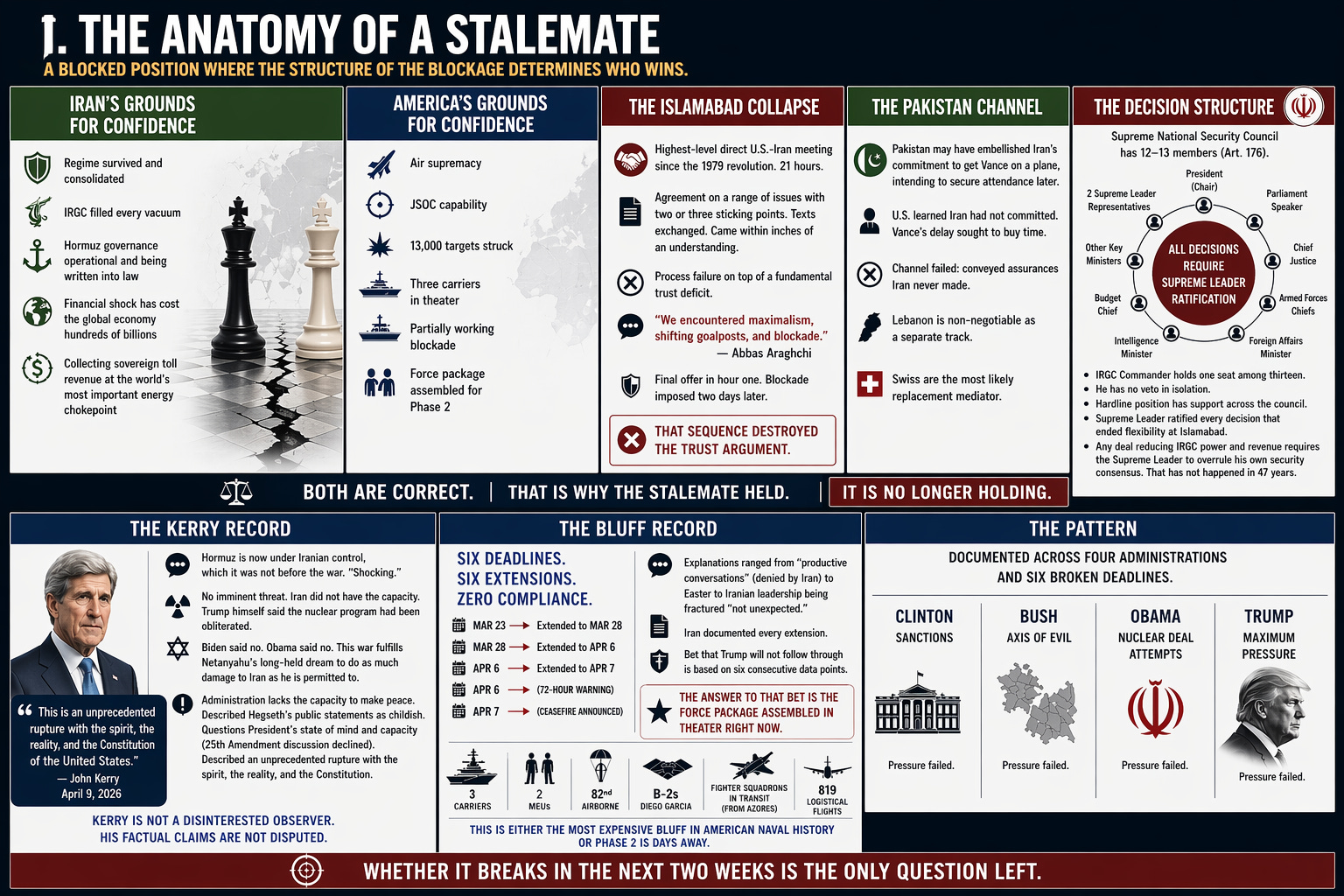
Iran measured this war in months from the beginning. The United States is only now realizing that.
A stalemate is not a draw. It is a blocked position where the structure of the blockage determines who wins.
Iran’s grounds for confidence: the regime survived, consolidated, the IRGC filled every vacuum, Hormuz governance is operational and being written into permanent law, the financial shock has cost the global economy hundreds of billions, and Iran is now collecting sovereign toll revenue at the world’s most important energy chokepoint.
America’s grounds: air supremacy, JSOC capability, 13,000 targets struck, three carriers in theater, a partially working blockade, and a force package assembled for Phase 2.
Both are correct.
That is why the stalemate held.
It is no longer holding.
The Islamabad Collapse
The Islamabad talks were the highest-level direct U.S.-Iran meeting since the 1979 revolution.
They ran 21 hours.
Iran’s spokesman said there was agreement on a range of issues with two or three sticking points. Texts were exchanged. Araghchi said the two sides came within inches of an understanding.
The gap was not structural impossibility.
It was process failure on top of a fundamental trust deficit.
Vance presented a final and best offer in the early hours of a negotiation covering nuclear sovereignty, economic sanctions, Hormuz governance, proxy network funding, and war guarantees simultaneously.
The Obama nuclear deal, which addressed a fraction of those issues, took 20 months.
Behavioral research on negotiations is unambiguous: making an early unilateral offer in a multi-issue negotiation decreases information exchange, increases positional rigidity, and forecloses creative solutions before either side has mapped the other’s actual interests.
Araghchi named what happened directly:
“we encountered maximalism, shifting goalposts, and blockade.”
Iran was bombed twice during previous negotiations. Ghalibaf said the U.S. side ultimately failed to gain the trust of the Iranian delegation.
Trust is not a soft variable.
It is the operational prerequisite for the pragmatist faction to overcome the hardline veto inside Iranian decision-making.
Without it, Araghchi and Ghalibaf have no internal argument.
The U.S. presented a final offer in hour one and imposed a blockade two days later.
That sequence destroyed the trust argument.
The Pakistan Channel
The Pakistan mediator problem is deeper than previously reported.
Reporting now suggests Pakistan may have embellished Iran’s commitment to the talks in order to get Vance on a plane, intending to convince Iran to attend once the U.S. delegation had landed.
The U.S. learned through separate channels that Iran had not committed.
Vance’s delayed schedule was reportedly an attempt to give Pakistan time to produce Iranian attendance before the delegation was publicly stood up.
Every party has an incentive to deny this.
It is embarrassing to Washington, to Islamabad, and to the mediation process simultaneously.
But if accurate, it means the channel failed because it was conveying assurances Iran never made, not because Washington failed to honor a commitment.
Iran also informed Pakistan that Lebanon is non-negotiable as a track separate from U.S.-Iran talks.
Pakistan conveyed a U.S. position that Lebanon should be handled bilaterally.
That means even if every other issue resolved, Lebanon remains a blocking condition.
The Swiss are the most likely replacement mediator if Islamabad is formally abandoned.
The Decision Structure
Iran’s refusal to produce a unified proposal is being misread as IRGC unilateralism.
Iran’s Supreme National Security Council has 12–13 members under Article 176 of the constitution.
The President chairs it.
The Parliament Speaker, Chief Justice, military chiefs, Foreign Affairs, Interior, Intelligence ministers, Budget chief, and two Supreme Leader personal representatives all hold permanent seats.
All decisions require Supreme Leader ratification.
The IRGC Commander holds one seat among thirteen.
He does not hold a veto in isolation.
The hardline position has support across the council.
The Supreme Leader ratified every decision that ended flexibility at Islamabad.
Any deal that reduces IRGC power and revenue requires the Supreme Leader to overrule his own security consensus.
That has not happened in 47 years under any amount of external pressure.
The war produced the leadership structure that makes the war hardest to end.
The Kerry Record
Kerry spoke on April 9.
He negotiated the 2015 deal this war was started to finish.
Kerry said Hormuz is now under Iranian control, which it was not before the war.
He called it shocking.
On the justification for the war:
there was no imminent threat.
Iran did not have the capacity.
Trump himself bragged after the June 2025 strikes that the nuclear program had been obliterated.
On Netanyahu:
Biden said no. Obama said no.
This war is essentially fulfilling the long-held dream of Prime Minister Netanyahu to do as much damage to Iran as he is permitted to.
On the administration’s capacity to make peace:
Kerry identified a strategic gap more significant than any he saw under any presidency.
He described Hegseth’s public statements as childish.
He raised the question of the president’s state of mind and capacity to make the necessary peace, while declining to discuss the 25th Amendment directly.
He described an unprecedented rupture with the spirit, the reality, and the Constitution of the United States.
Kerry is not a disinterested observer.
His factual claims are not disputed by any source in this series.
The Bluff Record
Trump has issued and extended six consecutive Iran deadlines since March 21.
On each occasion Iran did not meet his stated terms.
On each occasion he extended.
The explanations ranged from productive conversations Iranian officials denied to Easter to Iranian leadership being fractured in a way he called not unexpected.
Iran has documented every extension.
The bet that Trump will not follow through is not irrational.
It is based on six consecutive data points.
The answer to that bet is the force package assembled in theater right now.
Three carriers.
Two MEUs.
82nd Airborne.
B-2s at Diego Garcia.
Fighter squadrons in transit from the Azores.
819 logistical flights landed.
This is either the most expensive bluff in American naval history or Phase 2 is days away.
The pattern is documented across four administrations and six deadlines.
Whether it breaks in the next two weeks is the only question left.
II. The Kharg Calculation and Its Behavioral Flaw
Bessent’s storage crisis argument contained a critical assumption: the blockade is airtight.
Vortexa confirmed this week that 10.7 million barrels of Iranian crude transited the Strait and past the blockade line between April 13 and April 21. Six tankers running dark with AIS disabled.
The financial strangulation Bessent projected assumes zero Iranian exports.
Zero exports is not the operational reality.
The Gulf production shutdown is the more alarming number.
EIA reports Gulf states shut in 9.1 million barrels per day in April.
30 percent of combined prewar Gulf production idled.
The IEA projects 20 percent of Gulf production, roughly 2.5 to 3 million barrels per day, faces permanent damage risk.
Some Iraqi and Kuwaiti wells may never recover.
This is no longer a price story.
It is a permanent capacity destruction story.
The war’s most consequential long-term economic outcome is not being discussed in any ceasefire framework.
The behavioral prediction underlying maximum pressure at Kharg assumes economic pain produces Iranian capitulation on an American political timeline.
This assumption has failed every previous test.
Vahidi built Iran’s proxy network through every maximum pressure period.
Zolghadr suppressed the 2009 Green Movement.
These men have a higher pain threshold than American strategists project and no electoral incentive to reduce it.
The most plausible compliance mechanism is IRGC payroll disruption.
If the blockade tightens enough to stop Iranian exports entirely and the shutdown extends long enough to strain IRGC salaries, the regime faces a loyalty problem that civilian suffering cannot produce.
That is weeks to months away under a full blockade.
Under a leaking blockade, it is months to indefinite.
Iran is betting on the leaking blockade timeline.
The Vortexa data supports that bet.
III. The Island Arc
The U.S. is not going to take Kharg first.
It is going to take the islands.
Iran knows this.
The mining operation confirms it.
Satellite imagery from April 22 shows IRGC speedboats deploying mines throughout the Strait in organized groups. A classified Defense Department briefing to House Armed Services confirmed 20 or more mines emplaced, some GPS-guided.
The U.S. Navy is attempting to clear mines while Iran re-lays them.
The mine clearance minimum timeline was May 11.
The new active mining operation resets that clock entirely.
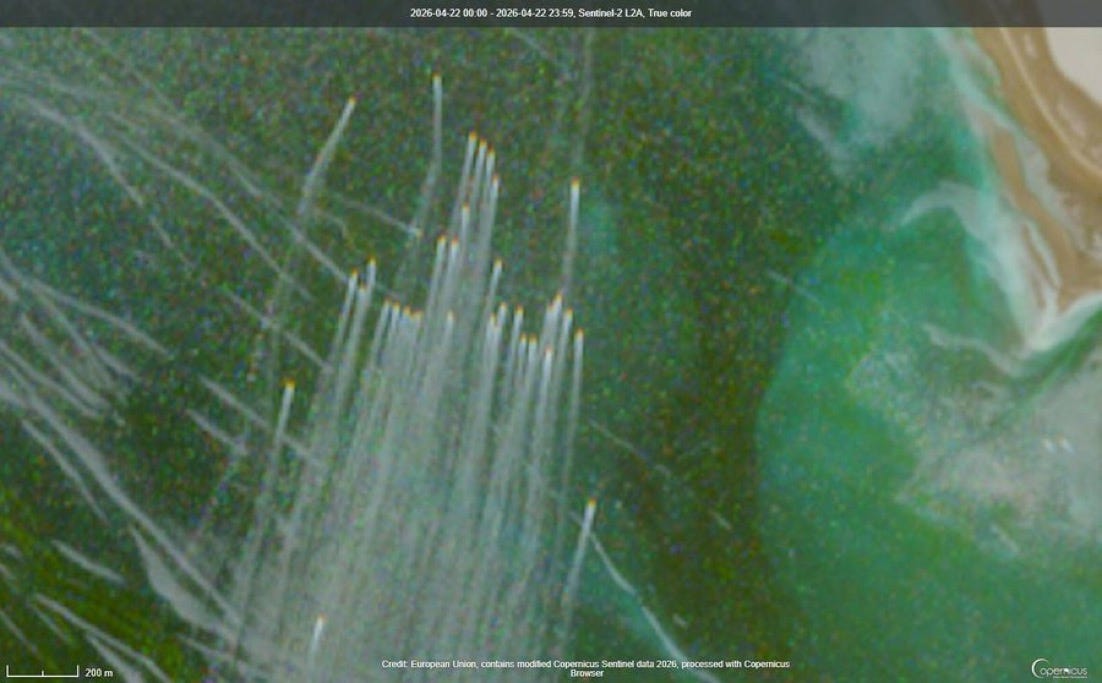
The islands must be controlled to stop the mining.
The seven islands form Iran’s arch defense.
Abu Musa.
Greater Tunb.
Lesser Tunb.
Hengam.
Qeshm.
Larak.
Hormuz Island.
They curve across the Gulf entrance.
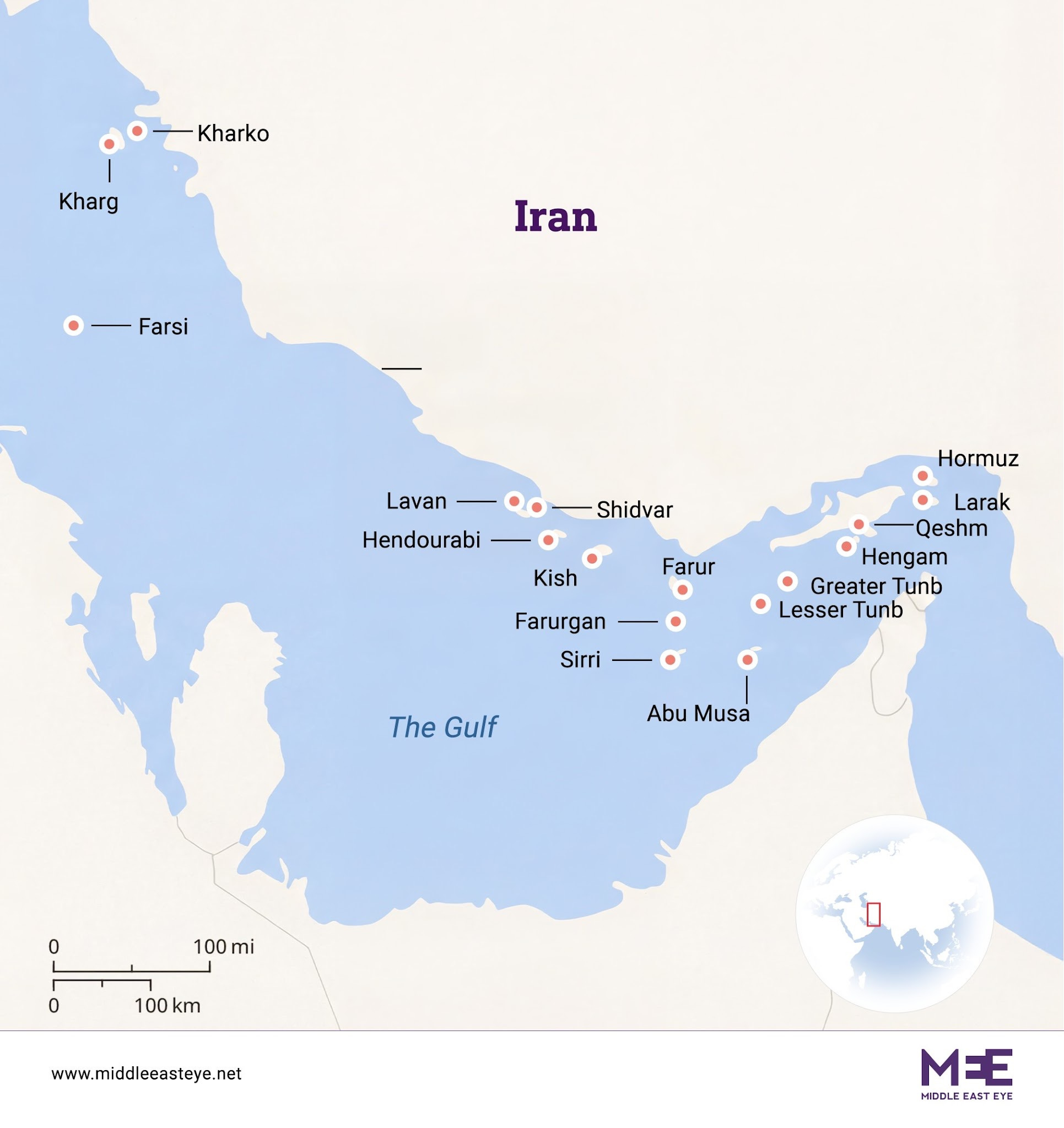
The “unsinkable” aircraft carriers.
Each hosts anti-ship missile batteries, IRGC naval assets, drone launch capability.
Larak at the eastern entrance can cut off anything trying to transit.
Every ship that moved through Hormuz during 54 days of war did so under Iranian permission.
The force package fits the operation.
Two MEUs.
82nd Airborne BCT.
Three carriers.
Schuster’s assessment: two MEUs take the three southern islands with overwhelming force in two days to two weeks.
1,800 to 2,000 troops to hold them.
The 31st MEU is on station.
The 11th is inbound.
The 82nd provides the follow-on force.
Three carriers provide air cover.
VMFA-312 Hornets are in transit now.
The political narrative fits the operation better than Kharg does.
Destroying Kharg’s oil terminals creates a permanent capacity destruction problem with no clean exit.
Taking the islands produces a freedom of navigation narrative: removing Iranian military installations from international maritime lanes, restoring legal transit.
That narrative can be sold.
Destroying oil infrastructure cannot.
The expected sequence:
Island seizure and resumed missile production strikes simultaneously, using the mining operation and storage crisis as public justification.
Islands controlled allow mine clearance to complete without active replacement.
Clearance restores Hormuz transit.
Transit reopens Gulf exports.
Trump declares victory.
That is the plan.
The resistance will not match it.
IV. The Miscalculation
Every behavioral prediction in this war based on the assumption that pressure produces Iranian compliance has failed.
Regime collapse did not happen.
Market pain thresholds did not produce negotiation. Decapitation did not fracture the command structure. Domestic opposition did not mobilize against the regime.
The strikes produced a rally-around-the-flag effect documented inside Iran during the war.
The island operation faces the sharpest version of this problem.
Abu Musa, Greater Tunb, and Lesser Tunb are not military installations on Iranian soil.
They are disputed territories seized from the UAE in 1971. They have been under Iranian sovereignty for 55 years.
Taking them is not presented to the Iranian domestic audience as a limited maritime operation.
It is foreign occupation of Iranian national territory.
The IRGC’s mobilized base will receive it as an existential violation.
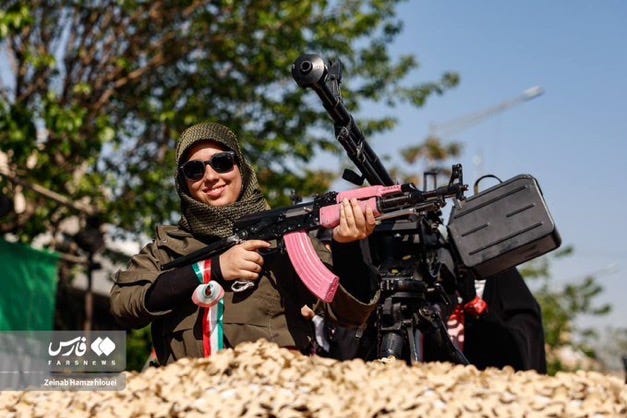
Iranian forces on the islands will fight in front of their mainland.
IRGC fast-attack craft will operate continuously from the mainland against the holding force.
Mainland SRBM fire will threaten the carrier strike groups at range.
The mining continues from positions the seized islands cannot fully cover.
Every resupply mission runs through water Iran partially controls.
The 82nd Airborne is not structured for sustained island occupation against asymmetric mainland pressure.
The 1,800 to 2,000 occupation troops face a sustained drone, missile, and fast-craft campaign that no comparable U.S. operation has faced.
The supply lines are exposed.
The UAE political problem has no resolution.
Return the islands to Iran and they were seized at American cost for nothing.
Return them to the UAE and you antagonize any post-war Iranian government you claim to support.
Keep them and you occupy Iranian territory indefinitely without a stated exit condition.
This question was not answered before the war started.
It remains unanswered.
The island operation is the right military sequence for reopening Hormuz.
The resistance calculation is wrong.
The occupation cost is higher than acknowledged.
The duration before a sustainable transit regime operates exceeds American political timelines.
This is the series’ central prediction for Phase 2.
V. The Four Clocks
Four deadlines converge in the next six days.
They are not synchronized.
The one that breaks first determines what Phase 2 looks like.
Ceasefire Clock: expired April 22.
Iran seized ships within hours of the extension.
The ceasefire is functionally over.
The formal end is a matter of incident, not decision.
Israel–Lebanon Clock: expires April 26, three days.
Israeli forces remain in southern Lebanon demolishing Hezbollah infrastructure.
Hezbollah has warned it will not accept a unilateral ceasefire.
One French UNIFIL peacekeeper dead.
The margin is three days and thin.
War Powers Clock: expires April 29, six days.
The 60-day deadline requires congressional authorization or withdrawal.
No vote scheduled. No withdrawal planned.
The Senate has failed to advance a War Powers resolution five times.
The administration will ignore the deadline.
The legitimacy cost accumulates regardless.
Kharg Clock: April 26 per Kpler, April 29 per Energy Aspects, June 13 per FGE.
The Kpler estimate fills in three days.
Under a leaking blockade with 10.7 million barrels already exported, the tight estimates are probably wrong.
But if Bessent is right and the blockade has tightened overnight, the production crisis arrives this weekend.
The IRGC payroll disruption mechanism is weeks to months away under either scenario.
Iran is betting it can outlast the American political clock.
The Vortexa data supports that bet.
VI. Predictions
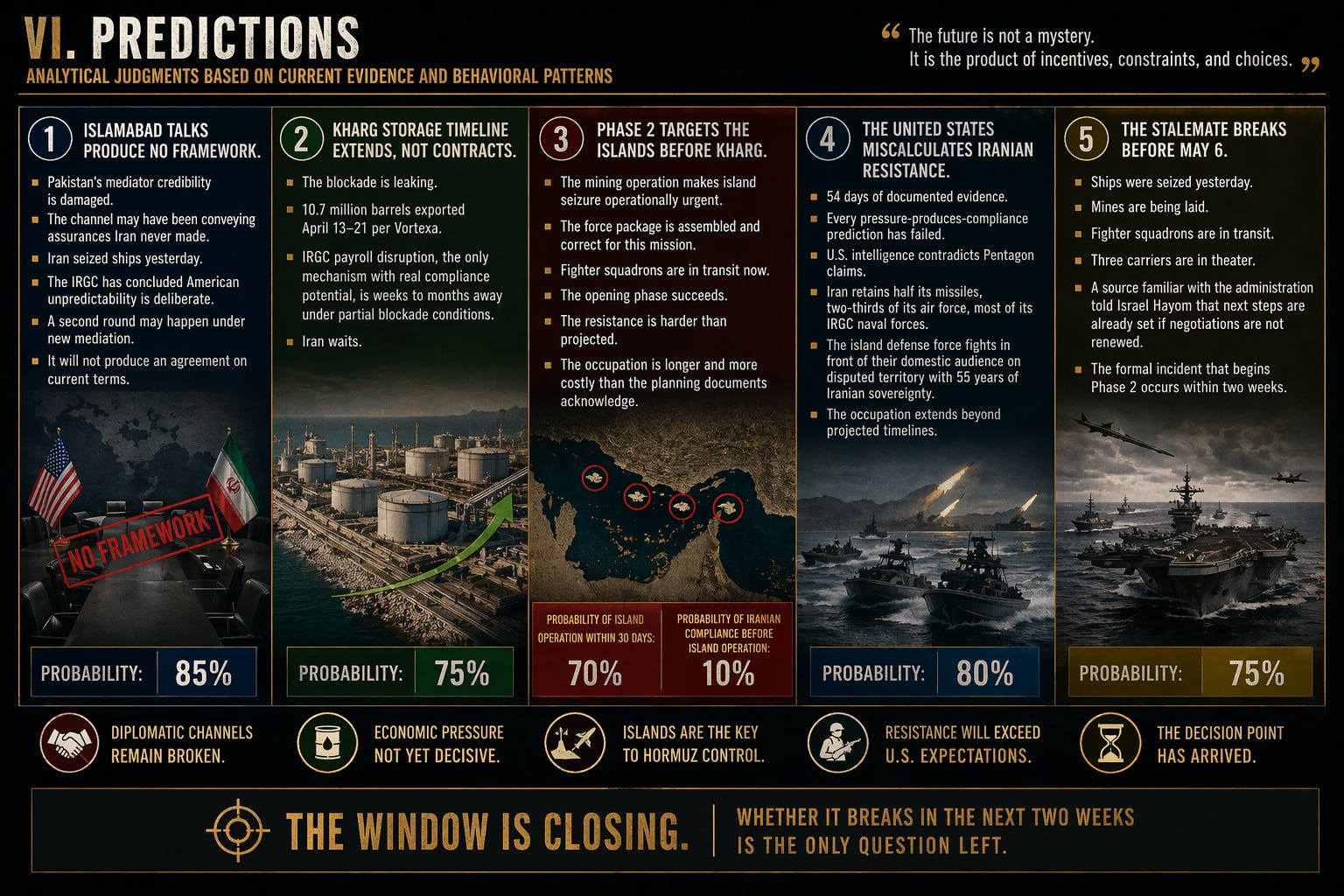
ONE: Islamabad talks produce no framework.
Pakistan’s mediator credibility is damaged. The channel may have been conveying assurances Iran never made. Iran seized ships yesterday.
The IRGC has concluded American unpredictability is deliberate.
A second round may happen under new mediation.
It will not produce an agreement on current terms.
Probability: 85%
TWO: Kharg storage timeline extends, not contracts.
The blockade is leaking. 10.7 million barrels exported April 13-21 per Vortexa.
IRGC payroll disruption, the only mechanism with real compliance potential, is weeks to months away under partial blockade conditions. Iran waits.
Probability: 75%
THREE: Phase 2 targets the islands before Kharg.
The mining operation makes island seizure operationally urgent. The force package is assembled and correct for this mission.
Fighter squadrons are in transit now. The opening phase succeeds.
The resistance is harder than projected. The occupation is longer and more costly than the planning documents acknowledge.
Probability of island operation within 30 days: 70%
Probability of Iranian compliance before island operation: 10%
FOUR: The United States miscalculates Iranian resistance.
54 days of documented evidence.
Every pressure-produces-compliance prediction has failed. U.S. intelligence contradicts Pentagon claims.
Iran retains half its missiles, two-thirds of its air force, most of its IRGC naval forces.
The island defense force fights in front of their domestic audience on disputed territory with 55 years of Iranian sovereignty.
The occupation extends beyond projected timelines.
Probability: 80%
FIVE: The stalemate breaks before May 6.
Ships were seized yesterday.
Mines are being laid. Fighter squadrons are in transit.
Three carriers are in theater.
A source familiar with the administration told Israel Hayom that next steps are already set if negotiations are not renewed.
The formal incident that begins Phase 2 occurs within two weeks.
Probability: 75%
HARD TIMESTAMPS
The following are analytical predictions. They are the honest output of the series’ framework applied to the current evidence.
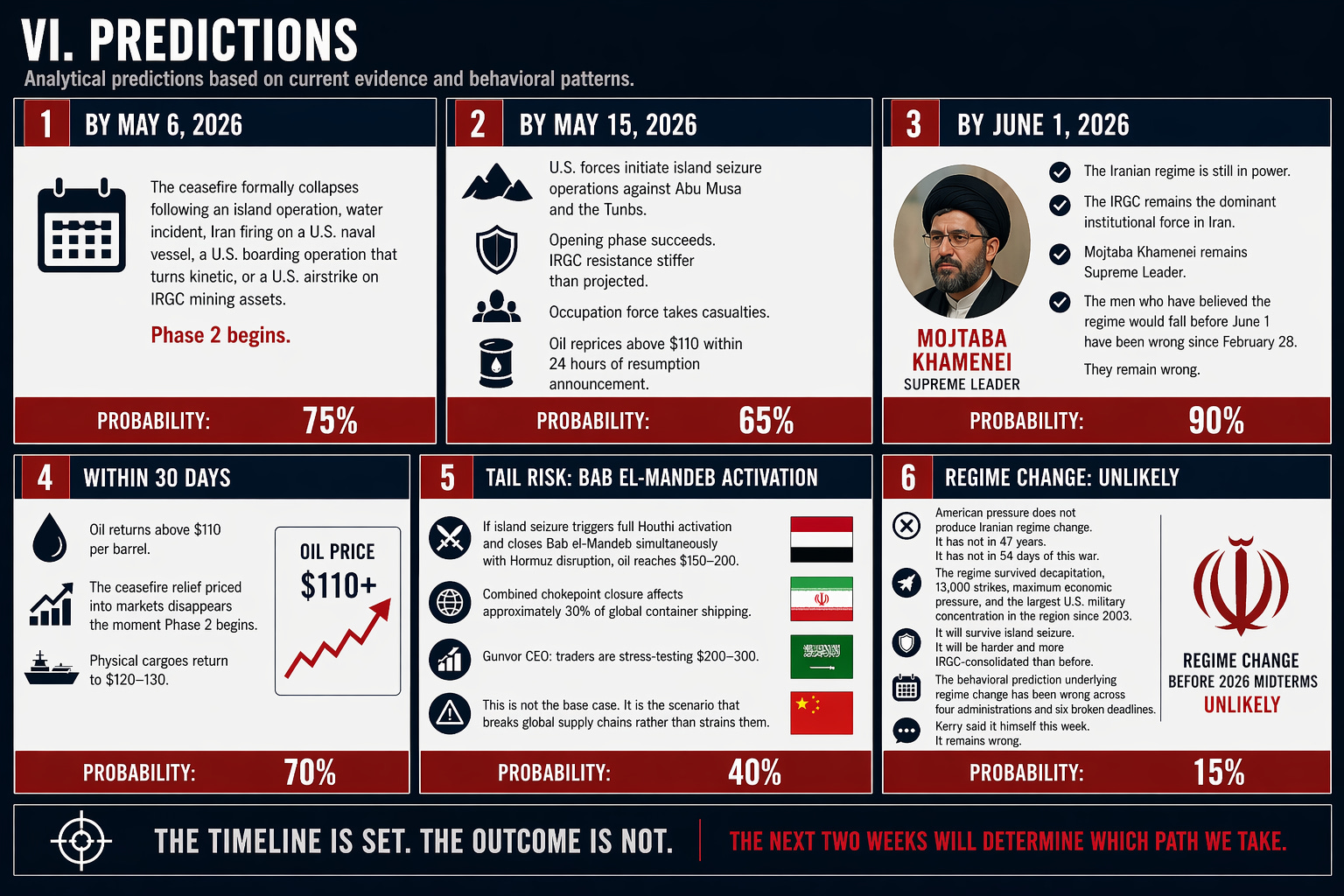
By May 6, 2026:
The ceasefire formally collapses following an island operation, water incident, Iran firing on a U.S. naval vessel, a U.S. boarding operation that turns kinetic, or a U.S. airstrike on IRGC mining assets.
Phase 2 begins.
Probability: 75%
By May 15, 2026:
U.S. forces initiate island seizure operations against Abu Musa and the Tunbs.
Opening phase succeeds. IRGC resistance stiffer than projected. Occupation force takes casualties.
Oil reprices above $110 within 24 hours of resumption announcement.
Probability: 65%
By June 1, 2026:
The Iranian regime is still in power. The IRGC remains the dominant institutional force in Iran.
Mojtaba Khamenei remains Supreme Leader. The men who have believed the regime would fall before June 1 have been wrong since February 28.
They remain wrong.
Probability: 90%
Within 30 days:
Oil returns above $110 per barrel.
The ceasefire relief priced into markets disappears the moment Phase 2 begins. Physical cargoes return to $120-130.
Probability: 70%
Tail risk, Bab el-Mandeb activation:
If island seizure triggers full Houthi activation and closes Bab el-Mandeb simultaneously with Hormuz disruption, oil reaches $150-200.
Combined chokepoint closure affects approximately 30 percent of global container shipping.
Gunvor CEO: traders are stress-testing $200-300.
This is not the base case.
It is the scenario that breaks global supply chains rather than strains them.
Probability of full Bab el-Mandeb activation in response to island seizure: 40%
American pressure does not produce Iranian regime change.
It has not in 47 years.
It has not in 54 days of this war.
The regime survived decapitation, 13,000 strikes, maximum economic pressure, and the largest U.S. military concentration in the region since 2003.
It will survive island seizure. It will be harder and more IRGC-consolidated than before.
The behavioral prediction underlying regime change has been wrong across four administrations and six broken deadlines.
Kerry said it himself this week.
It remains wrong.
Probability of regime change before the 2026 midterms: 15%
The Human Cost
The people living through this war were never the ones who chose it.
The 20,000 seafarers stranded in the Gulf did not choose it.
The 244 children buried in Iran did not choose it.
The 2,454 Lebanese now in graves since March 2 did not choose it.
The American service member whose carrier has been at sea for 325 days did not choose it.
None of them were consulted.
War is decided in rooms they will never enter.
The consequences reach them anyway.
The clocks are still running.
The stalemate broke yesterday.
And the window for a different outcome grows smaller with every hour that passes without a framework.
Post note:
Trump has just tweeted out “The President of the United States, DONALD J. TRUMP, Vice President of the United States, JD Vance, Secretary of State, Marco Rubio, Ambassador to Israel, Mike Huckabee, and Ambassador to Lebanon, Michel Issa, met today with High Ranking Representatives of Israel and Lebanon in the Oval Office. The Meeting went very well! The United States is going to work with Lebanon in order to help it protect itself from Hezbollah. The Ceasefire between Israel and Lebanon will be extended by THREE WEEKS. I look forward in the near future to hosting the Prime Minister of Israel, Bibi Netanyahu, and the President of Lebanon, Joseph Aoun. It was a Great Honor to be a participant at this very Historic Meeting! President DONALD J. TRUMP Apr 23, 2026 at 5:21 PM
I still consider the Lebanon-Israel ceasefire to be incredibly weak and about to break. As the IRGC stated “The war won’t be decided by idiots in a suit"
Outstanding analysis. Your diagnostic precision is the best I've seen on this conflict. Timestamped predictions with probabilities — that's how intelligence briefings should read.
But your briefings end where my framework begins.
Everything you're describing — island seizure, blockade, carrier groups, mine clearance — all of it becomes unnecessary when you ask one question nobody in Washington is asking: why are we still there?
Mackinder answered that question in 1904. Land routes bypass sea lanes. A pipeline from the Gulf to the Mediterranean removes Iran's leverage permanently. No carriers. No mine clearance. No island occupation. Infrastructure that creates jobs instead of casualties.
I've written about why Churchill fought for sea lanes Mackinder told him were already obsolete — and why America is repeating his mistake: theplummer.substack.com/p/why-churchill-couldnt-make-peace
And the pipeline that removes Iran's power entirely: theplummer.substack.com/p/the-pipe-that-removes-Iran's-power
But the pipeline is only one piece. America doesn't need the petrodollar if America stops borrowing. America doesn't need Hormuz if America builds the Western Hemisphere energy bloc. The grand strategy — a seven-prong tariff framework that replaces military dominance with economic aspiration — is here: theplummer.substack.com/p/the-high-value-nation
I have a forthcoming article called 'The Judo Move' that ties all three together — why the smartest thing America can do in the Middle East is leave. Coming soon.
Your diagnosis is the map. My framework is the exit. I think our work is complementary.
https://brandonbedard.substack.com/p/the-imperial-bug-why-the-us-god-mode?utm_source=share&utm_medium=android&r=7qos2e