
The Deal
Trump Tore Up a Better One. This Is What He Got Instead.

Strategic Conflict Assessment Series | Briefing #11
STATUS: Two-Week Ceasefire — Terms Disputed
DATA CUTOFF: April 9, 2026 | 12:00 EST
This is the eleventh briefing in the live conflict assessment series.
The guns have stopped.
Kind of. For now.
At 6:32 PM Eastern Time on April 7, 2026, thirty-nine days after the first bombs fell, Donald Trump announced a two-week ceasefire with Iran on Truth Social.
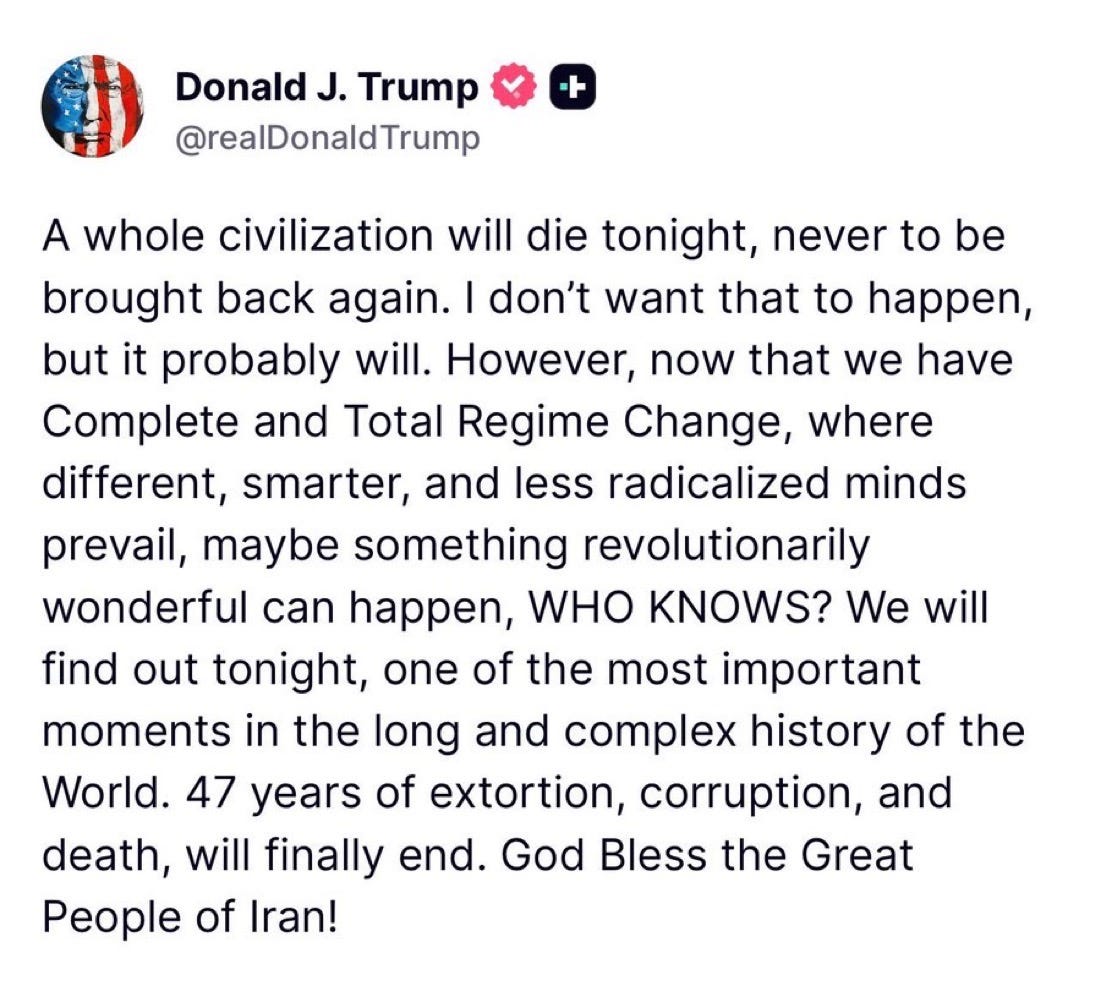
Just a few hours earlier he had threatened to wipe out a whole civilization.
The ceasefire does not end the war.
It does not resolve the structural issues that caused it.
It does not contain a formal written agreement.
It does not include Lebanon.
It formalizes Iranian control over the Strait of Hormuz.
It leaves Iran’s enriched uranium in place.
It leaves Iran’s missile program intact.
It leaves the regime in power.
And it leaves the Iranian people who trusted America exactly where they were before the bombs started falling, except now many of them are living under rubble.
Trump called it a total and complete victory.
This briefing examines what the ceasefire actually is.
The Strategic Conflict Assessment Series
Briefing #1: The Death of Khamenei: Decapitation Is Not Collapse

Briefing #2: Axis Activation

Briefing #3: The Math of War

Briefing #4: The Energy Front

Briefing #5: The Maritime War

Briefing #6: The Market Is Still Asleep

Briefing #7: The Regime That Won’t Fall

Briefing #8 Part 1: The Endgame Problem

Briefing #8 Part 2: The Reckoning

Briefing #9: The War That Reached the Dinner Table

Briefing #10: The Proxy Map

This briefing documents what the war produced and what it cost.
WAR CLOCK: THE FORTY DAYS
Feb 27, 2026
Oman’s Foreign Minister says peace is within reach.
Iran agreed to never stockpile enriched uranium.
Iran agreed to full IAEA verification.
Talks scheduled to resume March 2.
Feb 28, 2026 | 01:30 EST
The bombs fall.
Active nuclear negotiations interrupted.
The deal that was within reach collapses overnight.
Mar 1, 2026
Six U.S. soldiers killed in Kuwait.
First American deaths of the war.
Hezbollah drags Lebanon into the conflict.
Hormuz shipping begins to collapse.
Mar 8, 2026
Mojtaba Khamenei elected Supreme Leader.
IRGC fills the power vacuum left by the decapitation the war was supposed to achieve.
Mar 13, 2026
IRGC toll system operational at Larak Island.
Ships must coordinate with Iranian authorities to transit Hormuz.
First fees collected.
Payment in yuan.
Mar 17, 2026
Israel assassinates Ali Larijani.
His replacement, Zolghadr, is a harder man who suppressed the 2009 Green Movement.
Mar 18, 2026
South Pars struck. Qatar’s LNG capacity offline for five years.
This is the strike Trump promised would not happen.
Mar 19, 2026
War cost: $18 billion.
Pentagon requests $200 billion more.
Harvard economist estimates total future cost exceeds $1 trillion.
Mar 23, 2026
$1.5 billion in S&P futures bought five minutes before Trump announces a pause in strikes.
Someone knew 16 minutes early.
Mar 28, 2026
Houthis enter the war. The last containment line breaks.
Largest civilian protest in American history. Partly in response to the war.
Apr 1, 2026
Trump says he is no longer concerned about Iran’s enriched uranium buried underground.
The stated reason for the war is abandoned on Truth Social.
Netanyahu says the nuclear and missile threats have been eliminated.
Objectives declared achieved. War continues.
Apr 2, 2026
Trump threatens to bring Iran back to the Stone Ages.
B1 bridge struck.
Thirteen killed, 95 wounded.
Iranian families were celebrating Nowruz in the parks below.
Trump gloated.
Experts called it a war crime.
Trump said he attacked the bridge because Iran asked for five more days before talks and he decided they were not being serious.
Apr 3, 2026
F-15E shot down over Iran. One WSO missing for 36 hours.
A-10 downed during rescue. Six aircraft deliberately destroyed inside Iran.
The war costs two aircraft and a two-day special operations mission inside Iranian territory just to retrieve one crew member.
Apr 6, 2026
34 civilians killed in overnight strikes. Six children.
Sharif University of Technology bombed.
WTI spikes to $114 during Trump’s press conference.
Trump asked if he is winding down or escalating: I don’t know. I can’t tell you.
Apr 7, 2026 | 08:06 EST
Trump on Truth Social: A whole civilization will die tonight, never to be brought back again.
Apr 7, 2026 | 14:00 EST
Residents of Tehran flee north toward the Caspian Sea in one of the largest exoduses since the war began. They fear the power plants will be destroyed tonight.
Apr 7, 2026 | 17:00 EST
Russia and China veto the UNSC resolution authorizing defensive measures to protect Hormuz navigation. Confirmed.
Apr 7, 2026 | 18:32 EST
Trump announces a two-week ceasefire on Truth Social.
Ninety minutes before his own deadline.
Apr 8, 2026
CNN confirms there is no formal written document for the ceasefire agreement.
Israel strikes multiple residential and commercial areas in central Beirut during rush hour.
Dozens killed. Hundreds wounded.
Entire buildings destroyed.
Netanyahu says Lebanon is not included in the ceasefire.
Iran and Kuwait report new attacks hours into the truce.
Maersk says it is not making any changes yet.
Lloyd’s says trade is highly unlikely to simply resume.
800 vessels remain trapped inside the Persian Gulf.
Operational Status
Two-week ceasefire.
Lebanon excluded.
Terms disputed.
No written document.
Iran in control of Hormuz. Regime intact. Uranium intact.
Missiles intact.
SNAPSHOT: What the Ceasefire Is and Is Not
Cutoff: April 9, 2026 | 12:00 EST
What the Ceasefire Says
U.S. and Israel halt strikes on Iran for two weeks.
Iran ceases its defensive operations if attacks stop.
Safe passage through Hormuz is possible for fourteen days via coordination with Iran’s armed forces.
Iran and Oman will charge fees on ships transiting the Strait during the ceasefire period.
Fees will fund Iranian reconstruction.
U.S.–Iranian delegations are expected in Islamabad on Saturday for further negotiations.
Iran’s 10-point proposal has been accepted by Trump as a workable basis for negotiation.
What the Ceasefire Does Not Say
There is no formal written document.
There is no mechanism for enforcement.
There are no agreed terms for what happens to Iran’s enriched uranium.
There is no agreement on missile limits.
There is no timeline for sanctions relief.
There is no agreement on IRGC proxy disarmament.
There is no agreement on permanent Hormuz governance.
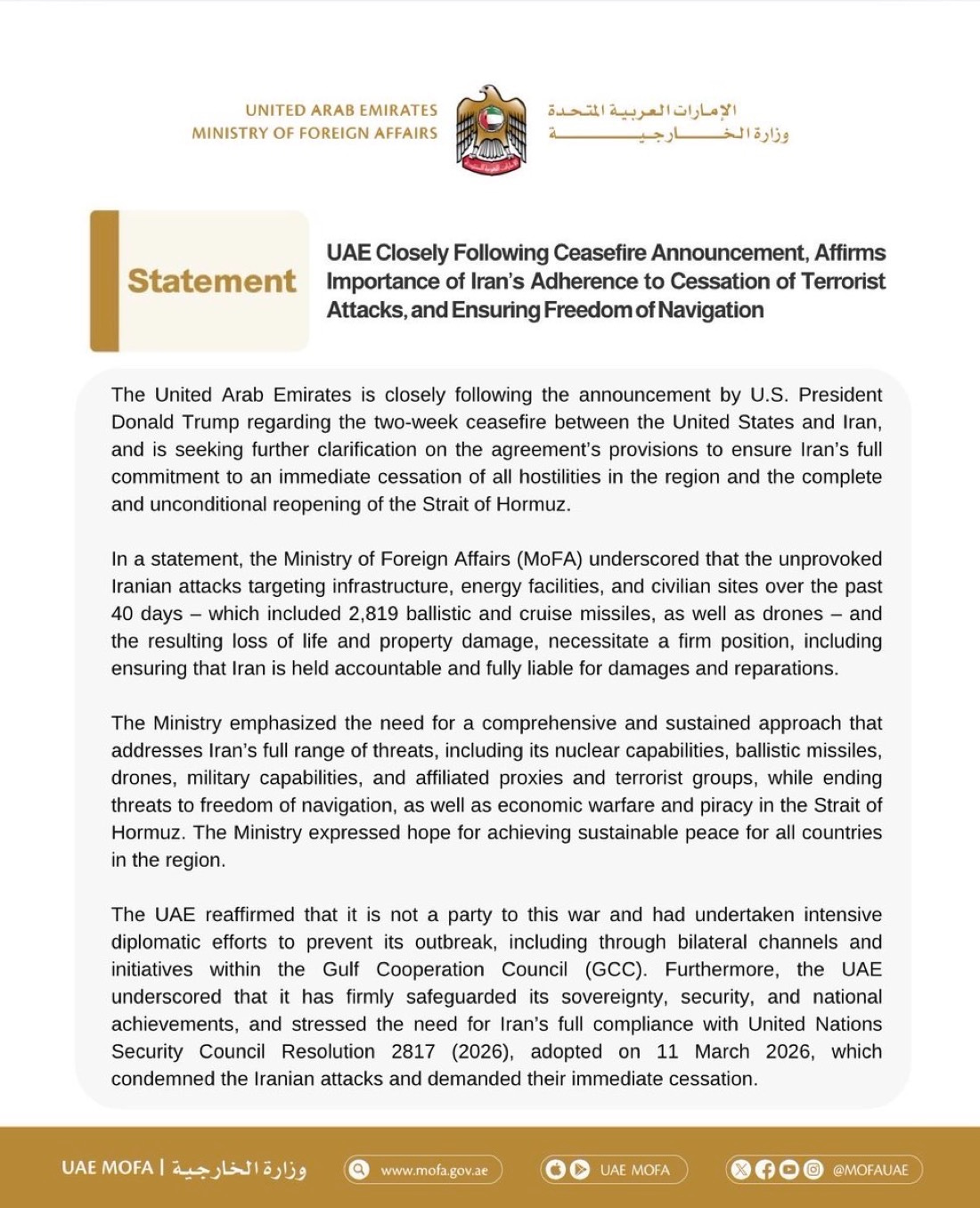
Lebanon is not included.
Israel is already striking Beirut.
There is no agreement that Iran will allow international inspectors.
The Fee Math
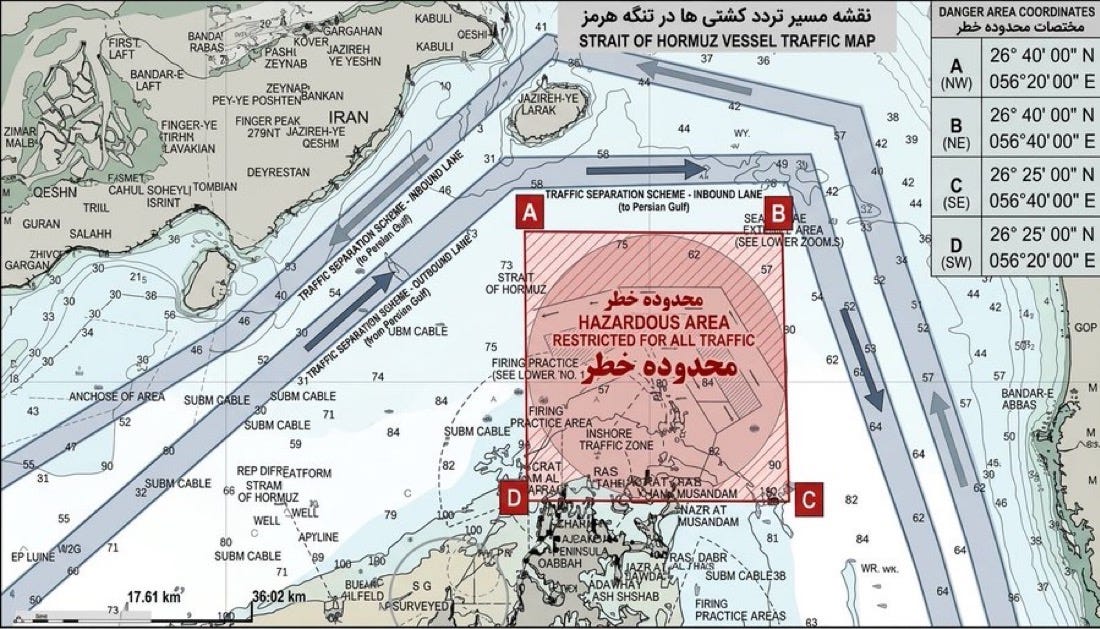
If Hormuz returns to normal traffic: approximately 135 ships per day.
135 ships per day over 14 days: 1,890 ships.
At $2 million per transit, split with Oman, Iran earns approximately $1 billion in the next two weeks.
If the system becomes permanent at $1 million Iranian share, revenue reaches approximately $50 billion per year.
This revenue funds the ballistic missile program the war was started to destroy.
The war produced its own financing mechanism for the regime it was started to weaken.
The Oil Market
WTI crude is now trading around $97.50 per barrel, still far above pre-war levels.
Prices initially fell on relief. They did not return to the levels that existed before February 28.
Even after the ceasefire announcement, oil remains roughly 35-50 percent above the pre-war range, reflecting the continuing disruption to shipping, insurance markets, and refinery supply chains tied to the Strait of Hormuz.
The structural damage to the global energy system does not disappear because a ceasefire was announced on Truth Social.
The International Monetary Fund warned Thursday that the war will slow global economic growth even if the ceasefire holds, citing energy infrastructure damage and supply chain disruptions.
The Supply Reality
800 vessels remain trapped inside the Persian Gulf.
Traffic through the Strait remains extremely limited.
On Wednesday, just five bulk carriers crossed the waterway and no oil or gas tankers made the transit.
Before the war, roughly 130 ships crossed the Strait each day.
Even when ships start moving, a tanker leaving the Gulf today takes three to five weeks to reach Europe.
The UK’s last pre-war crude and diesel shipments are arriving this week. Nothing loaded today arrives until May at the earliest.
Jet fuel supplies will remain tight for months regardless of Hormuz reopening due to refinery disruption.
IATA Director General: it will take months to return supply to required levels.
Maersk is not yet making any changes.
Lloyd’s market says trade is highly unlikely to simply resume.
Opening the Strait and fixing the shortage are two different things.
CONFIRMED CASUALTIES
Cutoff: April 8, 2026 | 11:39 EST
Primary Belligerents
Iran: 3,546+ killed per HRANA (1,701 civilian deaths per HRANA as of April 7, including 244 children) | 7,300+ per Hengaw | 26,500+ wounded
Israel: 35+ killed | 6,951+ wounded
United States: 15 killed | 520+ wounded
Lebanon: 1,700+ killed | 4,812 wounded | 1 million+ displaced
Regional Spillover
UAE: 12 killed | 217+ wounded
Kuwait: 10 killed | 109+ wounded
Iraq: 25 killed | 83 wounded
Qatar: 4 killed | 16 wounded
Bahrain: 3 killed | 42 wounded
Saudi Arabia: 2 killed | 16 wounded
Oman: 3 killed
Turkey: 3 killed
France: 1 killed
Philippines: 1 killed
Syria: 1 killed
West Bank: 4 killed
Proxy-Specific Losses
Hezbollah: 1,000+ fighters killed per IDF
PMF: 85+ fighters killed | 139+ wounded
Total Estimated Casualties
Total: approximately 3,800 to 9,200+ killed | 39,000+ wounded
The regime is still in power.
The uranium is still in the ground.
The missiles still exist.
The IRGC still controls Hormuz.
The war cost at minimum 3,800 lives, and by some estimates more than 9,000.
KEY JUDGMENTS
Trump got a worse deal than Obama had in 2015.
This came after spending $18 billion in confirmed costs, $200 billion in Pentagon requests, more than $1 trillion in estimated total future costs, and 39 days of bombing a country of 85 million people.
The Obama deal: Strait of Hormuz open for free.
Iran limits uranium enrichment.
Iran agrees to make no nuclear weapons.
Iran allows international inspectors.
Inspectors confirm full compliance.
Cost to the United States:
Zero American deaths.
Zero dollars.
The Trump ceasefire: Strait of Hormuz open only with Iranian military coordination and fees.
Iran makes no guarantee on uranium enrichment.
Iran makes no guarantees on nuclear weapons.
Iran makes no guarantee on international inspectors.
Cost to the United States:
15 service members killed, 520+ wounded, $18 billion confirmed, $200 billion requested, an estimated $1 trillion in future obligations, and Iran permanently positioned as the governing authority of the world’s most important energy chokepoint, with a new $50 billion annual revenue stream to fund the missile program the war was supposed to destroy.
The 2015 deal Trump called the worst deal ever made removed 97 percent of Iran’s nuclear stockpile from the country.
In that agreement, Iran shipped its enriched uranium out.
Under this ceasefire, Iran’s enriched uranium stays in the ground.
The ceasefire is better than the alternative Trump was threatening Tuesday morning, when he promised to wipe out a whole civilization.
That bar is not difficult to clear.
Iran’s National Security Council called the ceasefire a victory and said the United States accepted all of Iran’s conditions. Trump called it a total and complete victory.
Both sides are claiming victory. One of them is closer to right.
Iran still has its uranium.
Iran still has its missiles.
Iran still has the regime.
Iran now has formal fee collection authority at the world’s most important energy chokepoint.
Approximately $950 million in futures bets were placed on oil prices falling just hours before the ceasefire announcement.
Someone knew again.
There is no formal written document.
CNN and others confirmed this.
There is no enforcement mechanism.
The ceasefire is a Truth Social post that both sides are reading differently.
The Iranian people who trusted America are being left with the regime they were promised would fall, now in its most IRGC-consolidated form in forty-seven years, collecting tolls at Hormuz and executing protesters arrested during the January demonstrations.
Iran executed another man over the January protests on Monday.
The war that was supposed to liberate the Iranian people is ending with the Iranian people under the same regime, which is now strengthened, radicalized, and financially empowered.
Lebanon is not included.
Israel struck central Beirut during Wednesday afternoon rush hour without warning.
Entire buildings destroyed.
Dozens killed.
Hundreds wounded.
The Lebanese people who had nothing to do with any of this are still being bombed while Trump and Netanyahu and the world’s press conferences describe a ceasefire.
I. The Pattern
This is not the first time.
Afghanistan.
American soldiers spent twenty years there. The Taliban is in power.
The women who trusted America are living under its rule.
Vietnam.
America fought for more than a decade. The country reunified under the government America was fighting.
The people who trusted America were left to the consequences.
Libya.
America helped overthrow Muammar Gaddafi in 2011. No plan existed for what came next. Libya descended into a failed state and civil war that persists today.
The people who celebrated Gaddafi’s fall are living in the wreckage.
Iraq.
America invaded to destroy weapons of mass destruction that did not exist. The war cost $2 trillion. The state was dismantled. The power vacuum produced ISIS. The proxy networks that are fighting across the Middle East today were born in the chaos that followed.
The Iraqi people who trusted American promises of liberation are living in a country whose state-authorized militias are now formally fighting American forces.
Iran.
America has just spent thirty-nine days bombing a country of 85 million people, killing at minimum 3,800 and by some estimates more than 9,000, displacing millions, producing the worst global oil supply shock on record, destroying Qatar’s LNG capacity for five years, and threatening to wipe out a whole civilization.
The regime is still in power.
The IRGC has never been more dominant.
The Iranians in Los Angeles who were dancing in the streets on February 28 are now watching Trump describe their homeland as the scene of a total and complete victory.
The Iranian diaspora leader said it plainly. Why should we talk about bringing them back to the Stone Age?
The Iranian Jewish philanthropist said it plainly. This only achieves his goal if the goal is to confuse the whole world.
The Iranian American activist Nazanin Boniadi said it plainly. Trump’s threats empower the regime, reinforce its propaganda, and betray a people who have long been America’s natural allies.
The pattern is not a coincidence.
It is a direct feature of how American foreign policy operates when it is driven by the interests of the weapons industry, foreign government lobbies, and domestic political cycles rather than the interests of the people whose countries are being bombed.
Lindsey Graham spent three decades lobbying for this war and filed his reelection paperwork during the third week of it.
He is now calling the ceasefire a strong first step.
Netanyahu successfully lobbied Trump to start the war, successfully lobbied Trump not to ceasefire too soon, and is now bombing central Beirut during afternoon rush hour while the world’s press releases describe a ceasefire that he himself says does not include Lebanon.
The weapons industry consumed $18 billion in the first three weeks of the war.
The Pentagon is requesting $200 billion more.
That money does not disappear when the ceasefire is signed.
The same logic is already appearing across the economy. When asked whether airline ticket prices would fall if jet fuel prices dropped, the CEO of Delta Air Lines said lower fuel costs would instead help the company boost its margins this year and next.
The shock raises prices.
The prices stay high.
The margins expand.
It was already committed.
It was already contracted.
It is now purely profit.
II. What the Regime Gets
The regime is still in power.
The uranium is still underground.
The missiles still exist.
The IRGC is more dominant than at any point in forty-seven years of Islamic Republic history.
The Hormuz toll system is now formally legitimized by the ceasefire terms.
Iran and Oman will charge fees on ships transiting the Strait during the ceasefire period.
Those fees fund reconstruction.
That reconstruction rebuilds the military infrastructure the war was started to destroy.
At $1 million per ship in Iranian share, at pre-war transit volumes, Iran earns approximately $50 billion per year from the waterway it now governs.
The war started because Iran controlled a nuclear program.
The war ended with Iran controlling the world’s most important energy chokepoint as a permanent toll-collecting authority with a new revenue stream larger than most defense budgets.
The Center for a New American Security described it best.
“If Iran remains in control of the Strait, which was not the case before the war. That would be a materially worse outcome than existed before the war began. It is materially worse”.
Trump agreed to base the next two weeks of talks on Iran’s 10-point proposal.
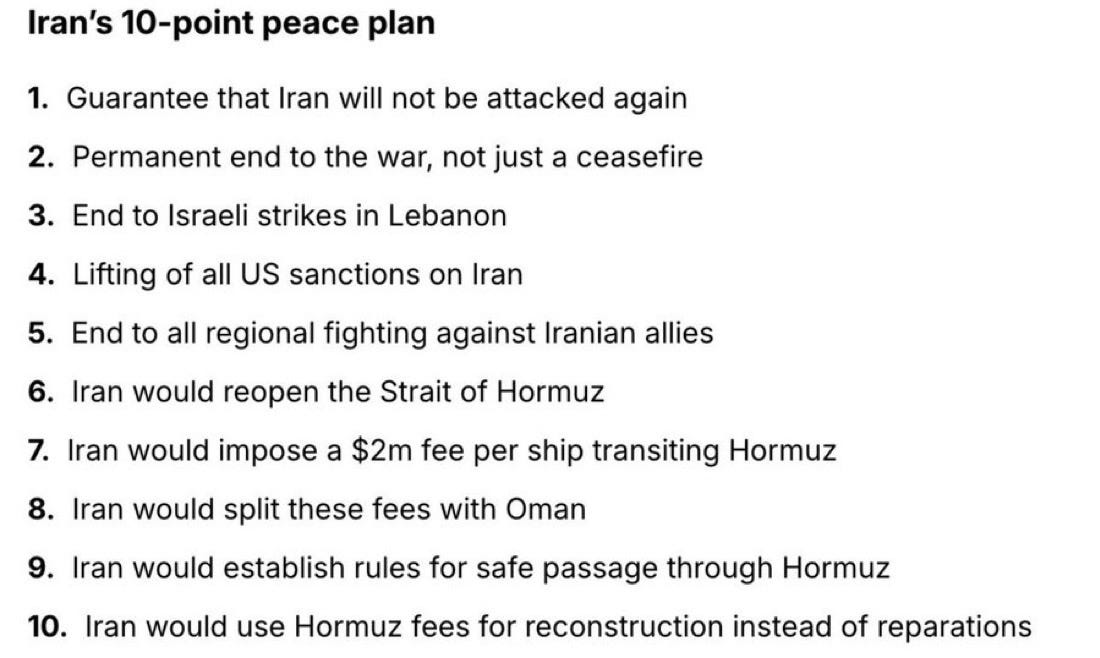
That proposal includes Iranian control over Hormuz.
It includes compensation to Iran paid through ship fees.
It includes lifting all sanctions.
It includes withdrawing U.S. forces from the region.
It includes a binding UN Security Council resolution to guarantee the arrangement.
Three weeks ago Trump was demanding unconditional surrender.
Now he is calling Iran’s wish list from before the war a workable basis on which to negotiate
III. What the Iranian People Get
They get the regime.
The regime that killed tens of thousands of them during the January protests.
The regime that shot at people celebrating in the streets when Khamenei was reported dead.
The regime that has been executing protesters arrested during the January demonstrations throughout the war.
The regime that handed out white SIM cards to government supporters while cutting off internet access for 85 million people for forty days.
The regime that ordered its own youth to gather around power plants as human shields on Tuesday afternoon.
They get the IRGC in its most consolidated form ever, having filled every power vacuum created by the decapitation campaign and emerged with more authority over the state than at any point since 1979.
They get 1,701 civilians dead including 244 children per HRANA.
They get 40 days and counting of internet blackout.
They get damage to at least 120 historical sites.
They get 65 schools targeted.
They get 41 ambulances destroyed.
They get the Minab school.
They get the B1 bridge families.
They get Sharif University bombed.
They get the Pasteur Institute destroyed.
And they get America claiming victory and going home.
The Iranian people who stood at their windows and chanted against the regime when the bombs started falling were told help is on the way.
Forty days later, the help that arrived killed 1,701 of their civilians, bombed their universities, left their regime stronger than it found it, and handed the IRGC a $50 billion annual revenue stream.
Tucker Carlson, who supported Trump through his first term, said it honestly.
“It is vile on every level. It begins with a promise to use our military to destroy civilian infrastructure in another country, which is to say to commit a war crime, a moral crime against the people of the country, whose welfare, by the way, was one of the reasons we supposedly went into this war in the first place”.
Joe Kent, who resigned as National Counterterrorism Center Director because he believed Iran posed no imminent threat and the war was started due to the Israel lobby, said it plainly.
“Trump believes he is threatening Iran with destruction, but it is America that now stands in danger. If he attempts to eradicate Iranian civilization, the United States will no longer be viewed as a stabilizing force in the world, but as an agent of chaos, effectively ending our status as the world’s greatest superpower.”
The Iranian people are not the Iranian regime.
This series has never confused those two things.
They have lived under this government for forty-seven years without being asked.
Their sons were conscripted into wars they did not vote for. Their daughters were shot in the streets for it.
The nuclear program that made Tehran a target was built on their backs, with their money, without their consent.
Washington looked at a city of nine million people and saw a target set.
It released the strikes and called them a success.
It held a press conference and called it a “capital V” massive victory win.
Nobody in that press conference was from Tehran.
Nobody in that press conference has ever even been to Tehran.
This is not new.
This is not some deviation from American foreign policy. This is American foreign policy.
In 1965, America backed the Indonesian military coup that killed between 500,000 and one million people.
The dead were mostly farmers, teachers, and union workers.
Washington called it a victory against communism.
In 1973, Chile had a democratically elected government. America decided that was inconvenient and backed the coup that replaced it with Pinochet.
Thousands were tortured. Thousands disappeared.
In the 1980s, America funded the Contras in Nicaragua, a paramilitary force documented for massacres, rape, and the systematic destruction of civilian infrastructure.
In each case the logic was the same.
America had a theory.
America acted on the theory.
The people who lived there inherited the bodies, the ruins, the embarrassment.
Nobody voted on the theory.
Nobody was asked to consent to the terror.
The Iranian people are still there.
The bombs have stopped for now.
The regime has not.
The people who were oppressed before the first strike are oppressed after the last one.
And Washington has already moved on.
Trump is publicly calling for regime change in Cuba. U.S. prosecutors are investigating Colombia’s president, a government that had the audacity to disagree with Washington, and the pressure is not subtle.
He is floating withdrawal from NATO, the single move that would do more to destabilize the people of Europe than anything Vladimir Putin has managed on his own.
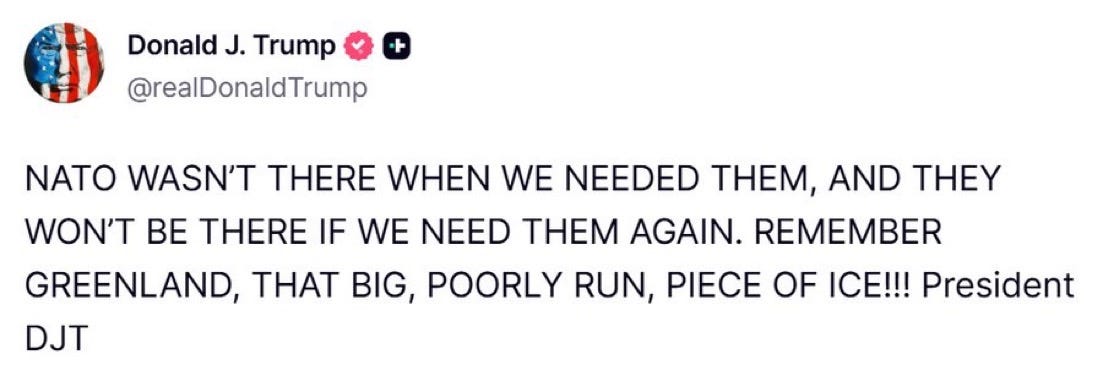
The man who called the Iran strikes a win is already pointing at the next target.
That is the pattern.
That has always been the pattern.
The people of Iran have the right to determine their own future.
Whatever that looks like.
A democracy.
A reformed Islamic republic.
Something that has no Western analog and does not need one.
That right was never factored in.
It was not treated as a variable even worth including.
A government on the other side of the world calculated what Iran needed, acted, and moved on to Cuba.
This publication exists because that logic has victims and the victims are always the last people consulted.
I have one belief that runs under everything written here.
It is not ideological.
It is not even partisan.
It is this: nobody puts themselves in the shoes of the person living in a war zone.
Nobody asks what it means to be in Tehran before February 28th, to be in Gaza, to be in Khartoum, to be in Kyiv, to be in any of the places that appear on a PowerPoint slide in a situation room and are discussed entirely without the people who live there in the room.
Those people are not points on a chart.
They are not strategic interests.
They go to university.
They argue about life with their parents.
They fall in love.
They want a better life, the same way every person reading this wants a better life.
The difference is that they are doing all of that while inside a war zone, or under a government they did not choose, or in a country that just appeared on someone else’s target list.
They are the entire point of this publication.
Every briefing.
Every number.
Every analysis.
It has always and will always be for them.
IV. What Comes Next
The Islamabad talks on Saturday will determine whether the two-week ceasefire becomes something more or unravels immediately.
The gaps between the two sides are not narrow at all.
Iran’s 10-point proposal includes formal Iranian authority over Hormuz, compensation via ship fees, the lifting of all sanctions, the withdrawal of U.S. forces from the region, and a binding UNSC resolution guaranteeing the arrangement.
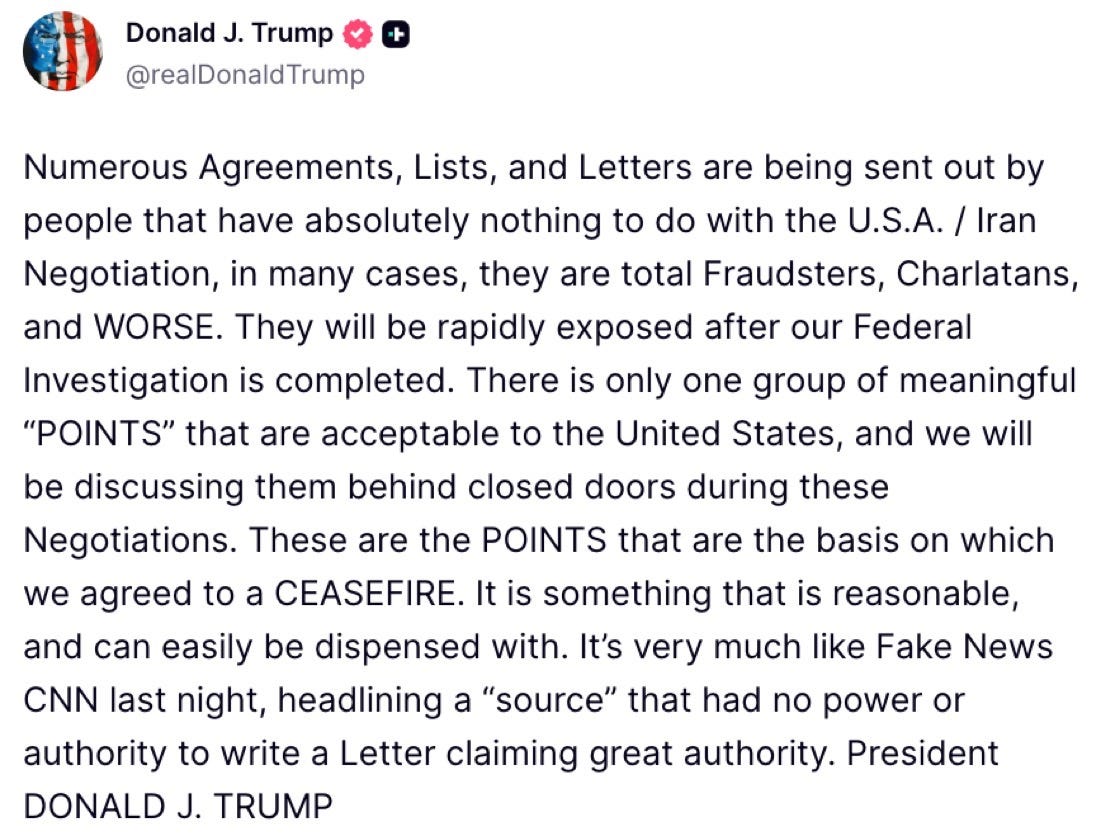
Trump said on Sky News that the 10 points Iran has formally leaked are different from the ones actually under negotiation and that most points have been fully negotiated.
Iran’s National Security Council said the United States accepted all of Iran’s conditions.
Both of those things cannot be true.
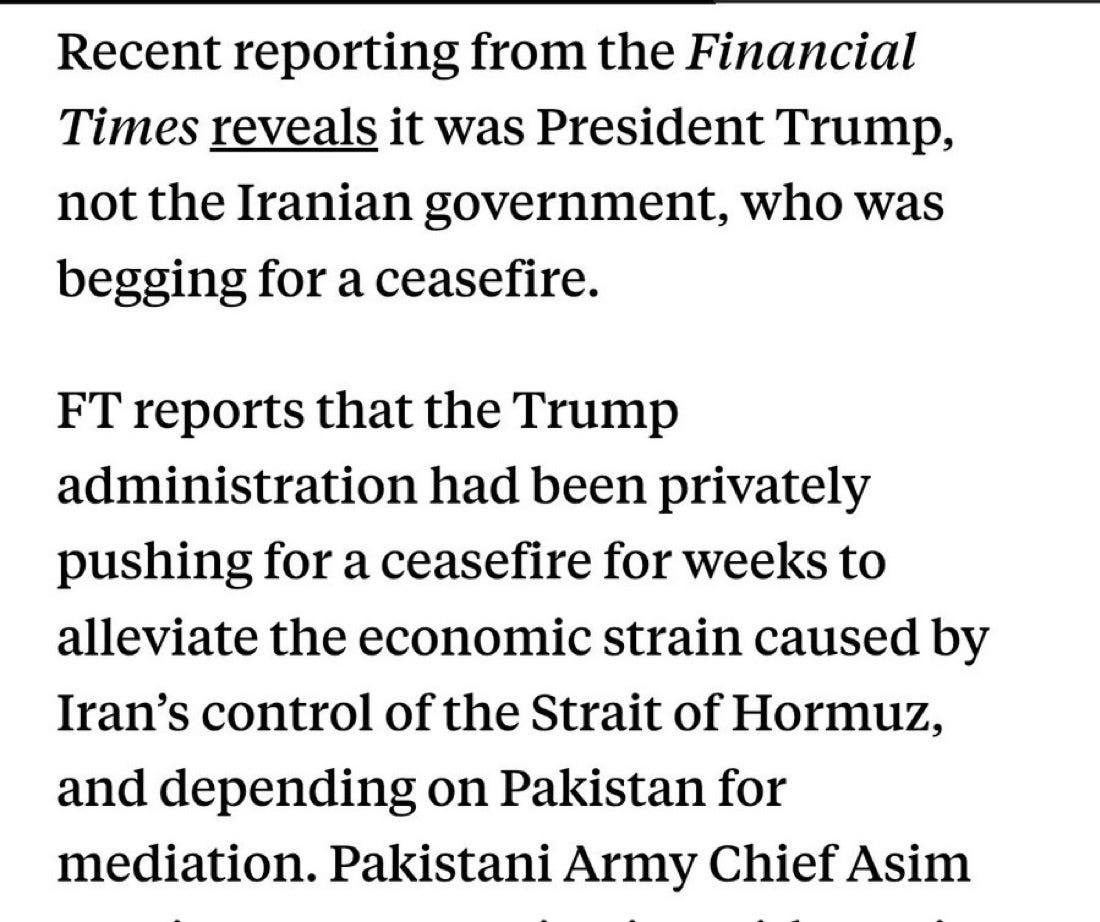
One of them is accurate.
The Richard Fontaine assessment from the Center for a New American Security is the right angle.
Iran’s proposal reads like a Tehran wish list from before the war.
The gap between the Iranian view of a final peace agreement and the American view is so wide that imagining a settlement in two years, much less two weeks, requires some diplomatic jujitsu.
It took two and a half years for the Obama administration to negotiate the 2015 nuclear accord in peacetime.
Meanwhile Lebanon is still being bombed.
European leaders have since demanded that Lebanon be included in the ceasefire agreement, warning that excluding it risks destabilizing the entire region.
An Israeli strike on central Beirut during Wednesday afternoon rush hour without warning destroyed entire buildings in residential neighborhoods and killed dozens.
The Lebanese health ministry has counted at least 1,530 killed since March 2, including 130 children.
Israel’s army chief said they will deepen the operation.
The ceasefire that Pakistan’s prime minister said includes Lebanon is the ceasefire that Netanyahu said does not include Lebanon.
Trump said Lebanon was not included because of Hezbollah.
That’s a separate skirmish.
There is no written document.
The terms are disputed.
The Lebanese are still dying.
The talks start Friday.
The ceasefire is a beginning that resolves nothing.
Everything that was wrong before April 7 is still wrong.
The Iranian people who wanted nothing more than a better life are still living under the regime America promised to remove.
The Hormuz toll system is now formalized rather than improvised.
The enriched uranium is still in the ground.
The missiles are being rebuilt with the revenue the ceasefire just guaranteed.
The regime that was supposed to collapse is congratulating itself on a victory that the terms of the agreement suggest it has reasonable grounds to claim.
And America is describing this as the Art of the Deal.
This is what thirty-nine days of war produced.
This is what a trillion dollars buys.
This is what the Iranian children got.
The ones who went to university.
The ones who wanted a better life.
The ones who were never asked.
The deal that existed on February 27 was better than this.
It was available for free.
It cost nothing.
It required no bombs.
It required no dead children.
It required no B1 bridge families celebrating Nowruz in parks that turned into rubble.
It required only that the men in the rooms keep talking for three more days.
They chose not to.
Everything since February 28 is the cost of that choice.
And the people paying for it were never in the room.
Please pray for all civilians caught in this war. The Iranian people, the Lebanese, everyone living inside a conflict they did not choose and were never consulted about. They deserved better. They always do
True to form, Trump makes everything worse, it's who he is, incompetent.
https://nicolekwrites.substack.com/p/the-new-species?r=6jbr0y&utm_medium=ios