
The Proxy Map
The Network That Was Backstage Is Now Center Stage

Strategic Conflict Assessment Series
Briefing #10
STATUS: Escalating Regional War — Active Diplomatic Track
DATA CUTOFF: March 29, 2026 | 17:00 EST
This is the tenth installment in the live conflict assessment series.
Previous briefings tracked the war’s principal actors, market consequences, and food system disruptions.
This briefing tracks the proxy network.
The “ongoing pause” applies to Iranian power plants.
It does not apply to Hezbollah.
It does not apply to the PMF.
It does not apply to the Houthis.
It does not apply to the Iraqi militias that have now been formally authorized by the Iraqi state to enter the war.
The network that operated under plausible deniability since February 28 now has formal state authorization.
Iraqi neutrality is over.
The Houthis have entered the war.
The containment line held for only 28 days.
The Strategic Conflict Assessment Series
Briefing #1
The Death of Khamenei: Decapitation Is Not Collapse

Examined whether the Islamic Republic could survive leadership decapitation.
Briefing #2
Axis Activation

Analyzed how regimes under existential pressure expand conflict outward through proxy networks.
Briefing #3
The Math of War

Examined how modern war is shaped by the cost imbalance between cheap offensive weapons and expensive defensive systems.
Briefing #4
The Energy Front

Examined how disruption in the Strait of Hormuz transmits directly into the global economy.
Briefing #5
The Maritime War

Documented the physical infrastructure of global trade breaking in real time.
Briefing #6
The Market Is Still Asleep

Examined the growing divergence between market pricing and the physical world.
Briefing #7
The Regime That Won’t Fall

Measured seventeen days of battlefield data against the original collapse thesis.
Briefing #8 — Part 1
The Endgame Problem

Examined the strategic problem that emerged once the war began: no defined political end state.
Briefing #8 — Part 2
The Reckoning

Documented what the principal actors achieved and what they cost others.
Briefing #9
The War that Reached the Dinner Table

Documented the food shock now underway across multiple continents.
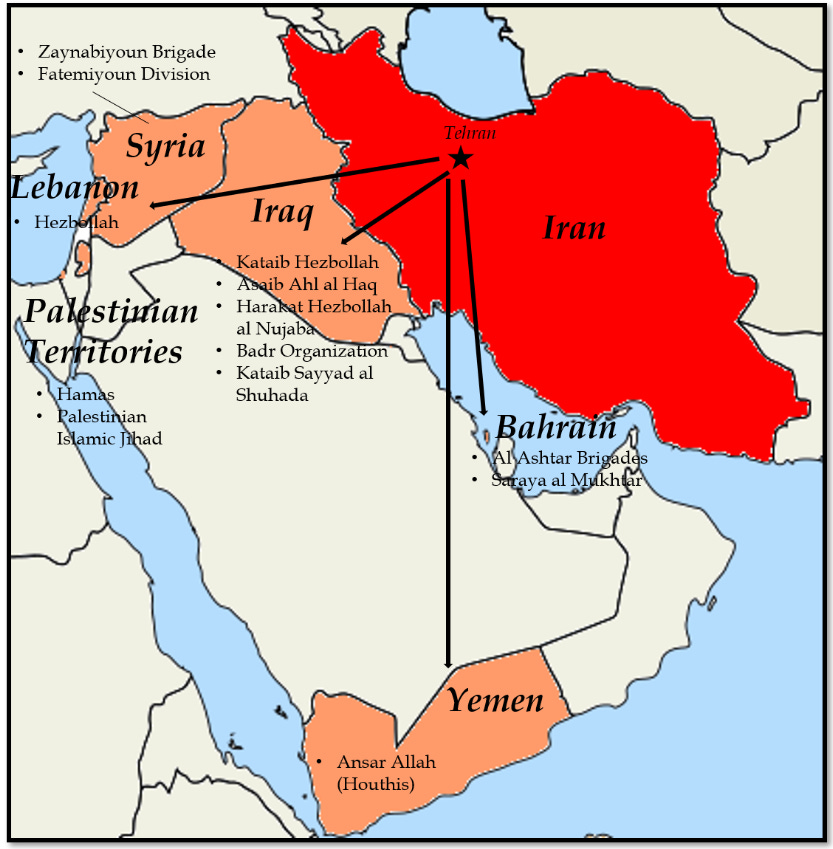
This briefing maps every active front beyond Iran itself.
WAR CLOCK — KEY EVENTS
Chronological record of major developments since the opening strike
T+0 hours
Feb 28, 2026 | 01:30 EST
U.S. and Israeli strike waves begin.
Leadership decapitation operations initiated.
Talks scheduled for March 2 collapse overnight.
T+1 day
Mar 1, 2026
Hezbollah joins the war.
Declares it is acting in response to the killing of Khamenei.
T+3 days
Mar 3, 2026
Israel authorizes ground invasion of Lebanon.
IDF 91st Division begins establishing a security layer in southern Lebanon.
T+14 days
Mar 14, 2026
Abu Ali al-Askari, Kataib Hezbollah security commander, killed in Baghdad airstrike.
T+17 days
Mar 17, 2026
Ali Larijani killed.
Israel launches ground invasion of southern Lebanon.
T+22 days
Mar 22, 2026
Iraqi Council of National Security formally authorizes PMF to retaliate against U.S. and Israeli attacks.
T+23 days
Mar 23, 2026
Hezbollah claims 36 attacks against Israeli forces in a single 24-hour period.
T+24 days
Mar 24, 2026
Iranian strikes kill six Peshmerga soldiers near Erbil.
Lebanese government expels Iranian ambassador.
Lebanese authorities arrest eight Hezbollah operatives transporting 21 rockets toward southern Lebanon.
T+25 days
Mar 25, 2026
Iran warns it could open the Bab el-Mandeb as a strategic front if the U.S. attempts ground operations on Iranian islands.
Hezbollah claims 79 attacks in a single day.
New wartime record.
21 drone attacks.
Also a new record.
T+26 days
Mar 26, 2026
Turkish tanker Altura struck by drone near the Bosphorus while carrying Russian crude from Novorossiysk.
First shipping attack of the war outside the Middle East theater.
T+28 days
Mar 28, 2026
Houthis launch ballistic missiles toward Israeli targets, triggering air raid sirens in Beersheba and Eilat.
The Red Sea front formally enters the war.
2,500 Marines from the 31st MEU arrive in CENTCOM’s area of responsibility.
Pentagon preparing for weeks of ground operations in Iran per Washington Post.
T+29 days
Mar 29, 2026
Four-nation summit in Islamabad. Saudi Arabia, Turkey, Egypt, and Pakistan.
Pakistan’s Deputy PM confirms both Washington and Tehran expressed confidence in Islamabad as a facilitator.
The most credible diplomatic infrastructure since February 27.
Operational Status
Active conflict across six simultaneous fronts.
Islamabad diplomatic track opening.
SNAPSHOT — Proxy Network Status
Cutoff: March 29, 2026
The proxy network now functions as Iran’s primary escalation ladder.
Each actor can increase pressure independently, allowing Tehran to raise the cost of the war without committing its own conventional forces at scale.
Several escalation triggers, maritime chokepoints, mass-casualty strikes, or strategic missile launches, could rapidly synchronize these fronts into a single regional war.
Iran’s direct ballistic missile and drone launch rates have declined sharply since the first week of the war.
That decline makes the proxy network more important, not less.
Tehran is preserving its direct strike capacity while the network absorbs the operational tempo.
Lebanon / Hezbollah
Over 700 attacks since joining the war on March 1.
IRGC reorganized Hezbollah after 2024 into a decentralized mosaic defense structure designed to survive leadership decapitation.
Estimated arsenal: 11,000–13,000 rockets and missiles.
Drone attacks are increasing as a share of total operations.
Israel is preparing to expand ground operations toward the Litani River security zone.
Most likely next move:
Sustain high-frequency rocket and drone attacks while avoiding a full strategic missile release.
Worst escalation trigger:
Mass launch of Hezbollah’s long-range missile inventory toward Tel Aviv and Israeli infrastructure.
Historical precedent:
During the 2006 Israel–Hezbollah War, sustained rocket fire continued despite heavy Israeli strikes on leadership and infrastructure.
Iraq / PMF
Iraqi Council of National Security formally authorized PMF retaliation against U.S. and Israeli attacks.
This converts militia attacks into state-authorized military retaliation.
Combined force strike on March 24 killed Anbar Operations Commander Saad al-Bajili and at least 13 PMF fighters.
Islamic Resistance in Iraq previously claimed 21 drone and missile attacks in a single day during the escalation phase.
Most likely next move:
Continued drone and rocket attacks on U.S. bases in Iraq and Syria while Baghdad maintains formal distance.
Worst escalation trigger:
A successful mass-casualty strike on U.S. personnel that forces Washington to retaliate directly against Iraqi state targets.
Historical precedent:
Iran-backed militias used identical tactics during the Iraq insurgency from 2004 to 2011 to raise the political cost of U.S. presence until withdrawal became the path of least resistance.
Yemen / Houthis
Houthis entered the war on March 28 with ballistic missile launches toward Israeli targets.
Weapons stockpiles reportedly degraded after Gaza operations, but recruitment and domestic production are expanding.
Saudi diplomatic channels attempting to contain further escalation.
The Houthis struck Israel rather than international shipping in their opening move, suggesting a cautious initial posture designed to avoid immediate U.S.-Israeli escalation.
Most likely next move:
Limited missile launches toward Israel and harassment of commercial shipping.
Worst escalation trigger:
Full naval blockade of the Bab el-Mandeb, reopening the 2024 global shipping crisis at far larger scale.
Historical precedent:
Egypt’s 1967 closure of the Strait of Tiran, a narrower and less trafficked waterway, was sufficient to trigger the Six-Day War within three weeks.
Syria
Iraqi militias launched rockets toward U.S. forces in Syria from Ninewa Province on March 23.
First reported attack on U.S. forces in Syria of the war.
Multiple Iranian-aligned militia networks remain embedded across eastern Syria.
Most likely next move:
Low-level harassment attacks designed to impose political pressure without triggering large retaliation.
Worst escalation trigger:
Sustained campaign against U.S. bases that forces Washington to expand airstrikes across Syria.
Historical precedent:
Proxy harassment campaigns were used through the entire Iraq War insurgency phase to gradually raise the cost of U.S. deployment until strategic fatigue set in.
Gulf States
Bahrain, Kuwait, and UAE continue absorbing sustained Iranian missile and drone fire as of Sunday.
Iran is limiting attacks on Saudi Arabia to avoid triggering direct Saudi military entry into the war.
Gulf governments increasing missile defense readiness and coordinating quietly with U.S. forces.
Most likely next move:
Continued limited Iranian strikes against smaller Gulf targets to maintain pressure without triggering Saudi entry.
Worst escalation trigger:
Direct Iranian strike on Saudi oil infrastructure, forcing Riyadh’s hand.
Historical precedent:
Iran targeted Gulf shipping and energy infrastructure during the 1980s Tanker War while calculating precisely which actions would and would not bring Saudi Arabia into direct conflict.
Kurdistan Region
Six Peshmerga soldiers killed in Iranian missile strike near Erbil on March 24.
KRG condemned the attack and affirmed its right to respond.
The region hosts Western intelligence and military installations that have been present for decades.
Most likely next move:
Political condemnation and security reinforcement without direct retaliation.
Worst escalation trigger:
Iran expands missile strikes near Erbil or targets Western facilities inside Kurdistan directly.
Historical precedent:
Iran conducted similar cross-border missile strikes into Iraqi Kurdistan in 2022 and faced no meaningful military response.
Confirmed Casualties
Cutoff: March 29, 2026 | 17:00 EST
Primary Belligerents
∙ Iran: 3,329 to 7,378 killed | 24,800 injured
∙ Israel: 29 killed | 5,492 injured
∙ United States: 15 killed | 313 injured
∙ Lebanon: 1,142 killed | 3,315 injured
Regional Spillover
∙ Iraq: 101 killed | 212 injured
∙ UAE: 11 killed | 160 injured
∙ Kuwait: 8 killed | 99 injured
∙ Qatar: 4 killed | 16 injured
∙ Bahrain: 3 killed | 38 injured
∙ Oman: 3 killed | 5 injured
∙ Saudi Arabia: 2 killed | 16 injured
∙ Turkey: 3 killed | 0 injured
∙ France: 1 killed | several injured
∙ Philippines: 1 killed | 0 injured
∙ West Bank: 10 killed | unknown injured
∙ Jordan: 0 killed | 19 injured
∙ Azerbaijan: 0 killed | 4 injured
Proxy-Specific Losses
∙ Hezbollah: 800 to 850+ fighters killed
∙ PMF: 80+ fighters killed | 130+ injured
Total: 3,411 to 9,114+ killed | 36,499+ injured
Key Judgments
The Iraqi authorization is the single most important proxy development of the war.
The Iraqi Council of National Security granted the PMF formal state authority to retaliate against the United States and Israel.
The Iraqi Ministerial Council affirmed the principle of self-defense applies.
These are state institutions authorizing a militia coalition to conduct attacks against the forces of a country whose ambassador remains in Baghdad.
The legal and strategic distinction between a militia attack and a state-authorized militia attack fundamentally alters escalation management and attribution for every engagement that follows.
The United States can no longer strike PMF positions and call it a targeted counter-militia operation.
It is now striking forces the Iraqi state has formally authorized to fight back.
Hezbollah is escalating, and the structure driving that escalation was built to survive Israeli pressure.
On March 25 the group conducted 79 attacks in a single day, including 21 drone strikes, both wartime records.
The IRGC-designed mosaic defense structure distributes command and logistics across cells that do not know each other’s operations.
Killing a commander does not disrupt the cell next to his.
Hezbollah retains an estimated 11,000 to 13,000 rockets and missiles.
The IDF has struck over 2,000 Hezbollah targets and killed roughly 800 to 850 fighters.
The attack rate is accelerating.
The Lebanese government fracture is real and militarily unenforceable.
Expelling Iran’s ambassador and arresting Hezbollah rocket transporters are the most direct actions any Lebanese government has taken against Hezbollah in the state’s history.
Hezbollah called it a coup.
The Lebanese Armed Forces cannot enforce disarmament. The Lebanese government has aligned itself politically with the anti-Hezbollah position.
It has no military capacity to make that alignment mean anything on the ground.
The result is a government that is politically courageous and operationally powerless, which is precisely the most dangerous position for a small state to occupy in the middle of a regional war.
The Bab el-Mandeb containment line has been breached.
Iran warned it could activate the Bab el-Mandeb front if the U.S. attempted ground operations on Iranian territory.
The Houthis entered the war on March 28 before any ground operations began. The warning condition was not met and the front activated anyway.
Saudi diplomatic pressure is still restraining a full Red Sea blockade. It is no longer restraining the Houthi entry into the conflict.
Simultaneous disruption of Hormuz and the Bab el-Mandeb would affect roughly 30 percent of global seaborne oil trade.
No modern historical precedent exists for that scenario.
Proxy warfare is now Iran’s primary escalation mechanism.
Iran’s direct missile and drone launch rates have declined sharply from the opening phase.
Tehran is now imposing costs through Hezbollah, the PMF, and the Houthis rather than through its own direct fire.
This preserves Iran’s missile inventory, reduces the targeting surface available to the combined force, and distributes the escalation risk across multiple geographies simultaneously.
Every front can escalate independently.
Every escalation increases the probability the fronts synchronize.
The war’s operational scale is expanding while its political objectives are contracting.
CENTCOM has struck over 11,000 targets in Iran. U.S. security officials no longer believe the campaign will achieve regime change or permanently eliminate Iran’s nuclear capabilities.
The objectives the war was started to achieve are officially assessed as unachievable.
The strikes continue anyway, now aimed at degrading capacity rather than achieving the original goals.
IV. The Iraqi Authorization
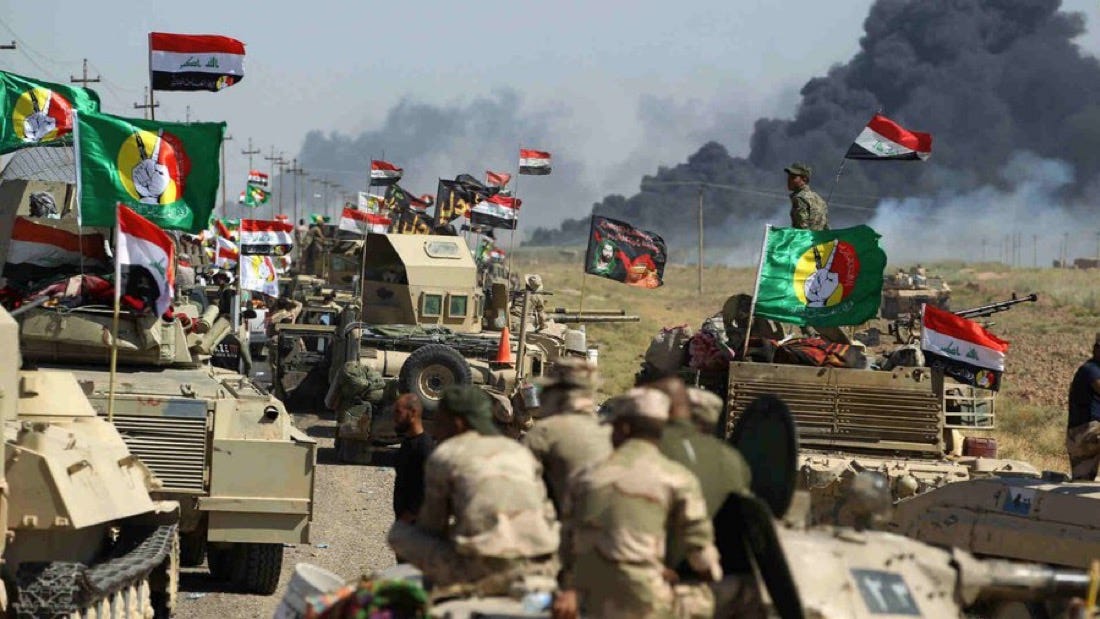
On March 22, the Iraqi Council of National Security gave the Popular Mobilization Forces full authority to respond to and retaliate against any U.S. and Israeli attacks.
An Iraqi state institution formally authorized a militia coalition to retaliate against the United States.
The PMF is a state-recognized umbrella network of mostly Shia armed groups. A number of those groups answer to Iran, not to the Iraqi prime minister.
They have been attacking U.S. bases since February 28.
The Islamic Resistance in Iraq claimed more than 21 drone and missile operations in a single 24-hour period on March 21.
Before March 22, those attacks operated under the pretense that the militias were acting independently of the Iraqi state. After March 22, the Iraqi state formally sanctioned them to continue.
The combined force struck the PMF’s Anbar Operations base on March 24.
The strike killed Commander Saad al-Bajili and at least 13 other PMF members during a meeting of senior commanders.
Iraq’s Defense Ministry condemned the strike as a blatant and serious violation of international laws prohibiting attacks on medical facilities, noting it hit near a military clinic.
The combined force struck the same base again on March 25, targeting an intelligence headquarters.
The Iraqi Ministerial Council responded by confirming that the principle of self-defense applies to PMF confronting military aggressions.
The Escalation Cycle
The combined force strikes PMF positions.
The Iraqi state condemns the strikes while having authorized the PMF to retaliate.
The PMF retaliates.
The combined force strikes again.
Iraq condemns again.
On March 26, the U.S. Embassy in Iraq issued a security alert calling on all U.S. citizens to leave the country immediately. Overland routes to Jordan, Kuwait, Saudi Arabia, and Turkey were the recommended options. Iraqi airspace is closed.
The proxy war in Iraq has moved from embedded conflict to official state-sanctioned war in 26 days.
The people who designed this outcome were Lindsey Graham, who spent three decades lobbying for the strike on Iran and filed his reelection paperwork during the third week of the war.
Benjamin Netanyahu, who lobbied Trump to attack Iran and told the press Israel acted alone while Trump told him to stop.
The Trump administration officials who told the press it would be better if Israel struck first so the U.S. would have a better justification for entering after Iran retaliates.
The Saudi Crown Prince who told Trump publicly to pursue diplomacy and privately urged him to strike.
All of them built the conditions for the Iraqi state to formally authorize a militia war against U.S. forces.
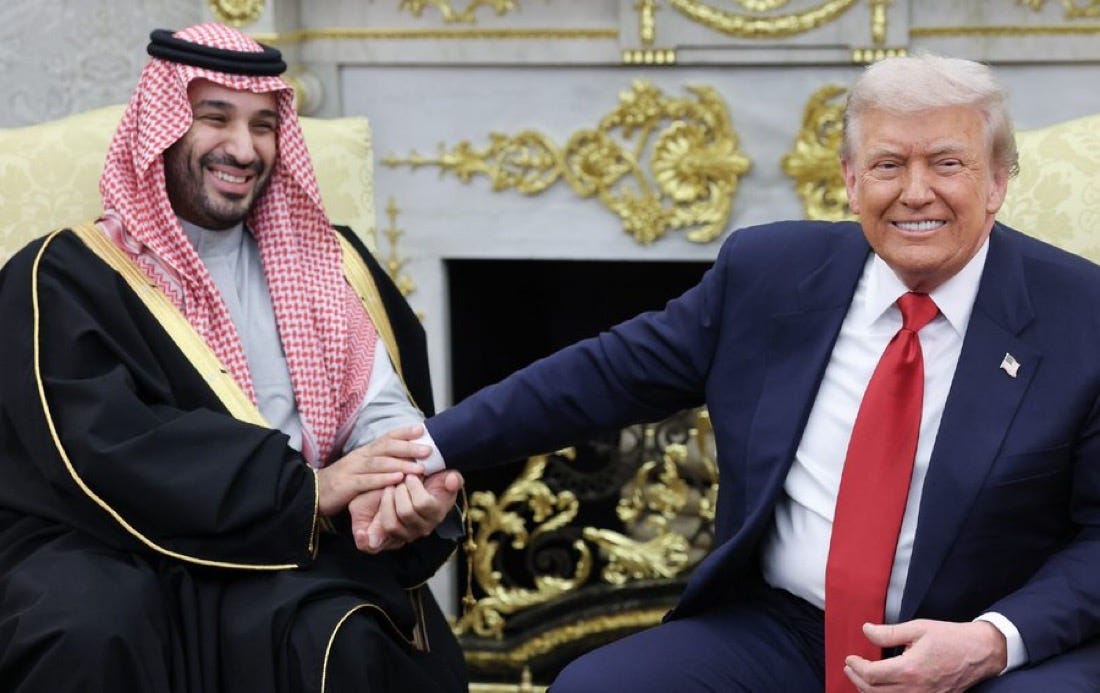
None of them are even in Iraq.
V. Hezbollah’s Mosaic
The IRGC deployed approximately 100 officers to Lebanon after the November 2024 ceasefire.
They built a different organization than the one Israel degraded in 2024.
The old Hezbollah was centralized, command-heavy, and penetrated by Israeli intelligence.
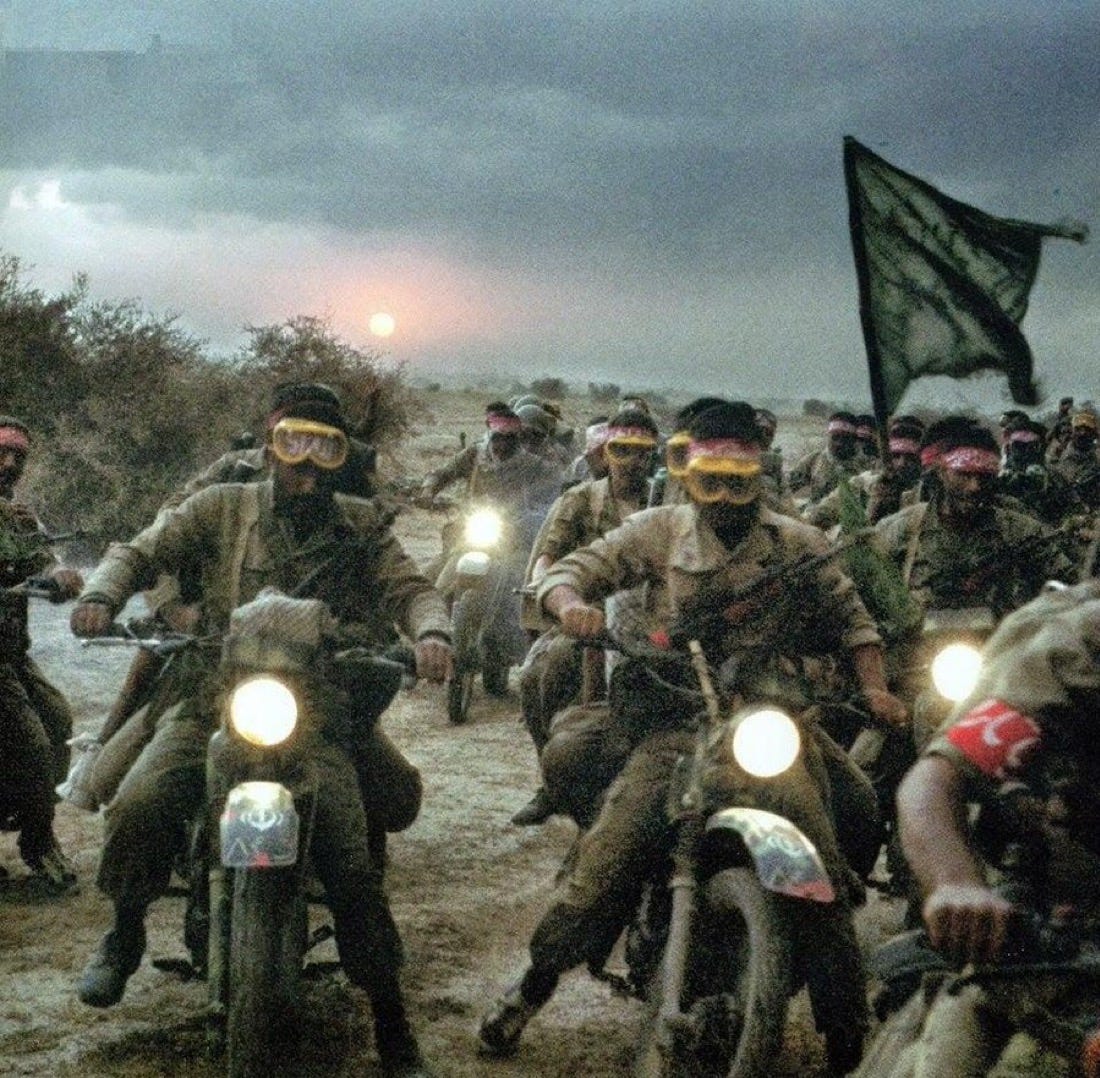
The IRGC reorganized the rebuilt Hezbollah into smaller, compartmentalized units with limited operational knowledge of each other.
Academic researchers describe the structure as a mosaic defense, the same model the IRGC uses inside Iran itself.
Units operate independently with enough autonomy to continue attacking even after command disruptions.
79 attacks in a single 24-hour period on March 25.
The highest daily total of the war.
It exceeds Hezbollah’s total claimed attacks during the most intense month of the Fall 2024 conflict. 21 drone attacks in a single day, also a new record.
Sustained over 20 rocket attacks per day since March 17.
Hezbollah retains 11,000 to 13,000 missiles and rockets per IDF assessment.
It assembles low-cost drones inside Lebanon from civilian components ordered online. Its Radwan Force fighters were already moving from the Bekaa Valley to southern positions at the start of the war.
The IDF struck over 2,000 Hezbollah targets and killed roughly 800 to 850 fighters. The attack rate is accelerating, not declining.
Decentralization is working as designed.
The IDF has now issued evacuation orders north of the Zahrani River, approximately 56 kilometers from the Israeli border.
The original stated objective was a security zone preventing Hezbollah from firing anti-tank missiles into northern Israel.
The objective line keeps moving north.
Netanyahu told northern Israeli mayors on March 25 that he has eliminated the threat of a Hezbollah ground invasion and is creating a broader buffer zone.
Hezbollah’s Secretary-General said on the same day that negotiating with Israel under fire would be surrender.
Those two positions describe the Lebanon front in its current state.
The Lebanese people being asked to absorb this are not the IRGC.
They are the 1.2 million-plus civilians already displaced from their homes, absorbed into a country that has been displaced and rebuilt and displaced again across five decades of wars it did not start and could not stop.
VI. The Lebanese Fracture
On March 24, Lebanon’s Foreign Ministry declared the Iranian Ambassador persona non grata and demanded he leave.
Lebanese authorities arrested eight Hezbollah operatives transporting 21 rockets to southern Lebanon.
No previous Lebanese government has taken these steps against Hezbollah or the IRGC.
Hezbollah called it a coup.
The group warned of internal division and said it deepens the national rift and plunges the country into a highly dangerous path of dependency, weakness, and vulnerability.
Lebanese PM Nawaf Salam said the government will not back down. He said the IRGC is present in Lebanon illegally and is leading military operations.
He said Hezbollah cannot force a reversal.
Hezbollah’s Secretary-General Naim Qassem rejected negotiations with Israel and urged the Lebanese people to reverse the government’s March 2 ban on Hezbollah’s military activities.
The country is splitting in real time from two directions simultaneously.
From the south: Israeli forces advancing toward the Litani River and beyond, IDF issuing evacuation orders 56 kilometers from the border, Netanyahu ordering the military to follow Gaza methods in southern Lebanon.
From within: Hezbollah calling any government constraint on its operations a coup and demanding reversal.
Lebanon has been here before.
Israeli forces occupied southern Lebanon for 22 years. Hezbollah was founded during and radicalized by that occupation.
The Lebanese government’s political alignment with the anti-Hezbollah position is the most significant development in Lebanese domestic politics in decades.
It is also unenforceable against a militia with 11,000 to 13,000 missiles that the Lebanese army cannot match.
The people paying for this were not consulted about any of it
VII. Russia’s Second War
Russia is delivering drones, satellite imagery, targeting data, and intelligence support to Iran. Deliveries started shortly after the war began per the FT and western security officials.
Iran and Russia held very active discussions in March about transferring upgraded Russian drones per U.S. and European officials speaking to the AP.
UK intelligence confirmed Russia has provided drone-related training, intelligence, and electronic warfare support. This is the first clear lethal military backing from Russia in this conflict.
Israel struck the Bandar Anzali port on March 18 specifically to disrupt this supply line. The IDF targeted dozens of vessels, a command center, and a shipyard.
Israeli media reported the strikes shut down the critical Caspian Sea corridor between Iran and Russia.
The WSJ confirmed the port’s dual purpose.
Russia uses the Caspian Sea corridor to receive Iranian Shahed drones, artillery shells, and ammunition for its Ukraine front. More than 300,000 artillery shells and one million rounds of ammunition were shipped from Iran to Russia in 2023 via the Caspian Sea.
Russia’s war in Ukraine and Iran’s war with the United States are now formally linked through a mutual logistics relationship running in both directions. Iran supplies Russia’s artillery war in Ukraine.
Russia supplies Iran’s drone war in the Middle East.
Russia’s monthly oil and gas revenues have doubled from approximately $12 billion to nearly $24 billion because of the energy price surge.
Putin profits from elevated energy prices while supplying the country sustaining those prices.
Every barrel that cannot exit Hormuz adds to Russia’s revenue.
Every drone Russia sends to Iran makes Hormuz harder to reopen.
The Trump administration eased Russian oil sanctions to reduce global energy prices. That revenue went partly to fund Russian support for Iran. The circular logic is precise and obvious.
Ukraine signed 10-year defense agreements with Qatar on March 28 and with Saudi Arabia on March 27. Ukraine is commercializing four years of experience countering Iranian drone technology with the Gulf states most exposed to that technology.
The Ukraine-Iran proxy dynamic has now formalized itself through Gulf defense cooperation. Washington should be watching this closely.
The allies most capable of helping the Gulf counter Iranian drones are not the United States.
They are a country the United States abandoned after 2022.
VIII. Bab el-Mandeb: The Second Lever
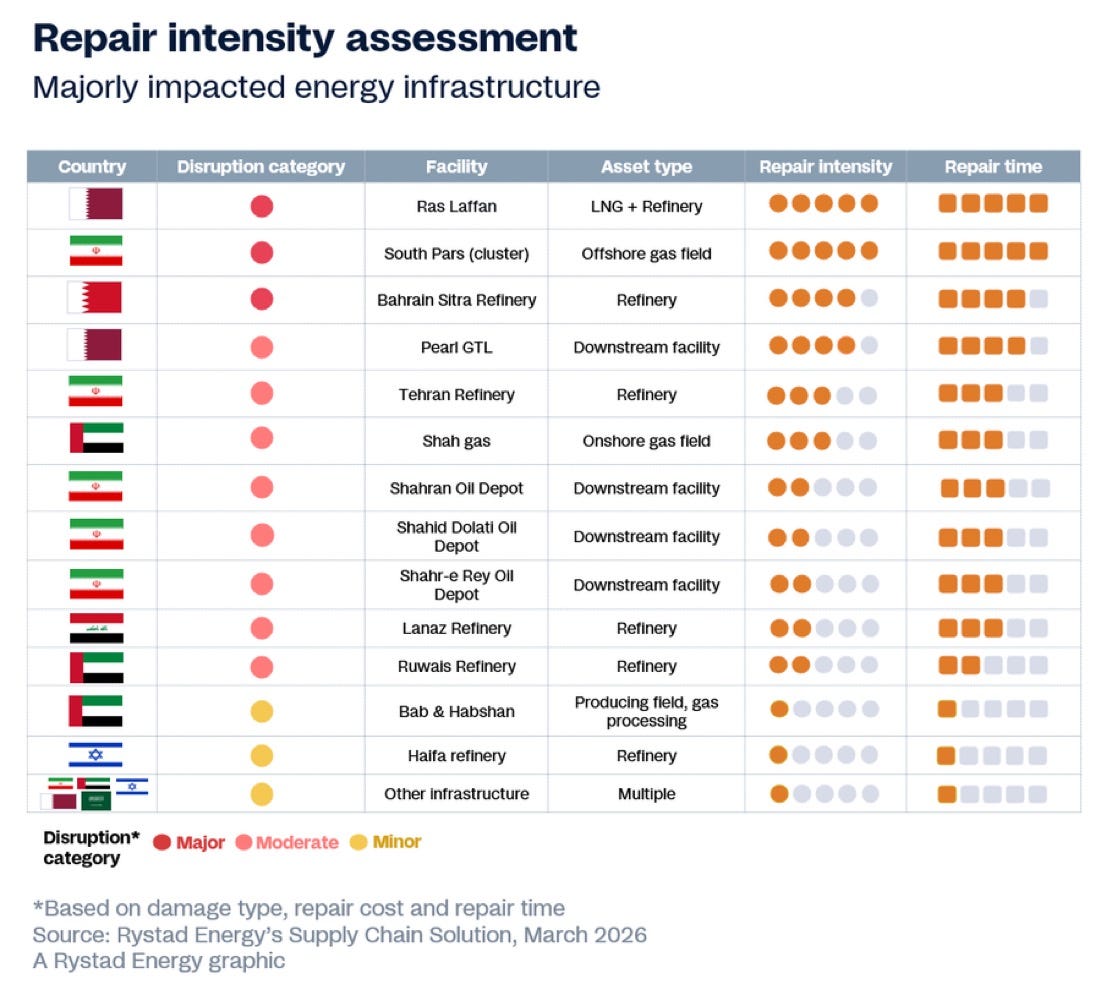
The Houthis entered the war on March 28 with ballistic missile launches toward Israeli targets.
Air raid sirens sounded in Beersheba and Eilat.
Israeli air defenses intercepted both attacks. No casualties from the Houthi strikes.
The Houthis struck Israel rather than international shipping.
That is the cautious opening move of an actor that wants to signal commitment to the Axis of Resistance without triggering an immediate U.S.-Israeli escalation against Yemen.
The Saudi diplomatic channels that contained them for 28 days are still functioning.
They are no longer preventing entry.
They are just limiting scope for now.
Iran warned on March 25 that if the U.S. attempts ground operations on Iranian islands or naval pressure in the Persian Gulf or Sea of Oman, it will open other fronts as a surprise.
The source named the Bab el-Mandeb specifically.
Ghalibaf separately warned that all vital infrastructure of any regional state assisting a seizure of Iranian islands will be targeted continuously and relentlessly.
The Bab el-Mandeb carries approximately 12 percent of total global seaborne oil and a significant share of global LNG. Hormuz carries approximately 20 percent.
Together they carry the entry and exit architecture of the Persian Gulf energy system.
Simultaneous disruption of both would produce a supply shock with no modern historical precedent. The 2024 Houthi campaign created severe disruption when only the Bab el-Mandeb was partially contested by a militia with degraded weapons.
Full coordinated closure of both straits would be beyond anything the global energy system has experienced since the 1973 oil embargo, and that comparison understates the current situation because the global economy is more integrated and the shipping infrastructure more concentrated than it was in 1973.
The Saudi diplomatic containment is the single most important underreported story of this war.
As of today it is barely holding.
It will fail if Kharg Island ground operations begin.
The people who need to understand this most clearly are the Trump administration officials who have spent weeks describing the war as almost over, wrapping up, and going extremely well.
If the containment breaks and both straits close simultaneously, the war will have produced an economic catastrophe that makes the current oil shock look like a price signal.
The people who will pay for that catastrophe are not the administration officials who will move on to the next press conference.
They are the consumers at the pump, the farmers who cannot buy fertilizer, the seafarers stranded in the Gulf of Oman, and the families in Somalia who were already paying 20 percent more for food before the second chokepoint closes.
IX. The Map That Doesn’t Pause
Six simultaneous fronts.
Lebanon:
Israeli forces advancing beyond the Litani River. Hezbollah at record attack tempo. Lebanese government fracturing. 1.2 million-plus civilians displaced. The Gaza model being applied.
Iraq:
PMF formally authorized by the Iraqi state to retaliate. Combined force striking PMF positions daily. Iraqi PM condemning strikes while affirming PMF legitimacy. U.S. Embassy telling Americans to leave immediately.
Syria:
Iraqi militia rockets crossing from Ninewa Province. Syrian Army backfilling former U.S. positions. New front opened in week four.
Yemen:
Houthis in the war with Israeli strikes. Shipping attacks the next threshold. Saudi diplomatic containment barely holding.
Gulf States:
Bahrain, Kuwait, and UAE absorbing sustained fire as of Sunday. Iran redirecting fire toward Bahrain after apparent Qatar pause. Qatar attacked again on March 28 despite Trump’s March 18 red line. That red line held for ten days.
Black Sea:
Turkish tanker struck near the Bosphorus while carrying Russian crude. Whether connected to this war or not, the geographic signal is not ambiguous.
The five-day pause did not touch any of these fronts.
The 15-point plan did not address any of these fronts.
The eventual Islamabad summit will not disarm any of these fronts even if it produces a ceasefire.
Dismantling it requires Iran to choose not to use it. That choice requires Iran to believe the political and security conditions on the other side of disarmament are better than the conditions the network currently provides.
Nothing in the 15-point plan, the eventual Islamabad summit, or any diplomatic signal from Washington or Tel Aviv has given Iran reason to believe that.
X. Escalation Scenarios
Prolonged multi-front war: 60 to 65 percent. All actors are reinforcing.
Limited maritime or island action: 50 to 60 percent. U.S. force posture supports raids near Hormuz or Kharg Island.
Regional spillover: 45 to 55 percent. Gulf states, Lebanon, Iraq, and Yemen already involved.
Bab el-Mandeb escalation: 45 to 55 percent. Houthi activation has already crossed the threshold. The scope is still limited.
Infrastructure war: 45 to 55 percent. Industrial and economic targets expanding on both sides.
Major Hormuz escalation: 40 to 50 percent. IRGC selective maritime control could force direct confrontation.
Iranian nuclear posture escalation: 25 to 35 percent. NPT withdrawal remains on the table as a response to continued strikes on nuclear sites.
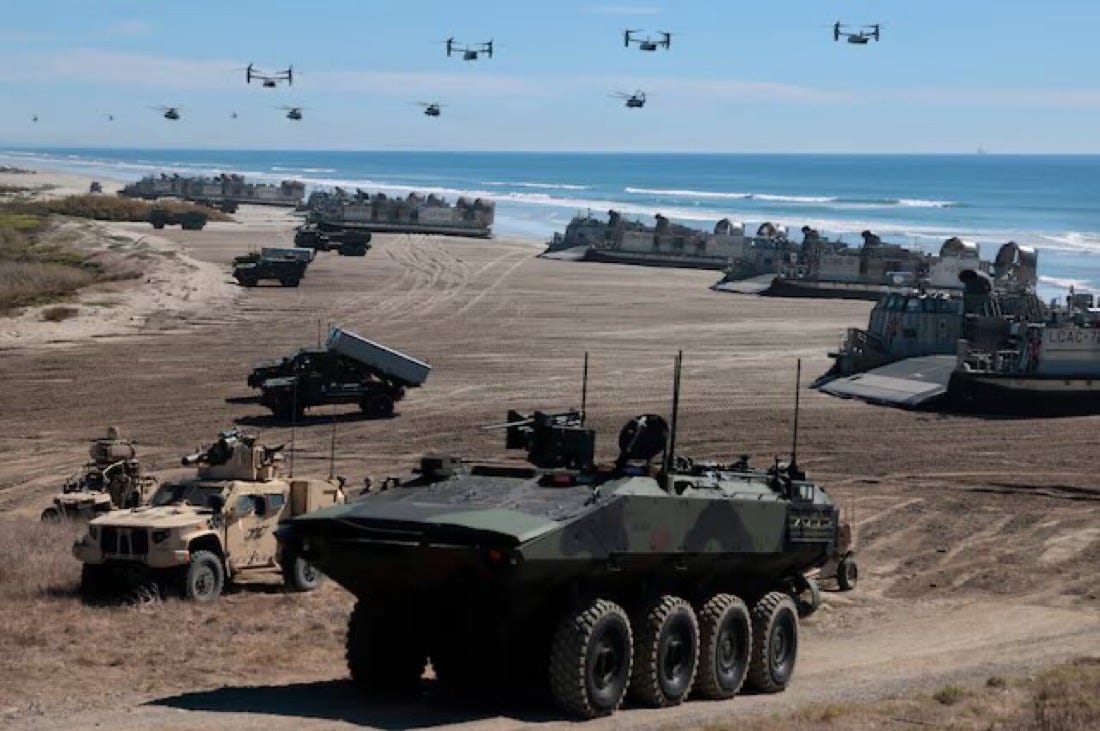
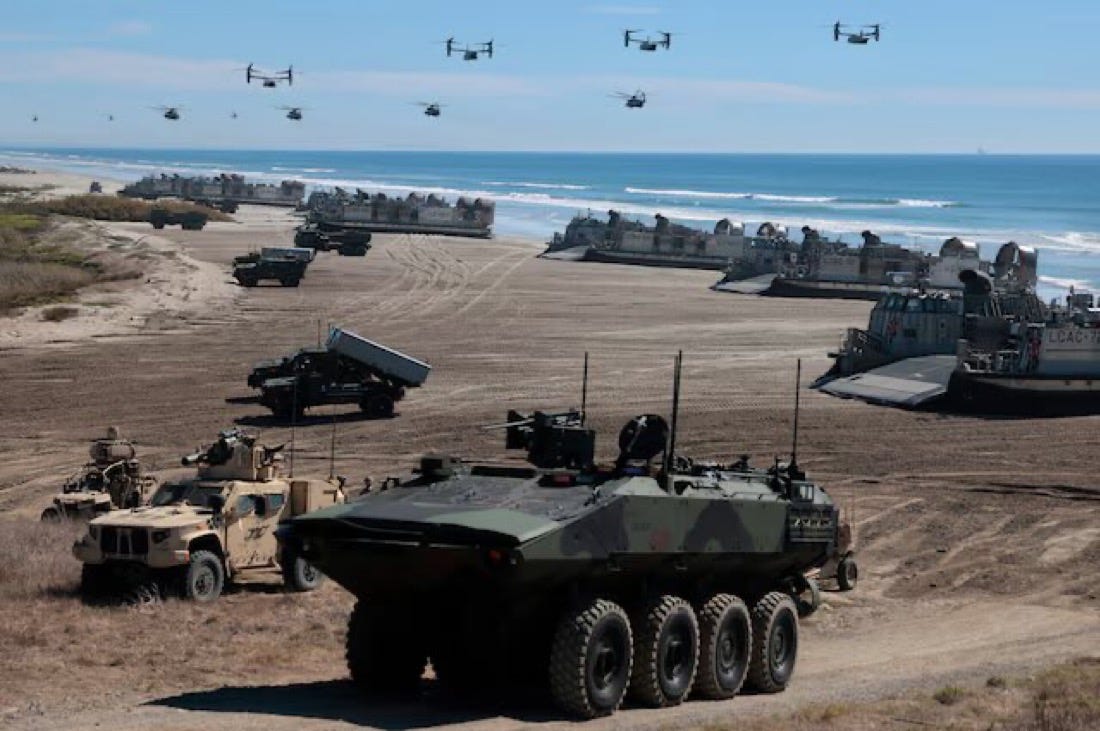
Full U.S. invasion of Iran: 12 to 18 percent. Current posture supports limited operations. The political cost of full invasion is prohibitive.
Regime collapse: 6 to 12 percent. No structural protest activity. IRGC cohesion intact. No defections at scale.
Near-term settlement: 7 to 12 percent. Islamabad summit is the most credible diplomatic infrastructure since February 27. The terms gap remains unbridgeable in days.
Read those probabilities as a whole.
The two outcomes the war was started to achieve, regime collapse and decisive settlement, are the two lowest-probability outcomes in the framework.
The scenarios the administration said it was trying to avoid, prolonged multi-front war, infrastructure war, Bab el-Mandeb escalation, regional spillover, are all running at 45 to 65 percent.
The war is producing the outcomes it was supposed to prevent.
XI. Immediate Escalation Risks
Expansion of Israeli-U.S. strikes on Iranian industrial infrastructure
Iranian attacks on Gulf economic targets
Limited U.S. island or maritime operations near Hormuz
Houthi escalation against Red Sea shipping
Iranian nuclear posture escalation
Saudi red line breach triggering Riyadh’s direct entry.
Coordination failure between Washington and Tel Aviv producing an unintended escalation neither side authorized.
Final Assessment
The proxy war is no longer backstage.
It is the primary battlefield architecture of the conflict.
Every front can escalate independently.
Every escalation increases the probability the fronts synchronize.
Once they synchronize, the war stops being a regional conflict.
The people who built this network over forty years knew exactly what they were building it for. The people who decided to attack Iran on February 28 knew the network existed.
They attacked anyway, during active nuclear negotiations, on a four-to-six-week timeline, with no plan for what happens when the network activates on all fronts simultaneously.
The bill for that decision is being paid by people who were never in any of the rooms where the decision was made.
That is what the proxy map shows.
Now this is how I would wanna stay informed about what's going in the whole world. Amazing 🙌🏻
So well done