
The Energy Front
How the Strait of Hormuz could turn a regional war into a global economic shock

THE FOURTH TURNING POINT
Strategic Analysis Series
STATUS: Ongoing Conflict Assessment
The first briefing, “The Death of Khamenei: Decapitation Is Not Collapse,” examined whether the Islamic Republic’s institutions could withstand the shock of leadership decapitation after the assassination of its Supreme Leader.

The second briefing, “Axis Activation: External War as Internal Stabilizer,” analyzed how regimes under existential pressure often expand conflict outward to stabilize the system at home.

The third briefing, “The Math of War,” examined how modern conflict is increasingly shaped by industrial capacity, production speed, and the cost imbalance between cheap offensive weapons and expensive defensive systems.

This fourth briefing moves to the next stage of the conflict.
Airstrikes continue across Iran.
Missile launches continue across the region.
But the most important pressure point of this conflict lies somewhere else.
The Strait of Hormuz.
The Strait of Hormuz carries roughly one-fifth of the world’s oil supply.
Few places on earth concentrate that much economic leverage.
If that corridor destabilizes, the consequences will extend far beyond the Middle East.
Wars in the Middle East have done this before.
The early signals are already appearing in shipping traffic, insurance markets, and oil prices.
If you want more analysis connecting markets, geopolitics and institutional risk, subscribe to The Fourth Turning Point
WAR CLOCK
T+0
Feb 28, 2026 | 01:30 EST
The first wave of U.S.–Israel strikes begins.
T+113h
Mar 4, 2026 | 19:00 EST
Iran’s regional proxy network steps up coordinated attacks across the region.
T+137h
Mar 5, 2026 | 18:30 EST
Drone saturation attacks continue across Gulf infrastructure and U.S. positions.
T+162H
Mar 6, 2026 | 19:30 EST
Commercial shipping disruption intensifies in the Strait of Hormuz. Energy markets begin reacting to the risk.
SNAPSHOT — Conflict Status
Cutoff: March 6, 2026 | 19:30 EST
162 hours have passed since the opening strike.
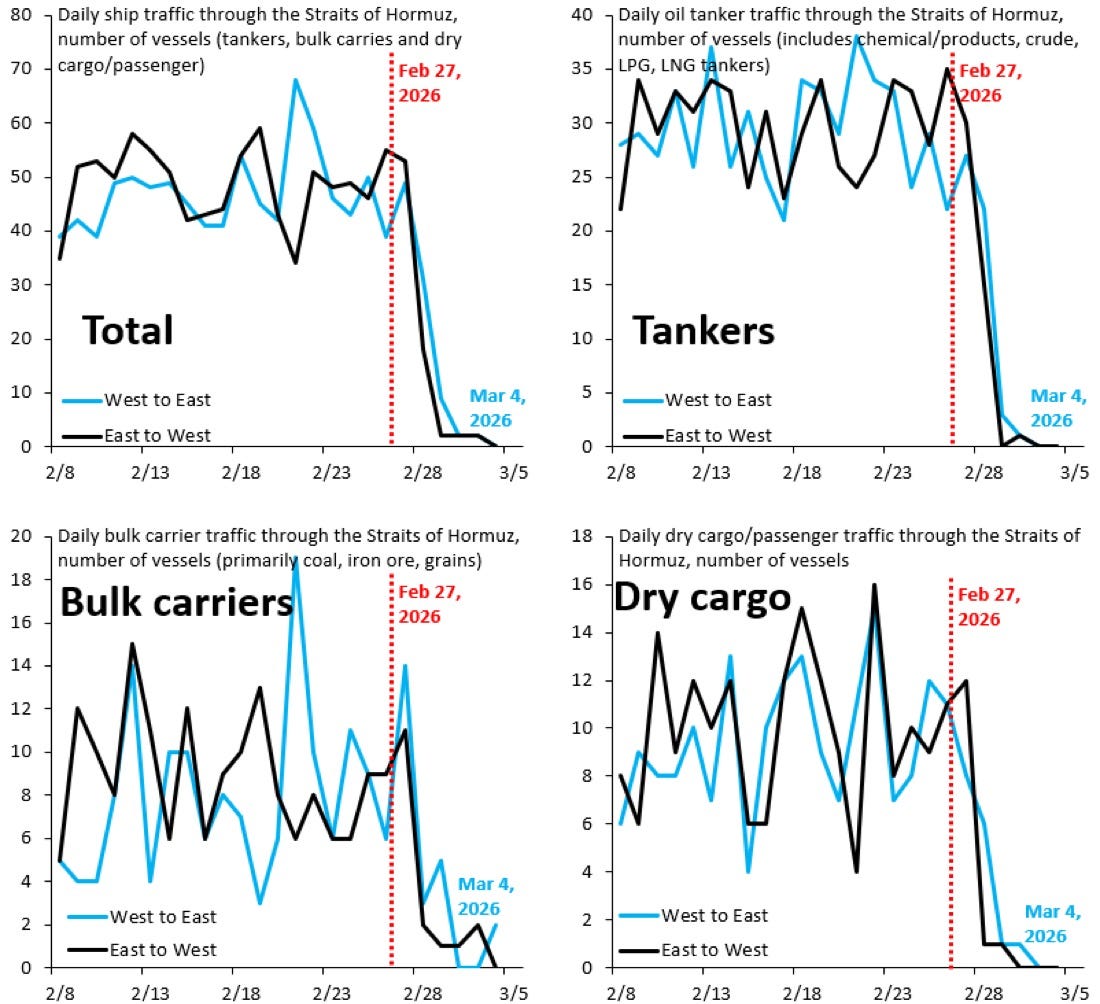
• Commercial shipping through the Strait of Hormuz has fallen from roughly 138 vessels per day to near zero, with multiple tankers struck or damaged.
• Roughly 20% of global petroleum supply normally transits the Strait of Hormuz each day.
• Average U.S. gasoline prices have recorded one of the largest weekly increases on record, rising more than 41¢ per gallon since the conflict began.
• U.S. diesel prices have surged to $4.33 per gallon as jet fuel spreads widen sharply across global aviation markets.
• Several Gulf producers are warning of storage pressure and potential export disruption as tanker traffic slows.
The military campaign continues.
The economic consequences of the conflict are beginning to propagate through global energy markets.
Confirmed Casualties
Primary Belligerents
• United States: 6+ service members killed, 20+ injured
• Israel: 12 civilians killed, 1,600+ injured, 11 missing
• Iran: 1,200–4,100+ fatalities reported, 5,000+ injured (military and civilian)
• Lebanon: 217 killed, 798 injured
Regional Spillover
• Bahrain: 2 killed, 6 injured
• Kuwait: 4 killed, 32 injured
• UAE: 3 killed, 78 injured
• Oman: 1 killed, 3 injured
• Jordan: 5 injured
• Qatar: 16 injured
• Iraq: 21 killed, dozens injured
The conflict now spans the widest geographic battlefield in the Middle East since World War II.
Leadership Decapitation
The opening strike wave eliminated multiple senior figures in Iran’s national security leadership:
Supreme Leader Ali Khamenei
Defense Minister Aziz Nasirzadeh
IRGC Commander Mohammad Pakpour
Iranian Defense Council Secretary Ali Shamkhani
Additional intelligence officials were also reported killed.
This level of leadership decapitation has no precedent in modern Middle Eastern conflict.
Precise casualty figures remain uncertain as operations continue across Iran and the wider region.
Market Reaction Since First Strike
S&P 500: 6,866 → 6,734 (−1.92%)
VIX: 19.87 → 29.49 (+48.36%)
WTI Oil: 67.05 → 90.90 (+35.57%)
Average U.S. Gasoline (Regular): 2.997 → 3.32 (+10.78%)
Energy and volatility markets have repriced sharply as traders factor in sustained disruption risk around the Strait of Hormuz.
Equities have moved far less so far.
Historically, broader market repricing tends to arrive during the second week of conflict, implying a possible S&P 500 test of 6,450–6,600 and WTI pushing toward $100–105 by next Friday if escalation continues.
I. The Energy Front Is the Real Battlefield
Air campaigns dominate headlines.
Fighter jets over Iran.
Missile strikes across the region.
Proxy attacks from Lebanon to Iraq.
Those images define the battlefield most people see.
But the strategic center of gravity in this conflict sits somewhere else.
The Strait of Hormuz.
Roughly one-fifth of the world’s petroleum supply moves through this corridor every day.
Oil from Saudi Arabia, the United Arab Emirates, Kuwait, Iraq, and Iran flows through a passage barely thirty miles wide.
Few geographic chokepoints concentrate that much economic leverage.
For decades, military planners and presidents have treated Hormuz as one of the most dangerous vulnerabilities in the global system.
Energy markets, shipping insurance, aviation fuel costs, and national inflation rates all depend on the stability of this passage.
That vulnerability is beginning to surface.
II. The First Shock Is Already Here
Commercial shipping through the strait has collapsed sharply as insurance costs surge and tanker operators hesitate to enter a conflict zone.
Traffic has fallen from roughly 138 vessels per day to near zero.
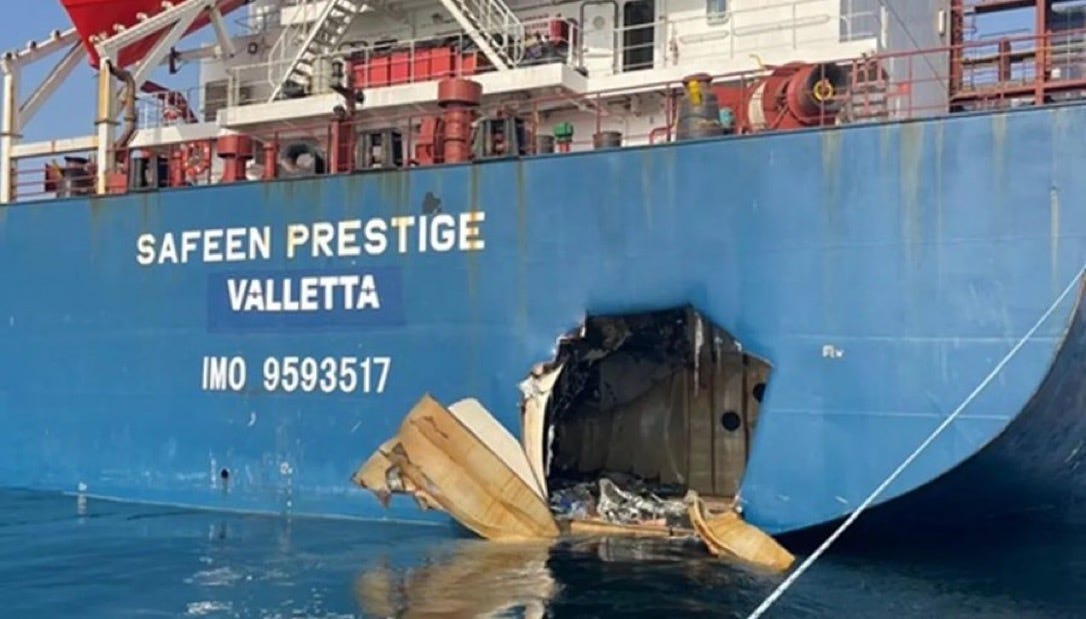
Several tankers have already been struck or damaged during the opening week of the war.
The effect is immediate.
Oil markets react to risk before supply actually disappears.
Prices rise not only when oil stops flowing, but when traders begin to believe it might.
That repricing has already begun.
WTI crude has risen sharply since the opening strike.
Diesel and jet fuel markets are tightening as shipping routes destabilize.
Across the United States, gasoline prices have recorded one of the largest weekly increases ever measured.
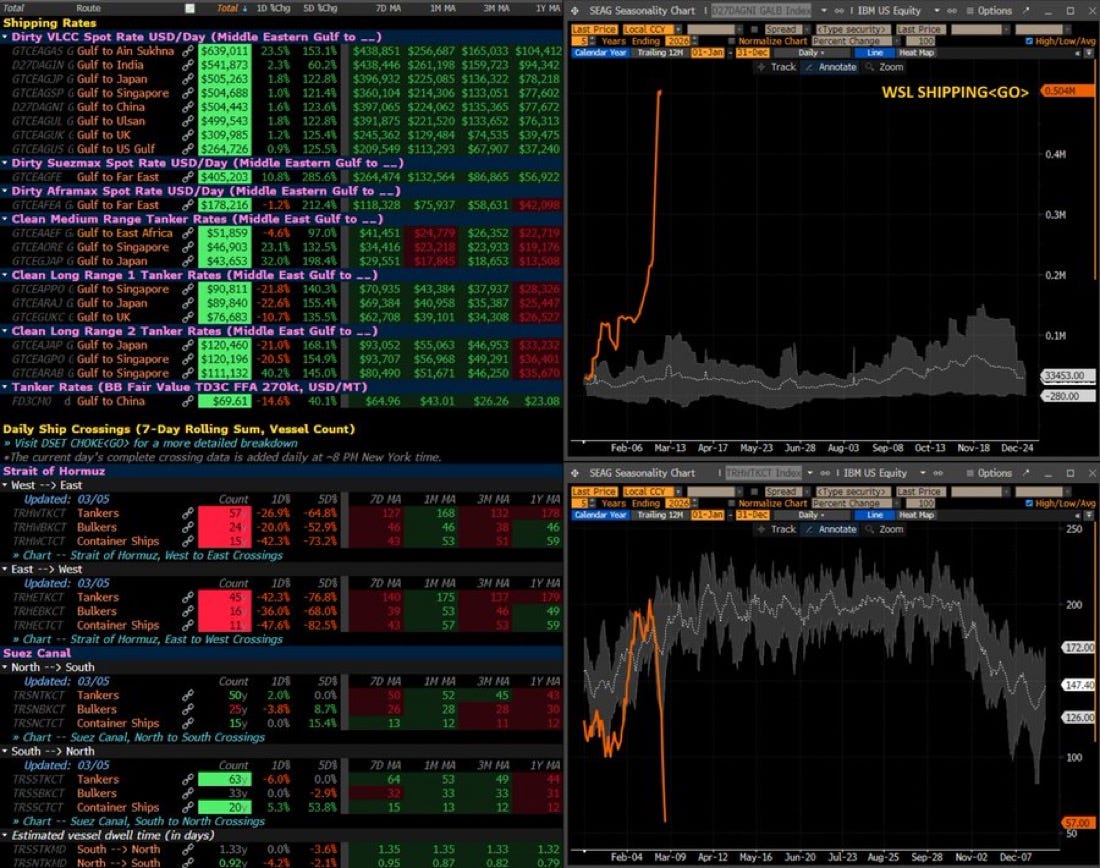
Energy systems transmit shock quickly.
A drone strike in the Gulf can ripple outward into airline costs in Europe, trucking costs in North America, and food prices across emerging markets.
III. Geography Is Iran’s Real Weapon
This is why Hormuz matters more than Tehran.
The United States and Israel possess overwhelming conventional military superiority.
No serious analyst disputes that.
Iran cannot defeat the United States in a direct military confrontation.
But wars are rarely decided by symmetrical strength.
Iran does not need to defeat the U.S. Navy.
It only needs to create enough uncertainty that shipping slows, insurance rates spike, and energy markets begin pricing prolonged disruption.
Markets react first.
Economic pressure will follow quickly.
Political pressure will mount.
And political pressure has a way of reshaping wars faster than missiles ever can.
Geography is supplying leverage where military parity does not.
A narrow strait can impose costs that entire armies cannot.
The weapons in this war are modern.
Geography still rules the map.
IV. We Have Seen This Movie Before
That vulnerability is why disruptions in the Strait of Hormuz have historically triggered some of the largest oil shocks in modern economic history.
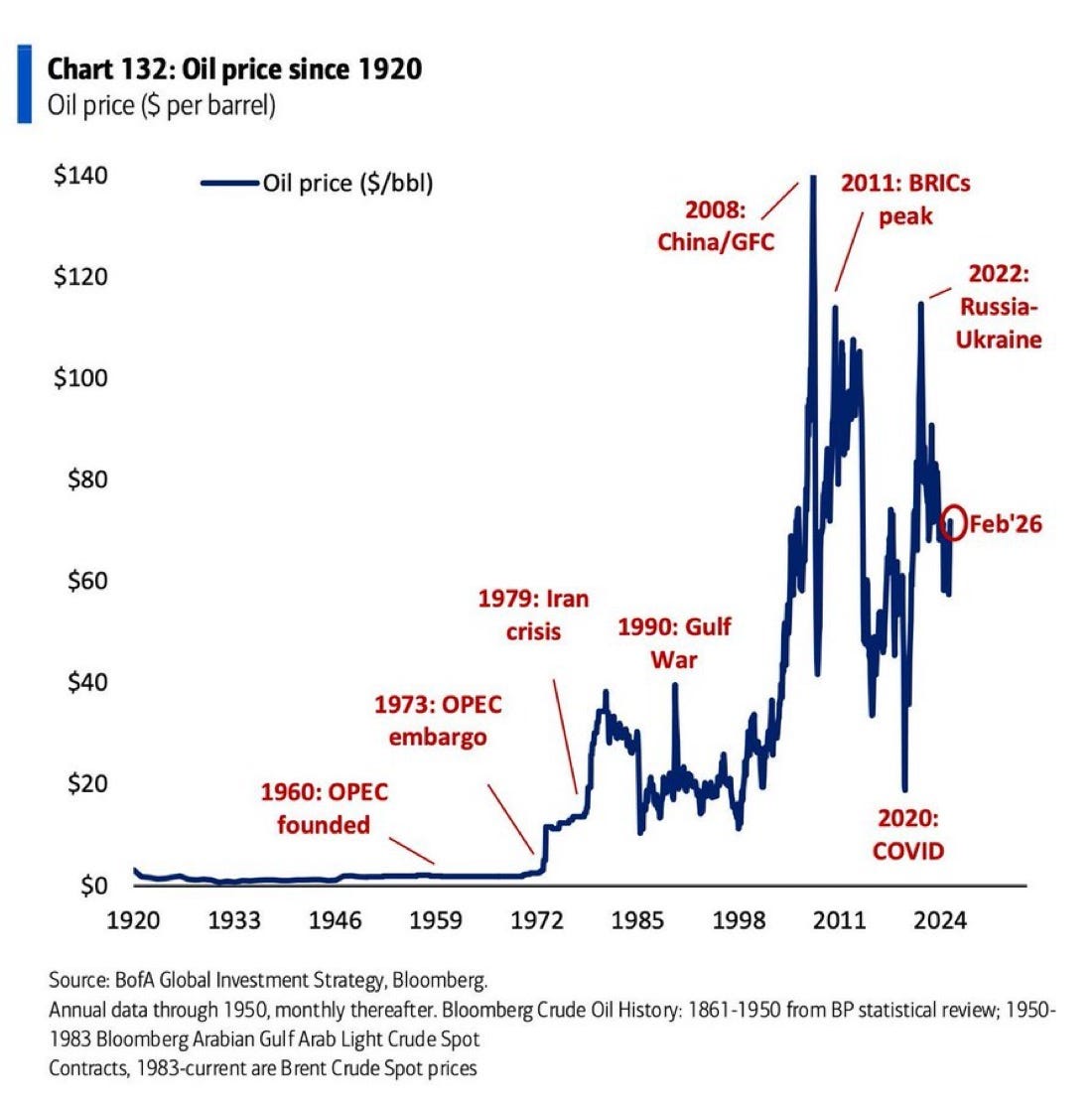
Historical oil shocks provide a useful percentage-change benchmark.
These projections apply the percentage increases observed during the major oil shocks of the 1970s to the pre-strike WTI price of $67.05 per barrel:
1979-scale shock
Oil: ≈ $188 per barrel
Inflation impact: +2.4 percentage points CPI
1973-scale shock
Oil: ≈ $268 per barrel
Inflation impact: +4.0 percentage points CPI
Full 1970s-cycle shock
Oil: ≈ $872 per barrel
Inflation impact: +16 percentage points CPI
These estimates reflect direct price transmission only, without accounting for second-order effects across wages, freight, food, and financial conditions.
Federal Reserve research suggests every $10 increase in oil prices adds roughly 0.2 percentage points to CPI.
Markets do not need to reach those extremes to cause serious damage.
Even a fraction of those historical moves would ripple through growth, inflation, freight, aviation, and political stability.
Energy shocks rarely stay contained once they begin.
V. The Second Week Is When Markets Wake Up
Energy markets have begun to adjust.
Equity markets, so far, have moved far less.
Historically, that sequence appears often during the first week of wartime markets.
Energy and commodity markets usually react first.
Broader financial markets tend to follow once the scale of disruption becomes clear.
The opening week of the conflict has demonstrated military escalation.
The next phase will test economic endurance.
Energy markets are beginning to price the possibility that the narrow waters of the Strait of Hormuz become the central pressure point of the war.
If that happens, the battlefield expands far beyond the skies over Iran.
Oil will react.
Inflation will react.
Politics will react.
In this war, the narrow waters of the Strait of Hormuz may prove more consequential than the air war over Iran.
My guess is that the next week will be key in seeing how well the IRGC is able to keep any control of the situation and how likely their threats remain in the Straight.
Key signals I'll be watching for:
- Whether the succession process produces a credible leader or fracture into factional competition.
- Whether the IRGC units in major cities are able to maintain discipline against their own population or show signs of hesitation.
- The frequency and sophistication of maritime attacks. This will be a big indicator of whether the IRGC is husbanding resources or still operating at full operational tempo.
One presure multiplier nobody is talking about much is StarLink. The Iranian people have demonstrated they can communicate through internet blackouts using satellite connectivity. Tehran residents were communicating with the outside world through StarLink even as state systems were shut down. That means the IRGC cannot achieve the information isolation they used so effectively during the January massacres. That changes the psychology of both protesters and security forces that are hard to fully predict but likely favor the population and not the regime.
This situation reminds me less of Iraq 2003 and more of Romania 1989; a deeply hated security aparatus that had successfuly suppressed everything for decades, a population that had internalized fear so completely that public dissent seemed impossible, and then a sudden crack in the dam where everything suddenly shifted almost overnight. Romania's Securitate looked formidable right up until the moment individual soldiers started to refusing to fire on crowds and the whole thing collapsed with remarkable speed.
Not an exact parallel but the structural similarities are worth noting.
Powerful tribute to the innocent lives lost in Iran: https://krisfeliciano.substack.com/p/international-womens-dayin-mourning?r=7vdiuz&utm_medium=ios