
What the Tea Party Actually Got
The Lost Generation of American Politics — Episode III

The Tea Party succeeded.
That is where the story gets complicated.
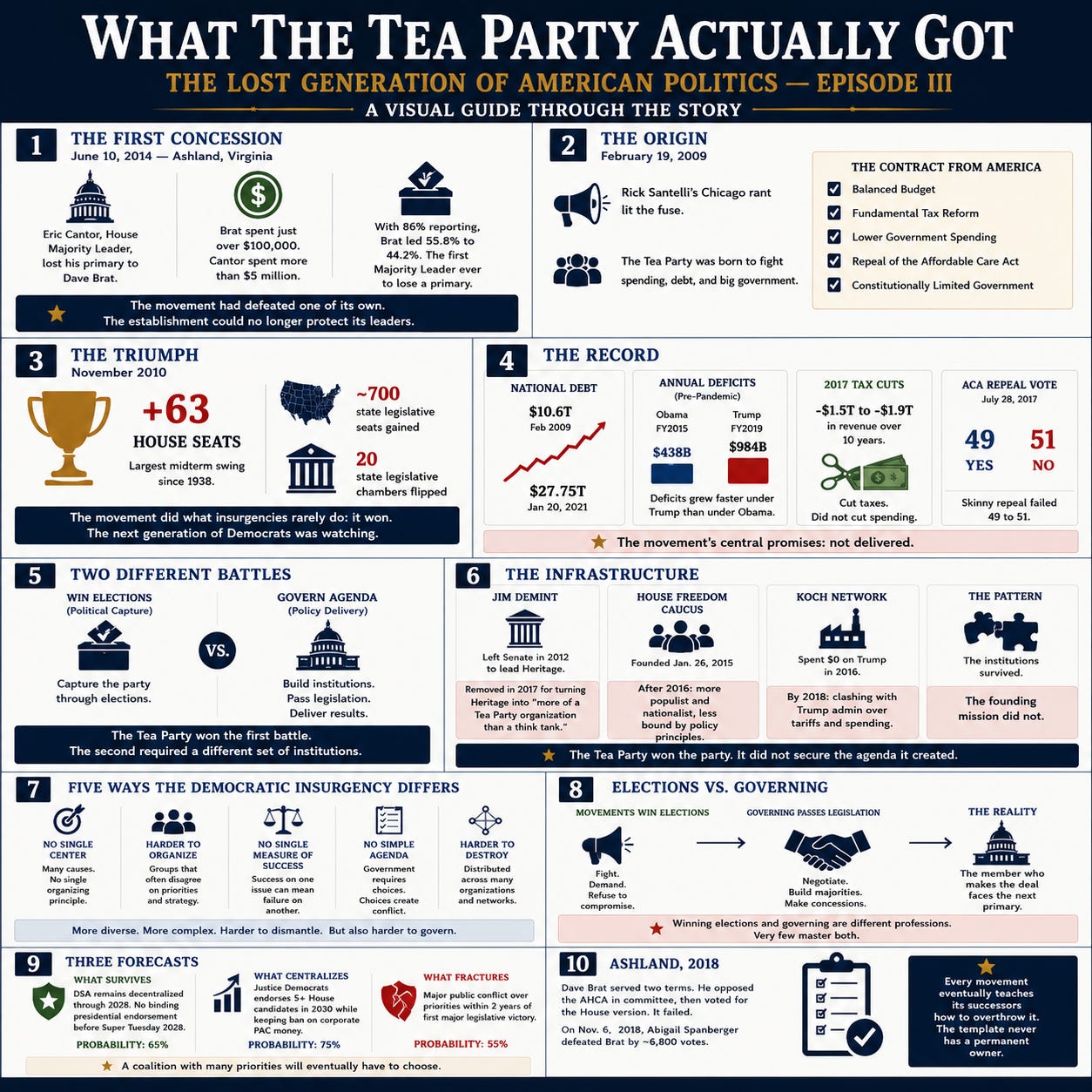
On the night of June 10, 2014, Eric Cantor stood at a microphone in Richmond and conceded defeat.
The House Majority Leader had just lost his primary to Dave Brat, an economics professor at Randolph-Macon College in Ashland, Virginia.
Brat spent just over $100,000.
Cantor spent more than $5 million.
Most of Washington expected Cantor to become the next Speaker of the House.
With 86 percent of precincts reporting, Brat led 55.8 percent to 44.2 percent.
Cantor became the first House Majority Leader in American history to lose a primary.
For the first time, the movement had defeated one of its own.
Cantor had done more than almost any Republican leader to accommodate the Tea Party inside the existing structure of party power.
It did not save him.
The Republican establishment had lost the ability to protect its own leaders from its own voters.
Every Republican incumbent in America understood the message before midnight.
The First Concession
What the Tea Party became requires an honest reading of 2014.
The comfortable version is that Dave Brat defeated Eric Cantor by running as a fiscal conservative against a Washington insider who had drifted from the movement’s founding principles on spending, debt, and the size of government.
He ran on those issues.
He also ran on immigration.
Brat called Cantor “the No. 1 cheerleader in Congress for amnesty.” Laura Ingraham and Ann Coulter backed him largely on those grounds.
Fiscal conservatism and immigration were not separate arguments.
They had become the same campaign.
In Virginia’s 7th District, the immigration message likely moved more votes than any debate over deficits or spending.
Donald Trump would not descend the Trump Tower escalator for another year.
By June 2014, however, the coalition he would inherit had already changed.
The Tea Party began as a movement organized around debt, deficits, constitutional limits, and opposition to the Affordable Care Act.
By 2014, immigration had become one of its defining issues.
That changes the story of Trump’s rise.
He did not arrive and transform a purely fiscal movement.
He entered a coalition that was already evolving and accelerated the direction it was taking.
The movement Trump inherited in 2016 was no longer the movement Rick Santelli called into being in 2009.
That makes Trump’s dominance easier to understand.
It also makes it harder to describe as a sudden break from the Tea Party’s past.
The Origin
Go back five years to understand what the movement claimed to be.
On February 19, 2009, less than a month into Barack Obama’s first term, CNBC reporter Rick Santelli stood on the floor of the Chicago Mercantile Exchange and accused the government of “promoting bad behavior” by “subsidizing losers’ mortgages.”
He proposed a “Chicago Tea Party” and asked:
“President Obama, are you listening?”
The clip spread within hours.
Conservative organizers coordinated protests across dozens of cities. On April 15, 2009, Tax Day, demonstrations took place across the country.
The movement later distilled its agenda into the Contract from America, drafted through an online vote of participants.
Its priorities were clear.
A balanced budget.
Fundamental tax reform.
Lower government spending.
Repeal of the Affordable Care Act.
A return to constitutionally limited government.
Those were the promises.
Everything that followed can be measured against them.
The Triumph
In November 2010, Republicans gained 63 House seats, the largest midterm swing since 1938.
They won the House majority.
Across the country, they gained roughly 700 state legislative seats and flipped 20 legislative chambers.
The movement had done what insurgencies rarely do.
It had won.
The generation that would later build the Democratic insurgency was watching.
They remembered the numbers.
The Record
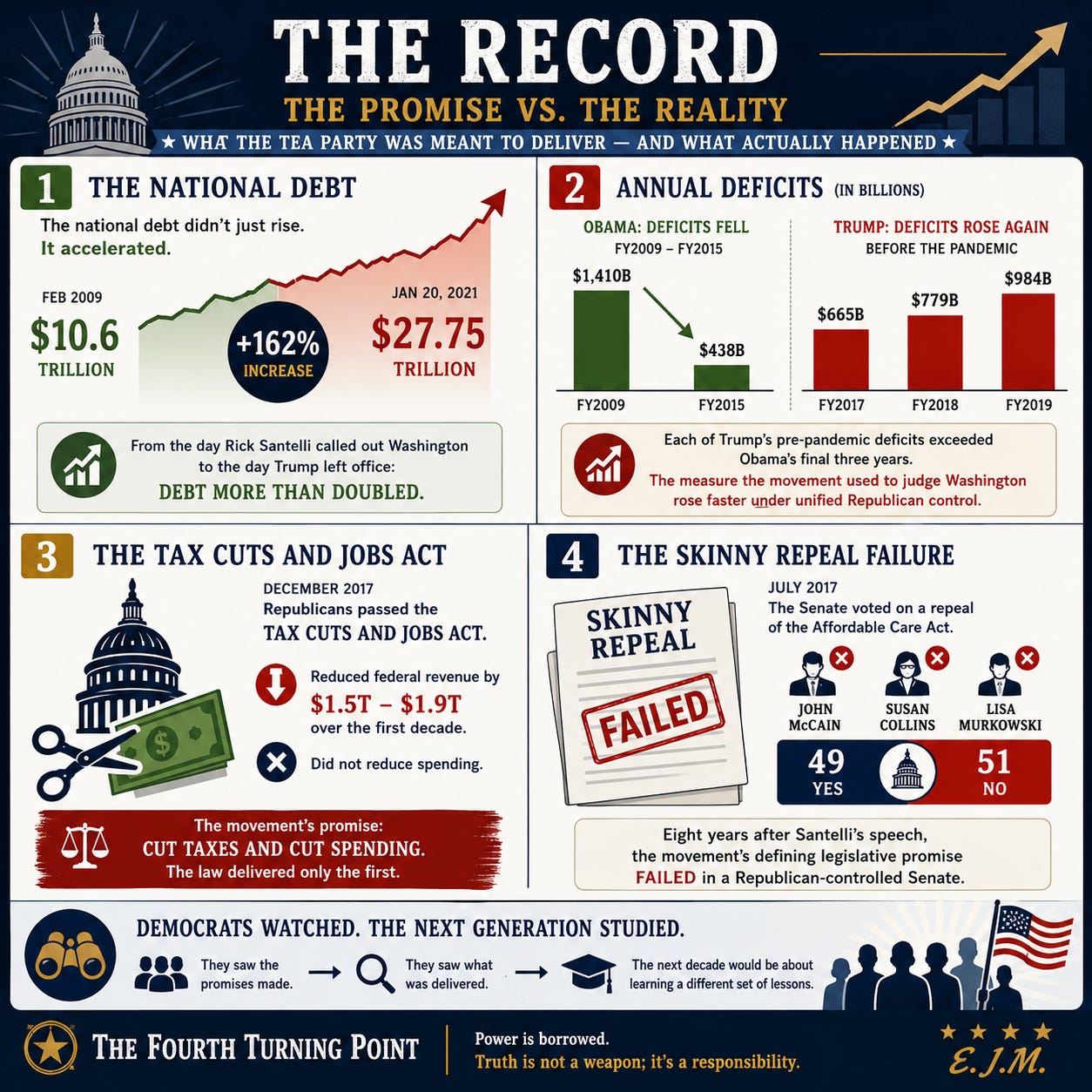
The national debt stood at roughly $10.6 trillion when Rick Santelli delivered his speech in February 2009.
When Donald Trump left office on January 20, 2021, it stood at $27.75 trillion.
Barack Obama’s annual deficits fell from $1.41 trillion in FY2009 to $438 billion in FY2015.
Before the pandemic, Trump’s deficits were $665 billion in FY2017, $779 billion in FY2018, and $984 billion in FY2019.
Each exceeded Obama’s final three fiscal years.
The measure the movement chose to judge Washington rose faster under unified Republican government than it had fallen under the president the movement was created to oppose.
In December 2017, Republicans passed the Tax Cuts and Jobs Act.
The law reduced federal revenue by an estimated $1.5 trillion to $1.9 trillion over its first decade.
It did not reduce spending.
The movement’s central promise was to cut taxes and cut spending.
The law delivered only the first.
In July 2017, the Senate voted on the skinny repeal of the Affordable Care Act.
John McCain, Susan Collins, and Lisa Murkowski voted against the bill.
Final vote: 49 to 51.
Eight years after Santelli’s speech, the movement’s defining legislative promise failed in a Republican-controlled Senate.
Democrats watched the outcome.
The generation now entering leadership spent the next decade deciding what to do with it.
Two Different Battles
The movement succeeded politically long before it succeeded legislatively.
That distinction matters.
Political parties are captured through elections.
Governing agendas survive through institutions: think tanks, congressional caucuses, policy networks, and donor coalitions that endure across election cycles and turn electoral victories into legislation.
The Tea Party won the first battle decisively.
The second required an entirely different set of institutions.
The Infrastructure
Jim DeMint was the Tea Party’s most influential champion in the Senate. Through the Senate Conservatives Fund, he financed primary challengers and pushed the Republican conference to the right.
In December 2012, he left the Senate to lead the Heritage Foundation, believing that shaping the movement’s intellectual infrastructure would have a greater long-term impact than remaining in office.
On May 2, 2017, Heritage’s board voted unanimously to remove him.
A founding trustee explained why.
Heritage had become “more of a Tea Party organization than a think tank.”
DeMint had spent four years turning the movement’s intellectual center into an advocacy organization.
Then the movement found its political vessel.
The institution faced a choice between serving the movement’s founding principles and serving its new leader.
DeMint lost.
The same pattern appeared elsewhere.
The House Freedom Caucus, founded on January 26, 2015, defined itself around fiscal conservatism, limited government, and constitutional accountability.
After 2016, Politico described it as becoming “more populist and nationalist, but less bound by policy principles.”
The Koch network followed a similar path.
It spent nothing supporting Donald Trump in 2016. At an August 2016 donor retreat, Charles Koch said, “At this point I can’t support either candidate.”
By August 2018, the network was publicly clashing with the Trump administration over tariffs and spending.
In every case, the institution survived.
The founding mission did not.
What the Tea Party Actually Got
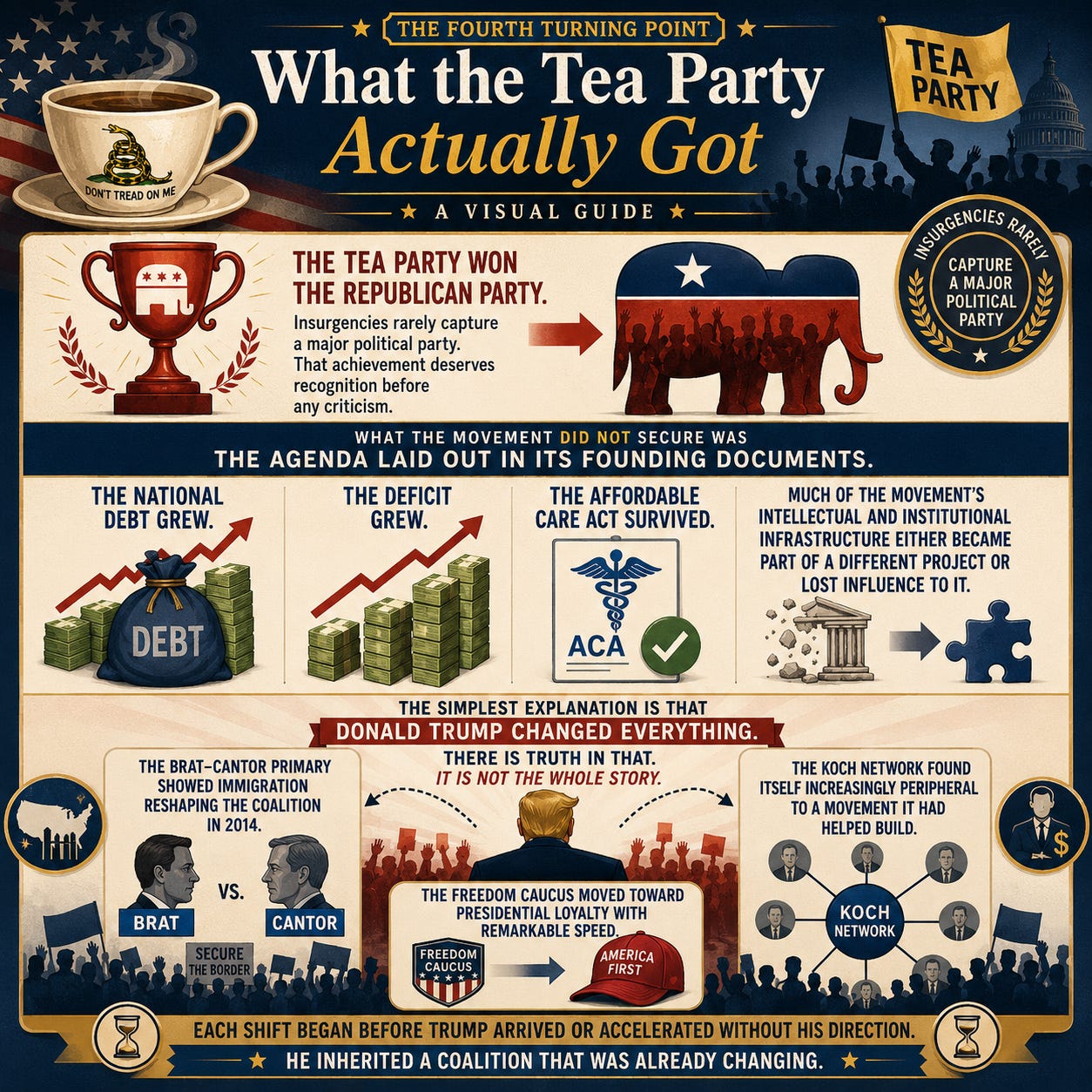
The Tea Party won the Republican Party.
Insurgencies rarely capture a major political party. That achievement deserves recognition before any criticism.
What the movement did not secure was the agenda laid out in its founding documents.
The national debt grew.
The deficit grew.
The Affordable Care Act survived.
Much of the movement’s intellectual and institutional infrastructure either became part of a different project or lost influence to it.
The simplest explanation is that Donald Trump changed everything.
There is truth in that.
It is not the whole story.
The Brat-Cantor primary showed immigration reshaping the coalition in 2014. The Freedom Caucus moved toward presidential loyalty with remarkable speed. The Koch network found itself increasingly peripheral to a movement it had helped build.
Each shift began before Trump arrived or accelerated without his direction.
He inherited a coalition that was already changing.
The Parallel
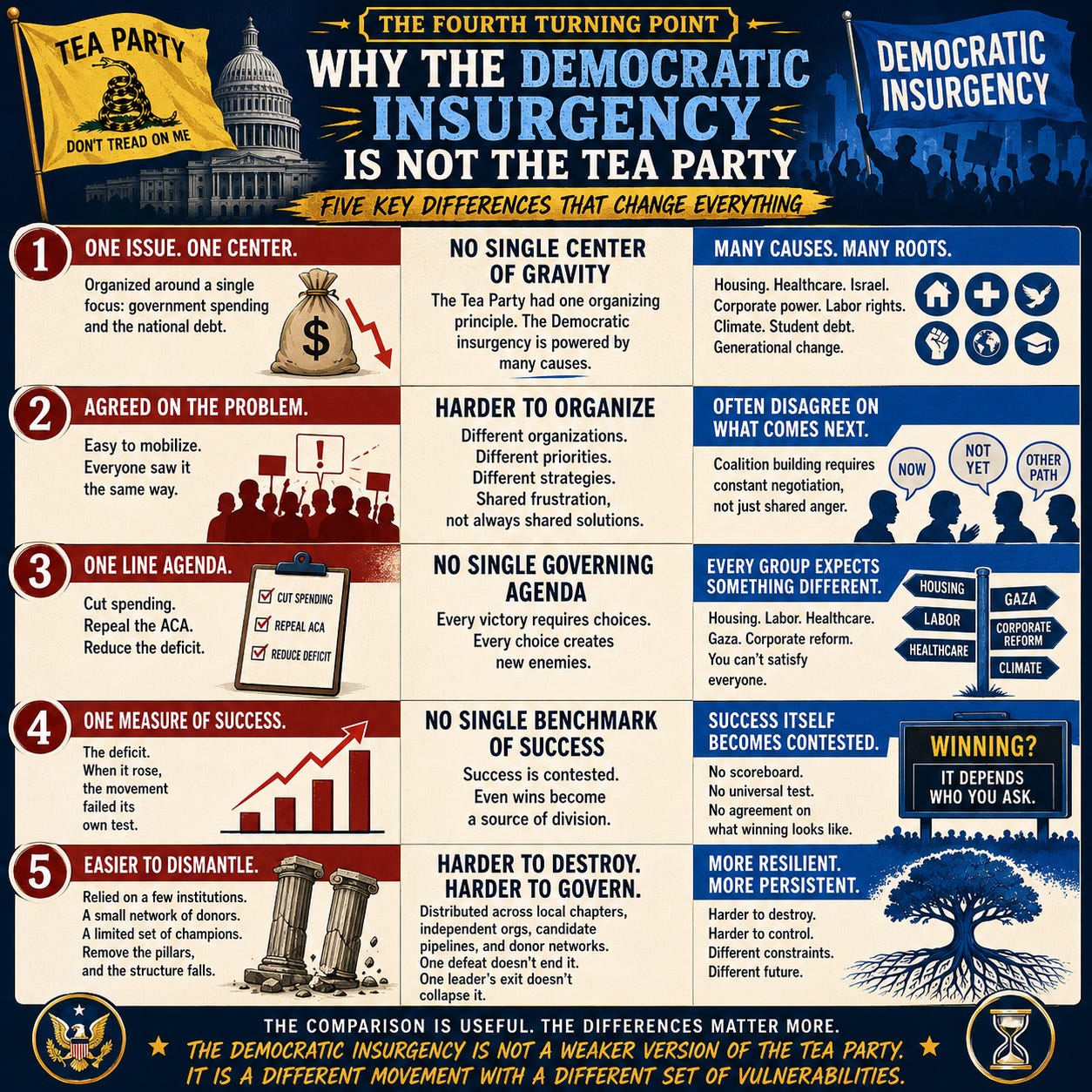
The Democratic insurgency differs from the Tea Party in five important ways.
Those differences explain why the comparison is useful, but incomplete. They also suggest the insurgency’s vulnerabilities will differ from the Tea Party’s rather than simply be weaker.
The Tea Party organized around one dominant issue: government spending and the national debt.
A movement with one organizing principle is easy to mobilize. Everyone shares the same objective. Everyone recognizes failure when the numbers move the wrong way.
It is also easier to capture.
A political leader needs only to embody that single grievance to inherit the movement.
Once Donald Trump successfully channeled the coalition’s frustration, the Tea Party had little to protect its original agenda.
A movement built on fiscal resentment had no principled barrier against a leader who spent more, provided he aimed that resentment at the right targets.
The Democratic insurgency has no equivalent center of gravity.
Housing. Healthcare. Israel.
Corporate power. Labor rights. Climate.
Student debt. Generational change.
Those causes emerged from different organizations and different political histories.
They are united less by a single policy than by dissatisfaction with the current Democratic establishment.
No candidate can fully absorb all of them.
A candidate who leads on Gaza loses housing organizers.
A candidate who leads on housing loses labor.
That diversity also makes the coalition harder to organize.
The Tea Party largely agreed on the problem.
The Democratic insurgency must coordinate organizations that often disagree about priorities, strategy, and timing.
The DSA, Justice Democrats, and Gaza activists may share frustration with the establishment.
They do not always agree on what should come next.
The governing challenge is even harder.
The Tea Party could summarize its legislative agenda in a sentence: cut spending, repeal the Affordable Care Act, reduce the deficit.
The Democratic insurgency cannot.
Housing advocates expect housing legislation.
Labor expects labor reforms.
Healthcare advocates expect healthcare.
Palestine activists expect action on Gaza.
Government requires choices.
Every choice disappoints someone.
The same coalition that defeats incumbents can eventually accuse its own leaders of compromise.
The movement also lacks a single measure of success.
The Tea Party had one.
The deficit.
When deficits rose under Republican presidents, the movement faced a clear test against its own standard.
The Democratic insurgency has no equivalent benchmark.
A housing bill without movement on Gaza satisfies some voters and alienates others.
Healthcare reform without broader corporate reform produces the same divide.
Success itself becomes contested.
Its greatest structural advantage is also its final difference.
The coalition is harder to dismantle.
The Tea Party relied heavily on institutions such as the Heritage Foundation, the Koch network, and a relatively small group of elected champions.
The Democratic insurgency is distributed across local chapters, independent organizations, candidate pipelines, and donor networks.
One defeat does not end the movement.
Removing one leader does not collapse the coalition.
Harder to destroy does not mean easier to govern.
It means the movement will face a different set of constraints.

Every Activist Wants Their Issue First
Every activist wants their issue at the top of the agenda.
Every member of Congress represents a different district.
Every Speaker counts votes, not slogans.
Committee chairs protect their jurisdictions. Moderates protect their seats. Presidents eventually run into appropriators, parliamentarians, and a legislative calendar that moves far more slowly than any campaign.
The movement’s language is built for elections.
Fight.
Demand.
Refuse to compromise.
Those messages win primaries.
Legislation works differently.
The votes that pass a bill are usually the votes that require compromise.
The member who refuses to compromise rarely has to explain an unpopular deal.
The member who makes it does.
That member faces the next primary defending the very concessions that made the legislation possible.
Governing rewards behavior that movements often describe as betrayal.
Winning Elections and Governing Are Different Professions
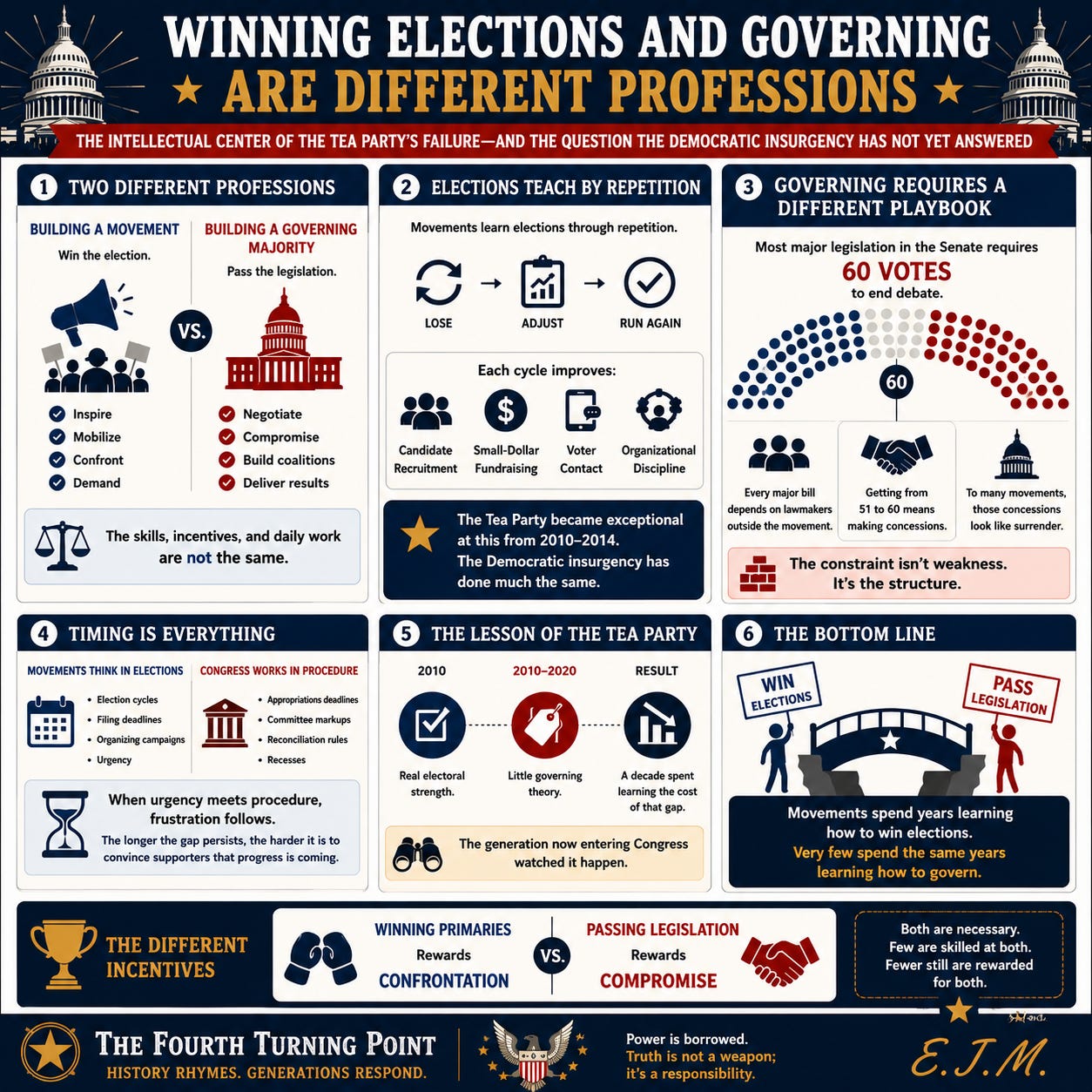
This is the intellectual center of the Tea Party’s failure.
It is also the question the Democratic insurgency has not yet answered.
The skills required to build a movement are not the same as the skills required to build a governing majority.
The skills required to build a governing majority are not the same as the skills required to keep one together once compromise begins.
An organizer who builds a canvassing operation in Brooklyn needs different abilities than the senator negotiating a housing bill through the Senate Banking Committee.
Both matter.
Political movements rarely develop both at the same time because the incentives point in opposite directions.
Winning primaries rewards confrontation.
Passing legislation rewards compromise.
Movements learn elections through repetition.
They lose. They adjust. They run again.
Each cycle improves candidate recruitment, small-dollar fundraising, voter contact, and organizational discipline.
The Tea Party became exceptionally effective at those skills between 2010 and 2014.
The Democratic insurgency has done much the same over the past decade.
Those are real capabilities.
Governing demands a different body of knowledge.
Most major legislation in the Senate requires 60 votes to end debate. Neither party has held 60 seats since 2009.
Every major bill depends on lawmakers whose districts, donors, and political incentives differ from the movement’s.
Getting from 51 votes to 60 means making concessions to people outside the coalition.
For many movements, those concessions look like surrender.
The constraint is structural.
Timing creates another problem.
Movements think in election cycles, filing deadlines, and organizing campaigns.
Congress works through appropriations deadlines, committee markups, reconciliation rules, and recesses.
A movement built on urgency eventually collides with an institution built on procedure.
The longer that gap persists, the harder it becomes to convince supporters that progress is coming.
The Tea Party entered 2010 with real electoral strength and very little governing theory.
It spent the next decade discovering the cost of that gap.
The generation now entering Congress watched it happen.
Movements spend years learning how to win elections.
Very few spend the same years learning how to govern.
Three Forecasts
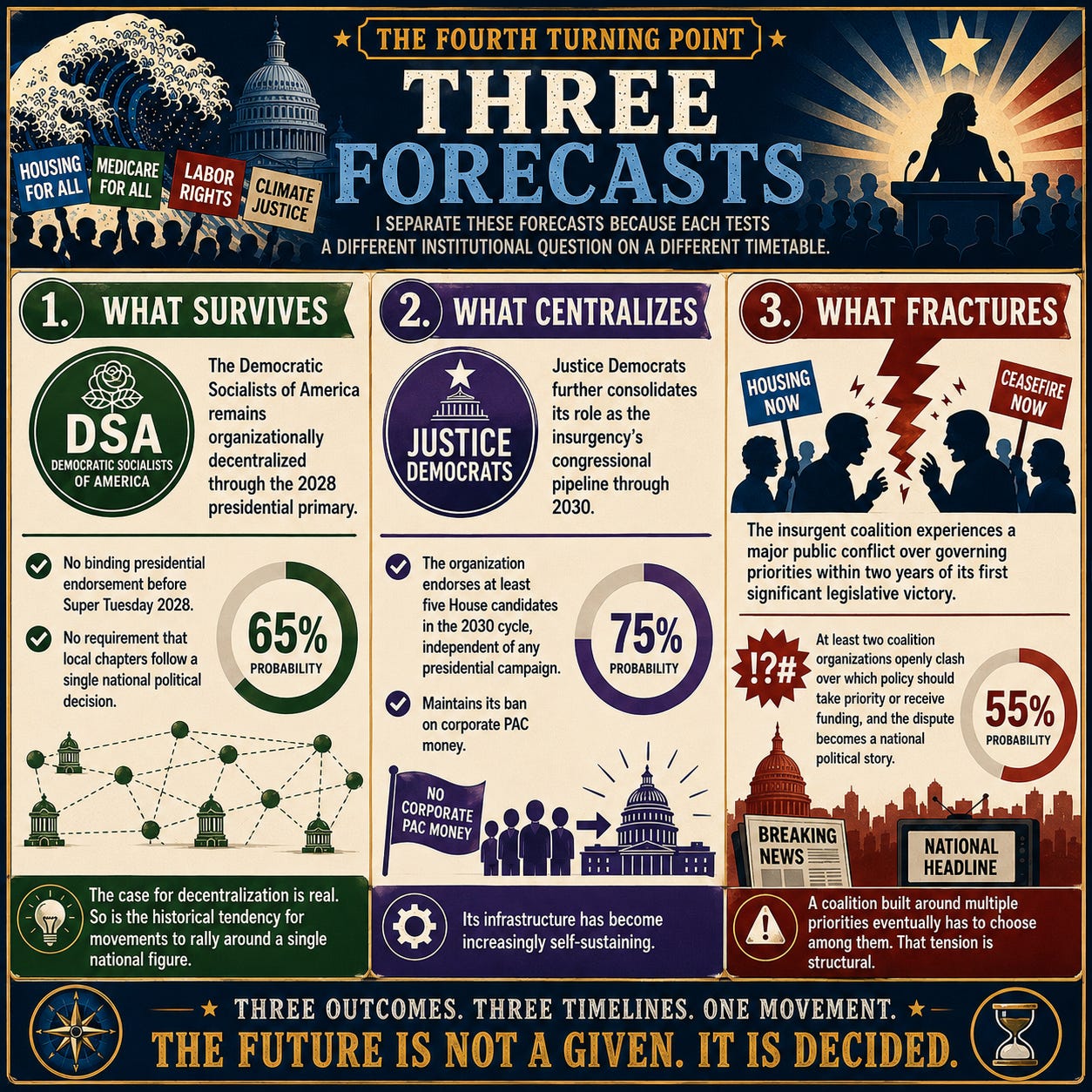
I separate these forecasts because each tests a different institutional question on a different timetable.
What survives
The Democratic Socialists of America remains organizationally decentralized through the 2028 presidential primary.
No binding presidential endorsement before Super Tuesday 2028. No requirement that local chapters follow a single national political decision.
Probability: 65%
The case for decentralization is real.
So is the historical tendency for movements to rally around a single national figure.
What centralizes
Justice Democrats further consolidates its role as the insurgency’s congressional pipeline through 2030.
The organization endorses at least five House candidates in the 2030 cycle, independent of any presidential campaign, while maintaining its ban on corporate PAC money.
Probability: 75%
Its infrastructure has become increasingly self-sustaining.
What fractures
The insurgent coalition experiences a major public conflict over governing priorities within two years of its first significant legislative victory.
At least two coalition organizations openly clash over which policy should take priority or receive funding, and the dispute becomes a national political story.
Probability: 55%
A coalition built around multiple priorities eventually has to choose among them.
That tension is structural.
Ashland, 2018
Dave Brat defeated Eric Cantor on June 10, 2014, proving that no incumbent is safe once a movement decides it no longer needs them.
He served two terms.
He opposed the American Health Care Act in committee because it did not go far enough. He later voted for the House version.
It failed.
On November 6, 2018, Abigail Spanberger defeated Brat by roughly 6,800 votes.
Every movement eventually teaches its successors how to overthrow it.
The template never has a permanent owner.
E.J.M. — The Fourth Turning Point
Next: Episode IV — The Children of Two Failures
The Tea Party won and forgot to govern. The Democratic insurgency lost and learned to organize. The generation entering Congress inherited both mistakes, and both advantages.
If you value evidence over outrage and depth over headlines, become a pledged paid subscriber.
The next phase of this project will go far beyond the public essays.
By pledging now, you’ll be first in line when paid subscriptions launch, with access to deeper research, exclusive analyses, and more detailed long-term forecasts that don’t fit into a single article.
Let's hope the DSA has as little success implementing its agenda as the Tea Party did.
I'd say the one plank of their platform that did come to fruition was their immigration stance.