
The Wall Held
Colombia chose Abelardo de la Espriella by less than a point. My forecast was right about the shape and wrong about one number. And the side I opposed won fairly.

The Fourth Turning Point — June 23, 2026
The Result
Abelardo de la Espriella is the president-elect of Colombia.
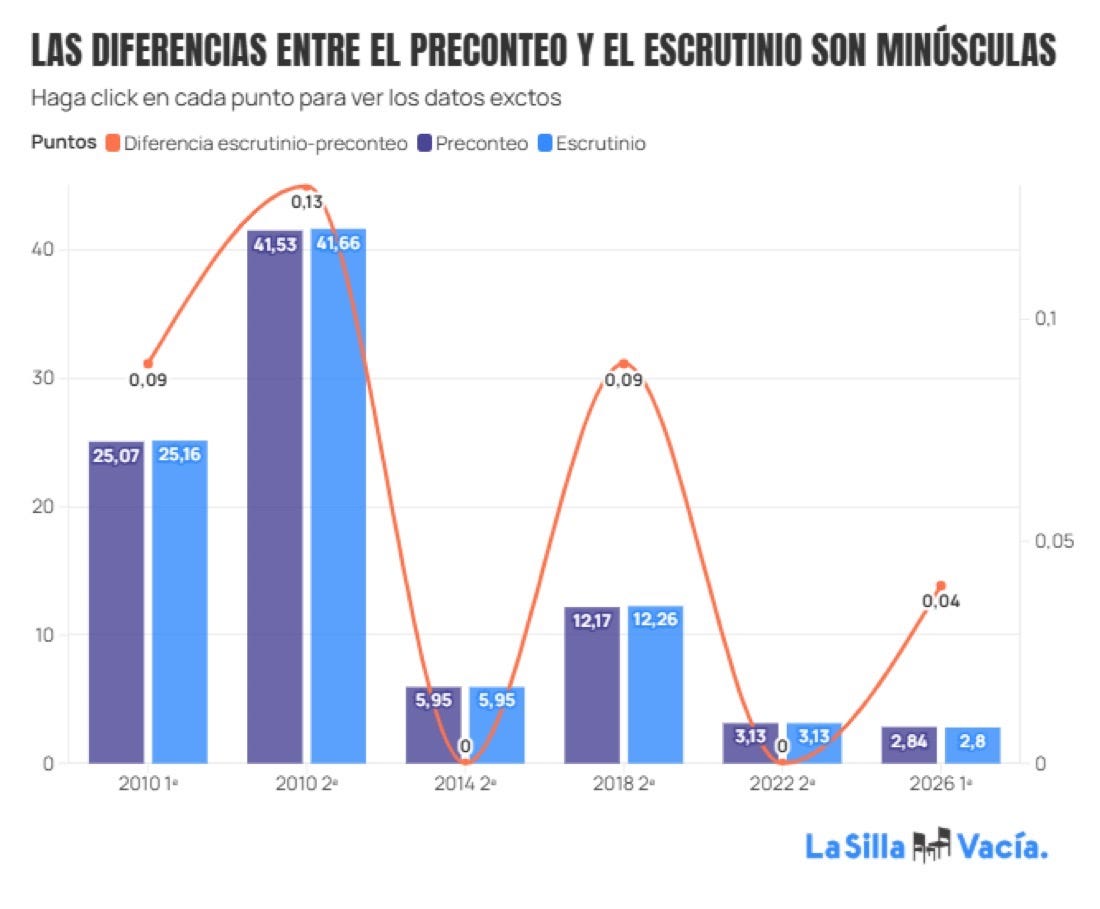
PRECONTEO (~100% reporting)
Abelardo de la Espriella 12,959,542 49.66%
Iván Cepeda 12,708,712 48.70%
Margin: +250,830 (+0.96 pts)
Turnout: 63.48%, the highest runoff turnout in Colombian history
The closest presidential runoff by percentage in Colombian history occurred on the highest-turnout runoff ever recorded.
Trump posted “He Won, Big!” within hours.
Rubio and Israeli Foreign Minister Gideon Sa’ar quickly followed with congratulations.
International recognition is moving faster than certification.

The Election in One Sentence
Colombia did not deliver a landslide, a revolution, or a realignment. It delivered a verdict.
In the highest-turnout runoff in its history, security concerns outweighed continuity concerns by less than one percentage point. The electorate split almost perfectly in half and chose change by 250,000 votes.
Every other story begins there.
The escrutinio.
The allegations.
The forecast.
The mandate problem.
The Escrutinio Question
The legal result comes from the escrutinio, the judicial count, not the preconteo. Cepeda is challenging 33,000 of 122,000 tables and says he will accept whatever it produces. The question is whether it can move 250,000 votes.
The strongest counterargument comes from the 2022 legislative count, where scrutiny shifted roughly 400,000 votes. The comparison is weak. Legislative elections involve thousands of candidates and error-prone forms; a presidential runoff is a simple comparison between two candidates at each table.
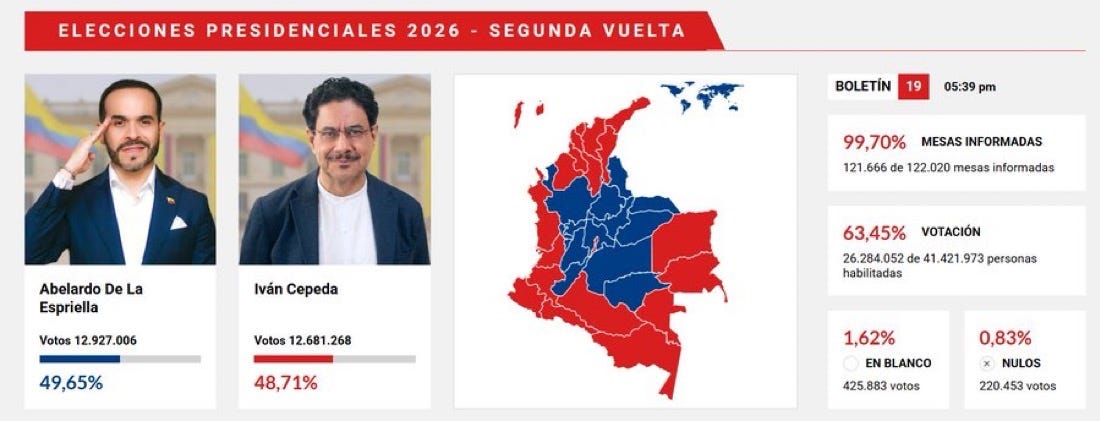
La Silla Vacía found that the largest presidential preconteo-to-escrutinio shift since 2010 was 0.13 points. Cepeda needs roughly ten times that.
Certification remains the most likely outcome.
The greater risk is not a reversal, but a result that much of the losing side refuses to accept.
The Allegations
Three categories of allegations are circulating. They should not be treated as the same thing.
Grounded
Vote-buying in northern departments · employer pressure on workers · reports that the count’s software vendor met with Abelardo de la Espriella earlier this year
Procedural
Lawyers denied access at Corferias · unsigned E-14 forms
Speculative
Petro’s claim that changes in server IP addresses prove Israeli involvement in the election
The grounded allegations deserve investigation.
The procedural allegations require transparency from electoral authorities but, on the evidence available, do not appear capable of changing the outcome.
The speculative allegations have no public evidence behind them.
None of them explain the result itself.
For that, you have to look at the map.
Where It Was Won
The election was decided in two departments.
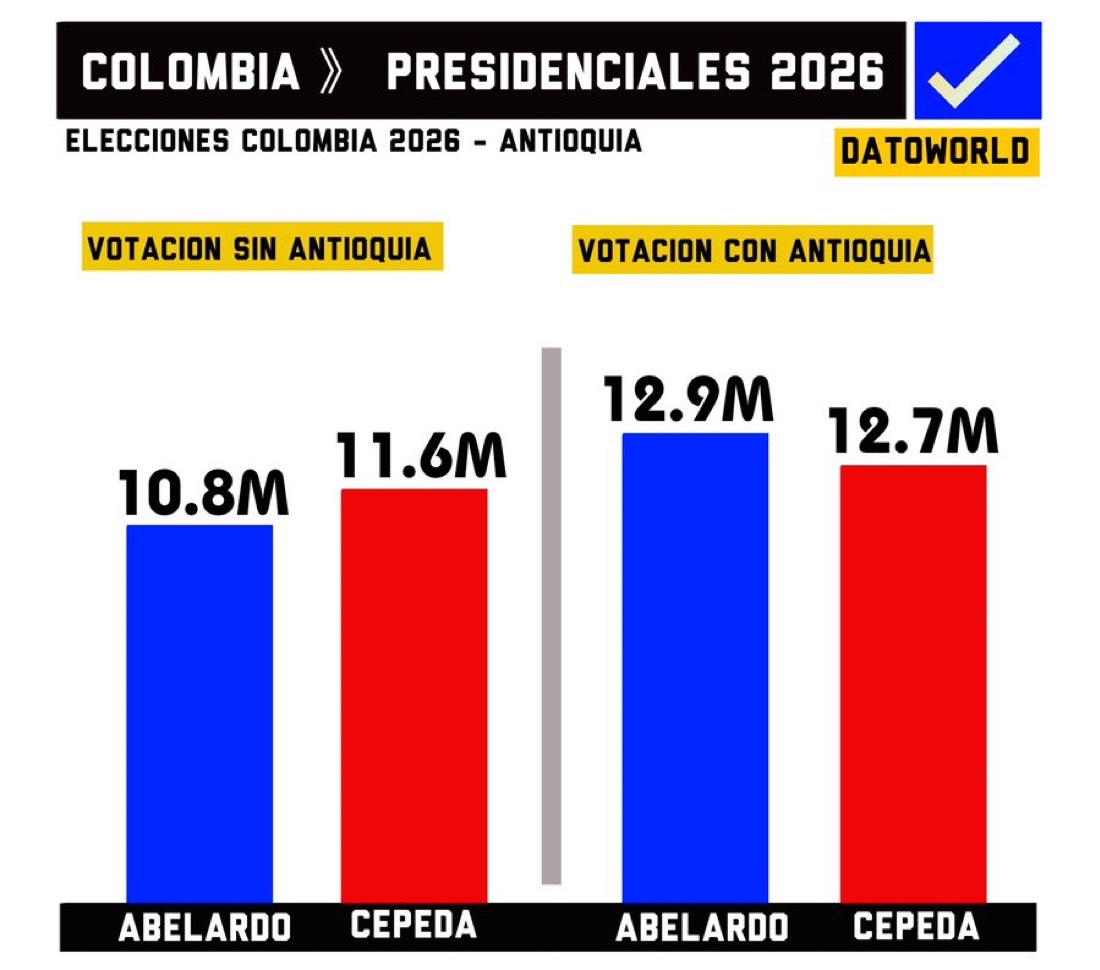
Antioquia (net right)
2022: +880,695 → 2026: +1,052,153 (+171,000)
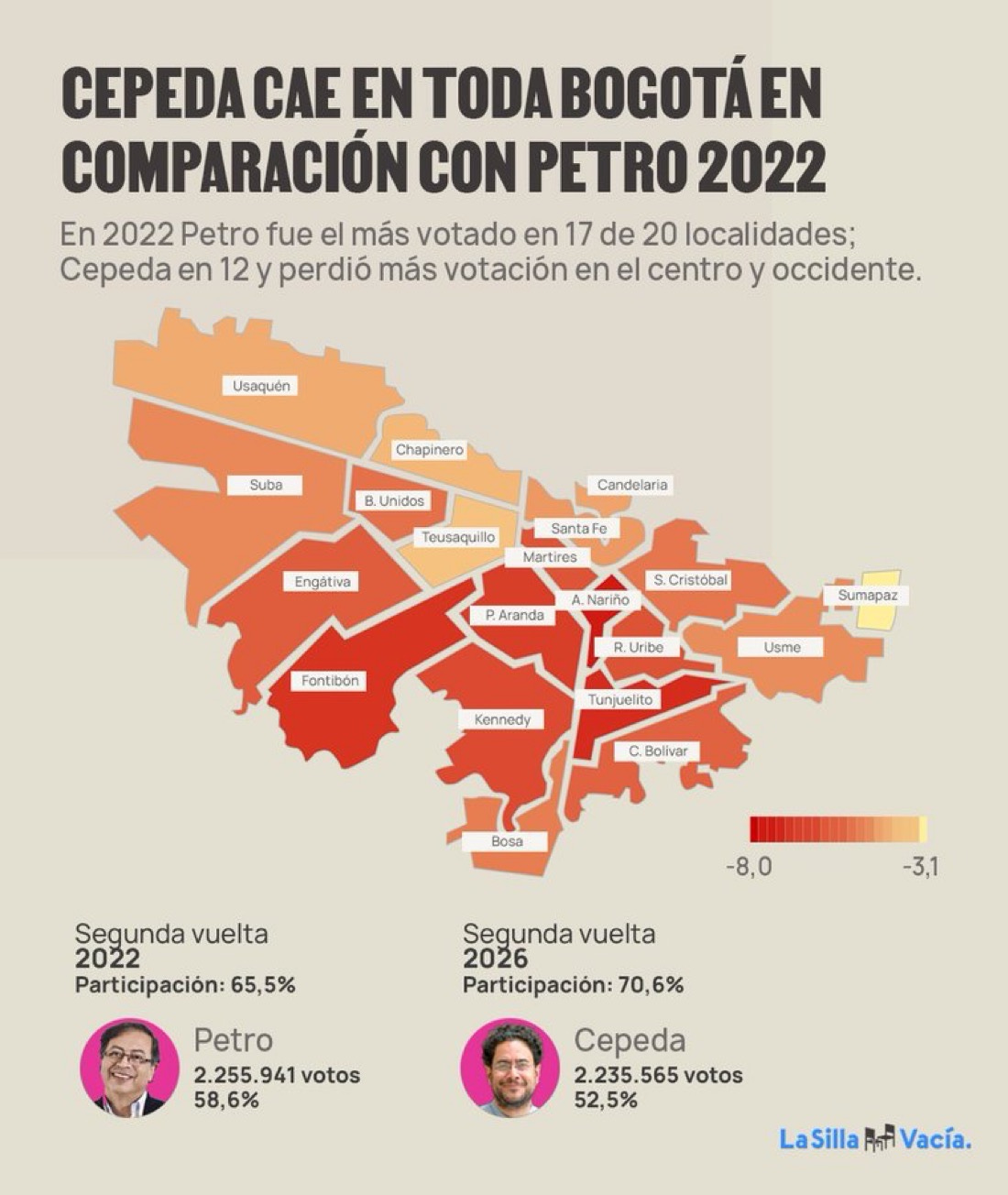
Bogotá (net left)
2022: +773,799 → 2026: +302,271 (−471,000)
The right gained roughly 171,000 votes in Antioquia.
The left lost roughly 471,000 in Bogotá. Together, those shifts produced a swing of about 640,000 votes, more than two and a half times the national margin.
Cepeda still carried the capital.
Bogotá simply mattered less than it did four years ago.
The election was won in Antioquia.
The defeat began in Bogotá.
The regional divide was stark.
Nariño voted 76.7% for Cepeda. Norte de Santander voted 76.6% for De la Espriella. Nearly identical margins pointed in opposite directions and largely canceled each other out.
De la Espriella carried much of the interior and the diaspora, winning 63.79% of the overseas vote. Cepeda carried the Pacific, the Amazon, and most of the Caribbean coast.
Only two departments changed hands from the first round.
The map barely moved.
The electorate did.
The paradox is that Cepeda expanded the left’s coalition.
He gained 3.02 million votes between rounds, compared with 2.60 million for De la Espriella. His final total of 12.71 million votes is the largest left-wing presidential vote in Colombian history.
It still was not enough.
De la Espriella entered the runoff with a 673,000-vote lead, and many of the left’s strongest margins came from less populous regions.
Petro leaves office having failed to elect a successor while presiding over the largest left-wing vote total the country has ever seen.
The Forecast, Audited
I published this forecast with falsifiable numbers and a promise: the audit would run either way.
Forecast
Abelardo de la Espriella 50.9% · Iván Cepeda 49.1% ·
Win probability 55%
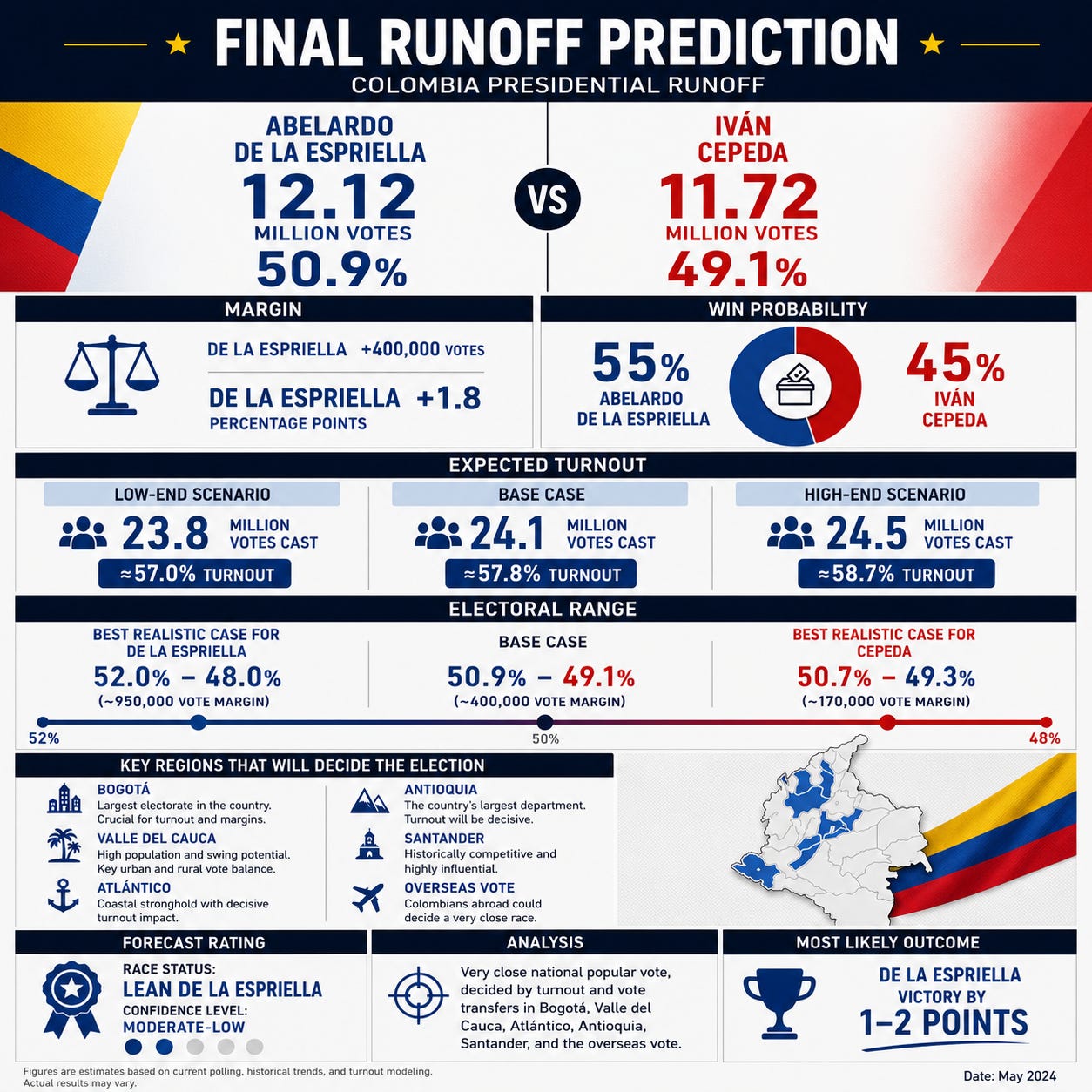
Result
Abelardo de la Espriella 49.66% · Iván Cepeda 48.70%
What the forecast got right
The winner.
The direction of the race.
The margin, within a point.
The mechanics.
Antioquia proved decisive. Bogotá was insufficient. The overseas vote broke heavily for De la Espriella.
The election became a turnout battle on a largely frozen map.
What it got wrong
The margin.
I projected a victory of roughly 400,000 votes.
The actual margin was about 250,000.
The probability was also too low.
I published 55% because late poll tightening pulled my range toward Cepeda. The stronger signal was the one I had already identified: the Antioquia wall.
The lesson for the next forecast is straightforward. Geography moves more slowly than headlines. The final week can change perceptions.
The map usually decides the result.
This time, it did.
Against the field, this publication’s 0.84-point margin error was the smallest. Atlas and Guarumo missed by roughly 6–7 points, while CELAG called the wrong winner.
The polls identified the winner.
They missed the margin.
What I Owe You
I covered this race against my own preference, and I said so before the vote, not after.
I disagreed with Cepeda on economics and wrote it plainly. My objection to De la Espriella was different. I saw a politics built on confrontation and contempt for institutions that constrain power.
Colombia heard all of it and chose him anyway.
The forecast was not bent by what I wanted.
I preferred Cepeda.
Had I allowed that preference to shape the analysis, I would have projected a Cepeda victory or a far tighter race.
I did neither.
The evidence pointed to De la Espriella, so that was the call. I held it through a tightening race and, if anything, overstated his margin. I expected him to win by more than he did.
My largest error ran against my preference, not toward it.
That is the purpose of a forecasting system.
It exists to constrain the forecaster.
If it cannot do that when the stakes become personal, it has little value.
The election itself was clean.
Turnout reached a record level.
Results were published within an hour. The largest observer mission in Colombian history was on the ground. No public evidence supports Petro’s claim that foreign actors manipulated the outcome.
A majority of voters looked at the same candidate I documented and chose him.
That is a verdict.
It went against my reading of the country’s interests.
It remains a legitimate result.
Calling an election illegitimate because I dislike the winner is the habit I have spent this series criticizing in others.
I will not adopt it now.
So I hold two conclusions at once.
The count was clean.
The concerns I raised during the campaign remain.
De la Espriella’s victory does not change my assessment of his politics. His victory also does not make his presidency illegitimate.
The campaign is over.
The documentation of what he does with power begins now.
The Constraint

Electoral victory is not a governing mandate, and Colombia has rarely offered a clearer example.
De la Espriella won with less than 50 percent of the vote, by less than one point, in a race defined by record turnout. He also enters office without control of Congress.
His movement holds only a small presence in the legislature. Cepeda’s Historic Pact remains the largest bloc in both chambers, including 26 Senate seats.
His response has been to propose governing around those constraints: 90 decrees on day one, dismantling the JEP, ending the peace process, reducing the size of the state by 40 percent, and threatening extradition proceedings against Petro and other Historic Pact figures.
The central question of this presidency is no longer whether De la Espriella can win an election.
He just did.
The question is whether a president elected by 0.96 points can govern as though he won by twenty.
That is the central tension of the next four years.
A narrow victory governing through decrees runs directly into the Constitutional Court, a divided legislature, and an opposition that remains nearly as large as the coalition that defeated it.
The mandate he projected and the mandate he received are different documents.
What This Was
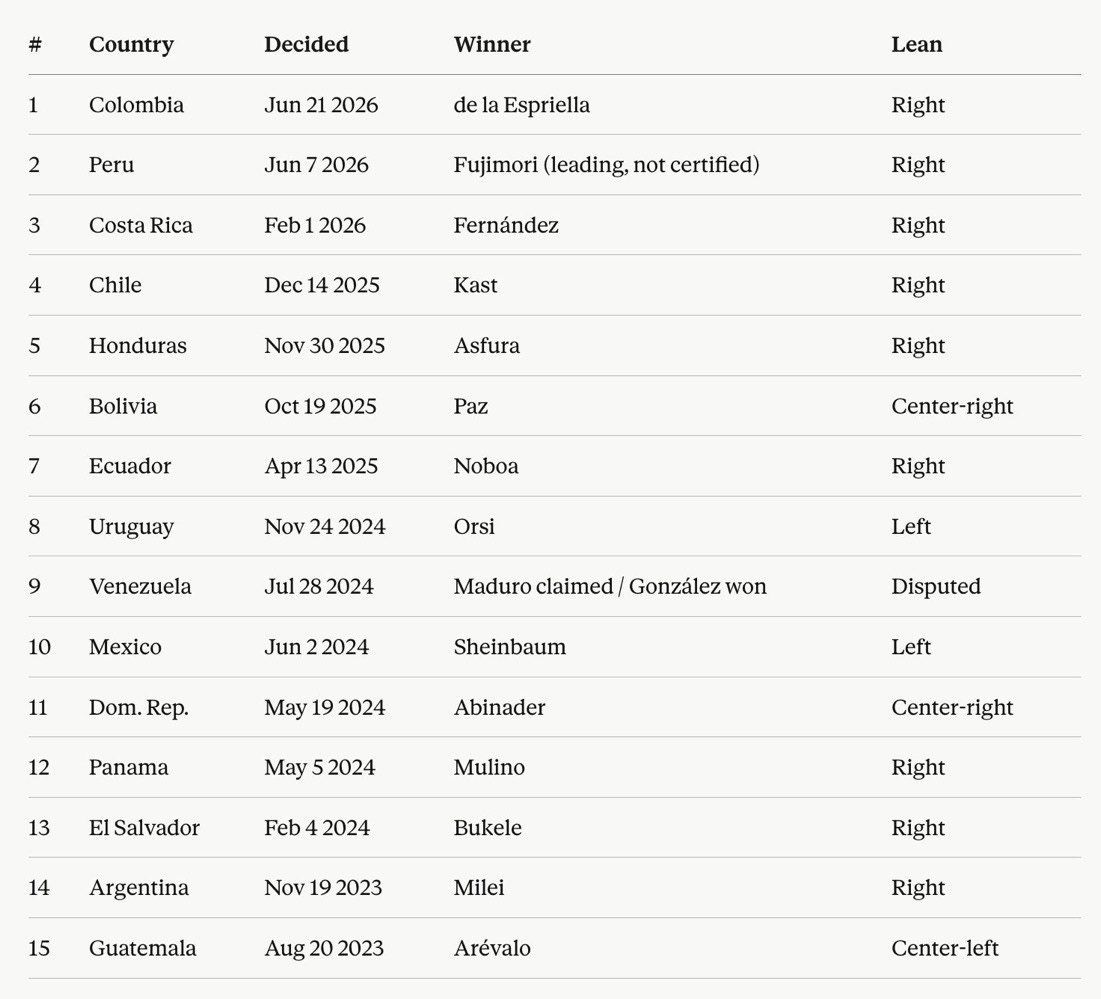
The closest historical analogue is a security election.
Voters did not suddenly become more conservative.
They became more dissatisfied, and the distinction matters.
Colombia is the seventh consecutive Latin American election to produce a rightward shift in government. Yet Latinobarómetro still places the country at 5.3 on the ideological scale, close to the regional center.
This election looks more like polarization than realignment.
Two established coalitions collided.
One finished 250,000 votes ahead.
The country split almost evenly in half.
Whether this pattern reflects a lasting regional realignment or a cycle of anti-incumbent voting driven by security concerns and inflation remains an open question. I lean toward the latter. The series capstone will examine that question directly.
For tonight, the simpler conclusion is enough: Colombia changed governments without changing countries.
After the Vote
I said the accountability record would be published whether the forecast was right or wrong.
Here it is.
The forecast was largely correct.
The probability estimate was not.
The error ran toward the candidate I preferred.
The man I documented and opposed won a clean election by less than one point.
Every part of that sentence is true.
A country turned out at 63.48 percent, split almost perfectly in half, and chose change by 0.96 points.
Every interpretation that follows has to begin there.
Colombia has chosen.
The count is ending.
The argument over what the count means is only beginning.
— E.J.M. The Fourth Turning Point
June 23, 2026
Wow!! This is great! Incredibly complete with explanations and a serious attempt to be non biased! Okay, I'm hooked and am going to be on the lookout for future predictions and then run to Polymarket and place my bet! Thx!!
I hope President-elect Abelardo de la Espriella recognizes that his mandate is weak and governs accordingly.
It is unfortunate that right wingers such as Abelardo de la Espriella support Zionist ethnic cleansing, apartheid, systemic human rights abuses and serial war crimes. It suggests that Abelardo de la Espriella does not believe in sanctity or wisdom of well-defined, secure and enforceable economic property rights. I know, I know. All those Chicago school property right economists are communists......
It also suggests that rather attempting to coopt the guerrilla in the countryside, Abelardo de la Espriella will actually make them more determined than ever to keep up the violent struggle against the Colombian state.
Why are hard right Latin American politicos such big boludos?