
THE REAL DEMOCRATIC AUTOPSY
The Institutional Failures That Handed Trump 2024
THE FOURTH TURNING POINT
May 21 2026
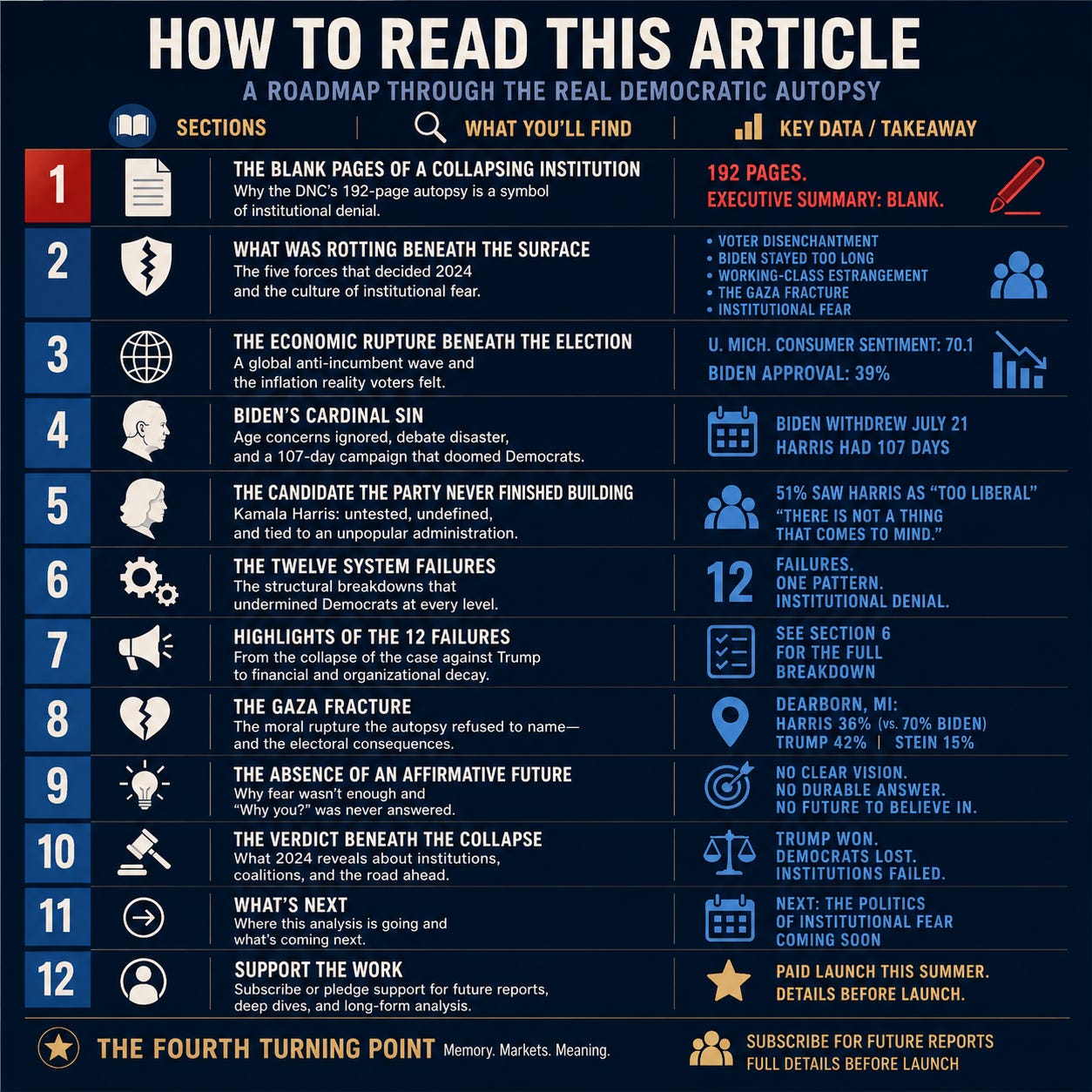
The Blank Pages of a Collapsing Institution
On May 21, 2026, the Democratic National Committee released 192 pages.
The executive summary was blank.
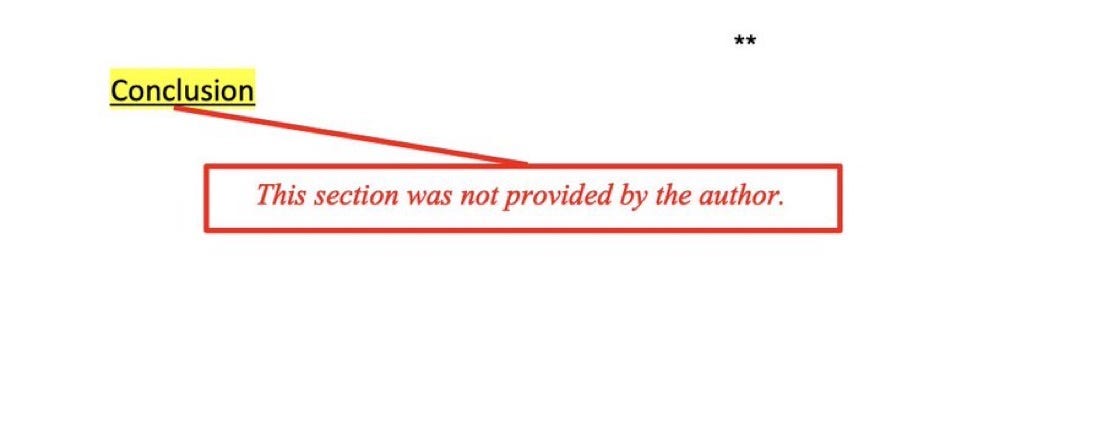
The conclusion section was blank.
Every page carried a disclaimer stating the DNC could not independently verify the claims inside its own document.
The author declined to comment.
The chairman apologized on a conference call.
This is what happens when an institution can no longer face itself honestly.
A real autopsy names the people who made the decisions. It follows the evidence wherever it leads, including back toward the people who commissioned the report.
It says what no one in the room wants to hear.
I am a registered Republican who voted for Kamala Harris.


I have written extensively about what I believe the Republican Party is becoming, what it is getting wrong, and what it would need to become again to earn back my vote and the votes of millions of Americans like me.


I have no institutional interest in protecting either party.
That gives me a vantage point most analysts will not use.
This is the document the Democratic Party refused to write.
What Was Rotting Beneath the Surface
The purpose is two-fold:
to document why Democrats lost and to explain why the party’s leadership structure proved incapable of stopping the collapse even while watching it happen in real time.
Five forces decided 2024.
Voter Disenchantment
Harris lost 6.8 million voters who had supported Biden in 2020. In a race Trump won nationally by 2.4 million votes, and by only 761,000 combined across seven swing states, that collapse was decisive.
Biden’s Decision to Stay
Biden’s refusal to leave the race until July 21 eliminated the possibility of a real primary, froze the party in paralysis for months, and handed Harris a 107-day campaign with no preparation beneath it.
Working-Class Estrangement
The Democratic Party spent years drifting away from the language, instincts, and priorities of working-class voters while assuming demographic trends would compensate for cultural distance.
The Gaza Fracture
The party treated one of the largest moral and political ruptures inside its coalition as a messaging inconvenience rather than a genuine crisis of trust.
Institutional Fear
The deepest problem underneath all of it:
leaders increasingly protecting institutions, careers, donor networks, and coalition management instead of confronting obvious reality.
That final point matters most because it explains nearly everything else.
The silence around Biden’s condition.
The refusal to challenge losing strategies.
The consultant culture.
The inability to adapt.
The blank executive summary.
The fear of dissent.
The fear of saying what voters were already saying out loud.
The modern political establishment increasingly protects itself before it protects truth.
That is all the real story of 2024.
The Economic Rupture Beneath the Election
Before naming a single strategic failure, one foundational reality must be established.
2024 was a severe global anti-incumbent cycle.
The United Kingdom’s governing party suffered one of the worst defeats in British political history. France’s coalition collapsed. Canada’s Liberal Party fractured after a decade in power. Germany’s incumbent coalition failed.
Across nearly every major democracy, voters delivered the same verdict: whoever governed during the inflationary period would pay for it politically.
The University of Michigan Consumer Sentiment Index sat at 70.1 under Biden. Every president above 82 since Jimmy Carter has won reelection.
Biden’s approval rating was 39 percent.
These were not close calls.
The Biden administration repeatedly cited falling inflation rates as evidence of economic success. But inflation measures the rate at which prices increase, not the prices themselves. When inflation slows, prices do not return to their previous levels.
Families still pay the new price.
Voters understood this instinctively.
They experienced it every week:
groceries,
rent,
gas,
insurance,
childcare,
utilities.
Prices normalized statistically.
They never normalized psychologically.
That was the floor Democrats entered 2024 standing on.
Everything built on top of it made the situation worse.
Biden’s Cardinal Sin
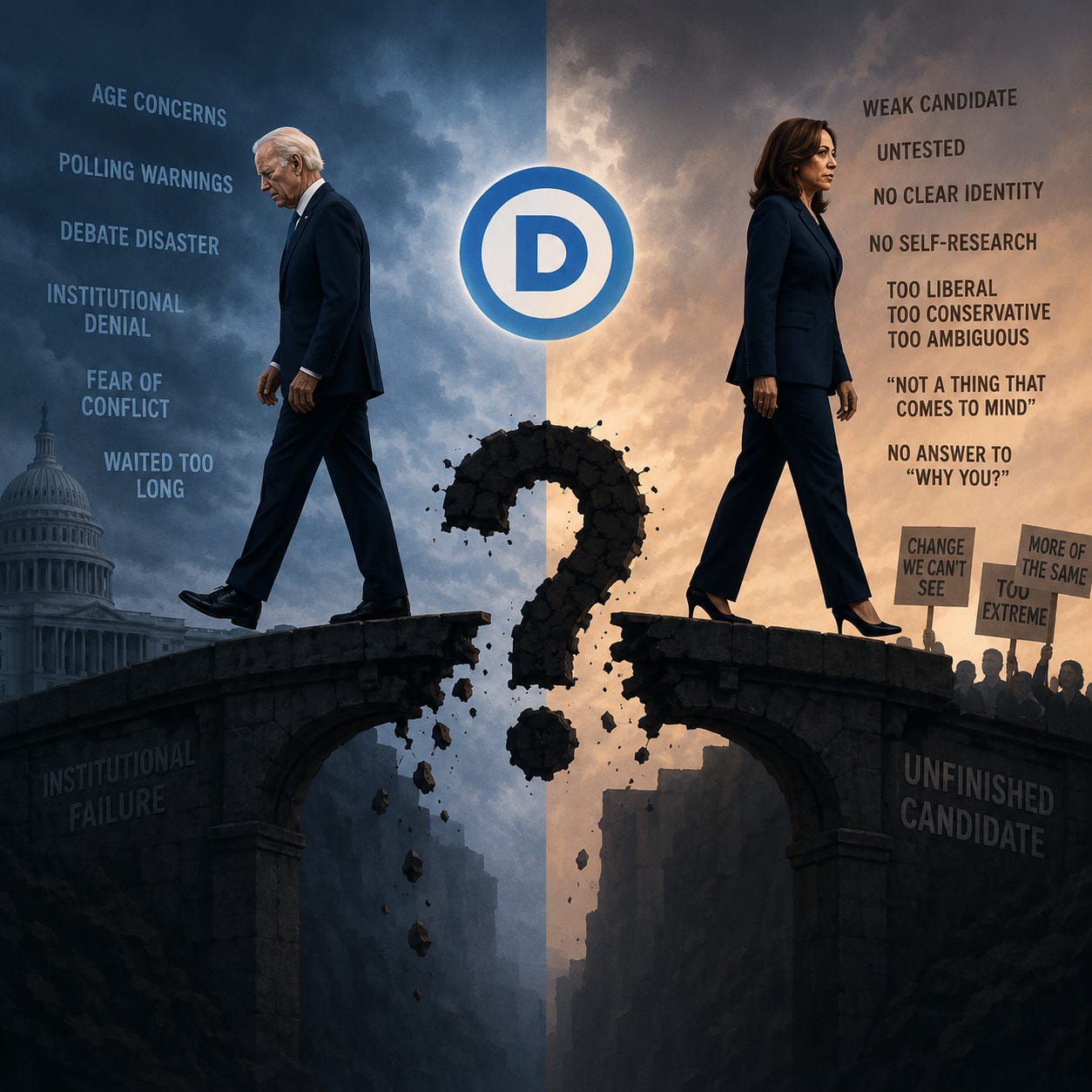
The word “age” does not appear once in the DNC’s 192-page autopsy.
Not once.
That omission alone tells you more about the party’s institutional psychology than any polling memo ever could.
Biden was 78 at inauguration, already older than Reagan had been when leaving office.
Concerns emerged publicly as early as 2022, when Representative Dean Phillips became the first Democratic member of Congress to openly suggest Biden should not seek reelection.
He was ridiculed for it.
Privately, many Democrats agreed with him.
By February 2024, 86 percent of voters said Biden’s age and health were major or moderate concerns. Special counsel Robert Hur described Biden as “an elderly man with poor memory” whose recollections “appeared to have significant limitations.”
The party saw all of this.
Its institutional response was denial.
Then came the June 27 debate.
Biden appeared confused, exhausted, unfocused, and physically diminished. He lost his train of thought repeatedly. He froze behind the podium. He struggled to complete arguments.
The political system instantly recognized what it was seeing.
The Democratic leadership class responded by pretending it had not happened.
Obama defended him.
Clinton defended him.
Newsom defended him.
Schumer defended him.
Harris defended him.
What followed was institutional self-preservation.
The defining political emotion of the modern establishment is fear:
fear of internal conflict,
fear of donor backlash,
fear of media panic,
fear of coalition instability,
fear of appearing disloyal,
fear of losing status inside the machine.
So everyone waited.
By the time Biden withdrew on July 21, after more than 30 Democratic members of Congress publicly called on him to step aside, the damage was irreversible.
That left Harris 107 days.
David Plouffe later called Biden’s prolonged candidacy the “cardinal sin” of the cycle. Nancy Pelosi admitted there likely would have been other candidates had Biden exited earlier.
But the deeper institutional failure preceded the withdrawal itself.
The White House commissioned polling before the 2022 midterms on how Jill Biden could best help the president politically.
No equivalent self-research was conducted on Kamala Harris in three and a half years.
The DNC autopsy acknowledged this directly:
At the moment Biden exited, the polling team discovered there was “no self-research on the Vice President.”
Three and a half years.
No preparation.
No political identity construction.
No succession planning.
No serious institutional investment in the person most likely to inherit the party.
That is a governing institution incapable of preparing for reality because acknowledging reality threatened the existing hierarchy.
The Candidate the Party Never Finished Building
Kamala Harris was a weak presidential candidate placed inside an almost impossible political situation.
Both things are true simultaneously.
Her political weaknesses were visible long before 2024:
inconsistent ideological identity,
weak voter connection,
difficulty sustaining a coherent rationale for her candidacy,
and inability to establish durable public definition.
Those weaknesses were submerged beneath Biden’s presidency until they resurfaced all at once.
Her California political history repeatedly hinted at the same structural problem. In 2010, despite a strong Democratic environment statewide, she barely won the attorney general race against a relatively weak Republican opponent. In 2019, after a breakout debate moment briefly elevated her campaign, her support collapsed within months because voters still struggled to understand what larger political identity anchored her candidacy.
Was she a progressive prosecutor?
A pragmatic liberal?
A technocratic institutionalist?
A post-Obama coalition candidate?
The answer changed depending on the audience and moment.
That ambiguity became survivable inside an administration.
It became fatal inside a presidential election built around economic frustration and demand for clarity.
Harris entered the race:
untested by a primary,
tied to an unpopular administration,
unable to separate herself from Biden without appearing disloyal,
and carrying positions from 2020 she could not credibly renegotiate without a real nomination process.
In September 2024, Gallup found 51 percent of voters viewed her as “too liberal.”
Her defining political moment came on The View, when she was asked what she would have done differently from Biden.
Her answer:
“There is not a thing that comes to mind.”
That moment became fatal because it confirmed what swing voters already suspected:
she represented continuity in an election defined by dissatisfaction.
The campaign never resolved the most basic question presidential candidates must answer:
Why you?
Not why Trump is dangerous.
Not why democracy matters.
Not why the other side is worse.
Why you?
The campaign never found a durable answer.
The Twelve System Failures
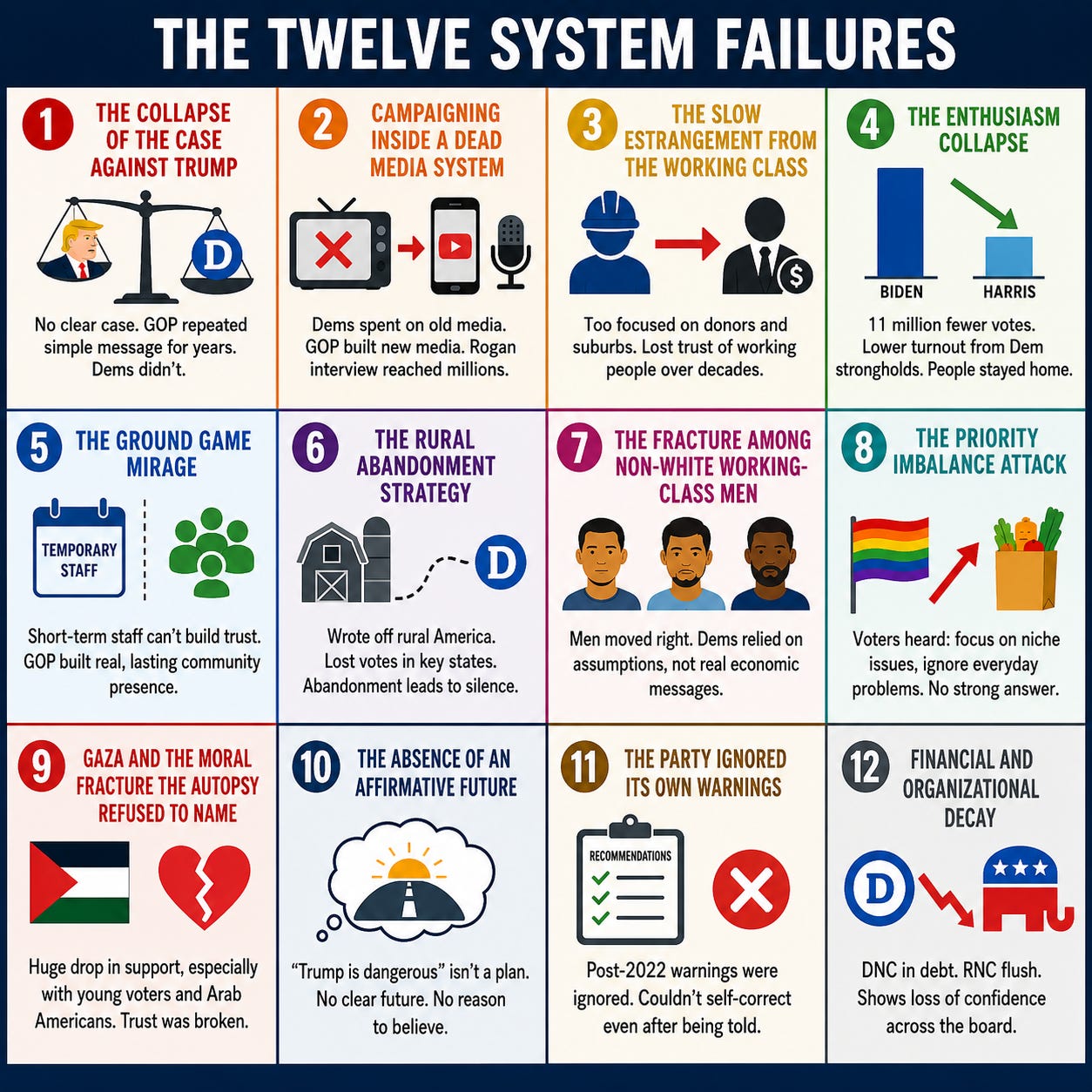
1. The Collapse of the Case Against Trump
Democrats assumed Trump’s negatives were permanent and self-executing.
They were wrong.
Republicans spent four years repeating a simple economic message across every platform available. Democrats raised a billion dollars and never developed an equally disciplined case against Trump’s first-term record.
The arguments existed.
The repetition did not.
Political memory decays without reinforcement.
2. Campaigning Inside a Dead Media System
Roughly $850 million went toward traditional media buys.
Roughly $150 million went toward voter contact and organizing.
Republicans built a permanent media ecosystem:
podcasts,
YouTube networks,
influencers,
streamers,
decentralized digital communities.
Democrats continued campaigning as if persuasion still primarily lived inside television advertising.
Joe Rogan’s interview with Trump reached tens of millions of people.
Harris declined a similar appearance.
That decision symbolized something larger:
the party’s inability to understand where modern political culture actually forms.
3. The Slow Estrangement From the Working Class
The problem accumulated over decades.
The Democratic Party increasingly became:
donor-funded,
consultant-managed,
culturally professionalized,
and linguistically disconnected from non-college workers.
The campaign prioritized suburban anti-Trump Republicans while its relationship with working-class voters deteriorated further.
Internal campaign analysis later showed terms like:
“living wage,”
“union jobs,”
“affordable housing,”
and “paid leave”
largely disappeared from speeches after Labor Day.
Policy alone could not repair the erosion.
Trust had already deteriorated.
Millions of working-class voters no longer believed Democrats genuinely prioritized their material concerns over donor relationships and coalition branding exercises.
2024 was where the accumulated distrust became measurable.
4. The Enthusiasm Collapse
Harris received 11 million fewer votes than Biden.
Independent voters turned out at higher rates than registered Democrats for the first time in two decades.
Counties that produced Biden’s largest margins delivered dramatically lower turnout for Harris.
Millions of people looked at the election and concluded:
Neither side represented them enough to justify participation.
That dynamic is significantly more dangerous for a political party than ordinary vote-switching.
5. The Ground Game Mirage
The Democratic Party outsourced organizing infrastructure to independent groups and seasonal operations.
The result was activity without rootedness.
Conservative organizations built long-term presence inside communities:
churches,
schools,
local events,
youth networks,
digital spaces.
Democratic organizing increasingly became temporary staffing.
Organizing is relational.
You cannot build durable trust through temporary deployment.
6. The Rural Abandonment Strategy
The campaign effectively conceded large parts of rural America before the election began.
That strategy compressed Democratic margins in key states below survivable levels.
Rural voters are not monolithic Republicans.
Many voted twice for Obama.
Voters who are treated as unreachable eventually stop listening altogether.
Political abandonment compounds over time.
7. The Fracture Among Non-White Working-Class Men
Latino men swung dramatically toward Trump.
Black male support shifted modestly but meaningfully.
Young male voters across racial categories moved rightward.
Working-class men increasingly consume media ecosystems saturated with anti-establishment rhetoric, economic frustration, and distrust toward institutional liberalism.
Democrats often responded with demographic assumptions instead of material arguments.
The party increasingly spoke to many voters as categories instead of citizens.
Voters noticed.
8. The Priority Imbalance Attack
The “they/them” ad worked because it communicated priority imbalance.
Persuadable voters interpreted it economically:
The administration appeared focused on symbolic niche issues while ordinary affordability problems dominated daily life.
In suburban counties across Pennsylvania, Michigan, and Wisconsin, post-election focus groups repeatedly showed soft Democratic and independent voters describing the party as “focused on everything except people like me.”
Among lower-information swing voters, the ad became a symbolic summary of a broader frustration:
elite political conversations increasingly revolved around activist and online priorities while ordinary economic pressure dominated family life.
That was the real damage.
The Harris campaign never developed a convincing counterweight.
9. Gaza and the Moral Fracture the Autopsy Refused to Name
The DNC autopsy never mentions Gaza.
Not once.
That omission is historically revealing.
Large sections of the Democratic coalition, especially younger voters and Arab American communities, concluded the party’s stated human rights framework collapsed when politically inconvenient.
In Michigan, the electoral consequences became measurable immediately.
In Dearborn, where more than 55 percent of residents are of Middle Eastern descent, Harris received only 36 percent of the vote after Biden had received nearly 70 percent four years earlier. Trump won the city with 42 percent while Jill Stein received 15 percent. In Hamtramck, the country’s first Muslim-majority city, Democratic support collapsed as well.
The damage extended beyond Michigan itself.
The Gaza rupture accelerated a broader perception among younger and progressive voters that moral concerns inside the coalition could be deprioritized, managed, or ignored whenever they conflicted with institutional caution or donor sensitivity.
For many younger voters, Gaza became symbolic of something larger:
The party spoke the language of human rights more comfortably than it accepted the political risks that genuine human rights commitments sometimes require.
Coalitions do not survive indefinitely under those conditions.
10. The Absence of an Affirmative Future
The campaign’s central argument was:
Trump is dangerous.
That argument was accurate.
The campaign never answered:
what materially changes under a Harris presidency,
what national purpose she represented,
or what larger future voters were being asked to believe in.
Fear can mobilize temporarily.
It rarely inspires durable participation.
11. The Party Ignored Its Own Warnings
After the 2022 midterms, Democrats conducted an internal review and produced recommendations.
Most were never meaningfully implemented.
That revealed a deeper institutional problem:
The inability to self-correct even after diagnosis.
Organizations decline when preserving internal equilibrium becomes more important than adaptation.
12. Financial and Organizational Decay
The DNC entered 2026 with significant debt while the RNC maintained a massive financial advantage.
That gap reflects more than fundraising.
It reflects institutional confidence.
Donors, activists, consultants, organizers, and voters increasingly sensed the same thing:
The Democratic Party leadership structure was reactive, fragmented, and strategically exhausted.
The failures were different in form but connected in function.
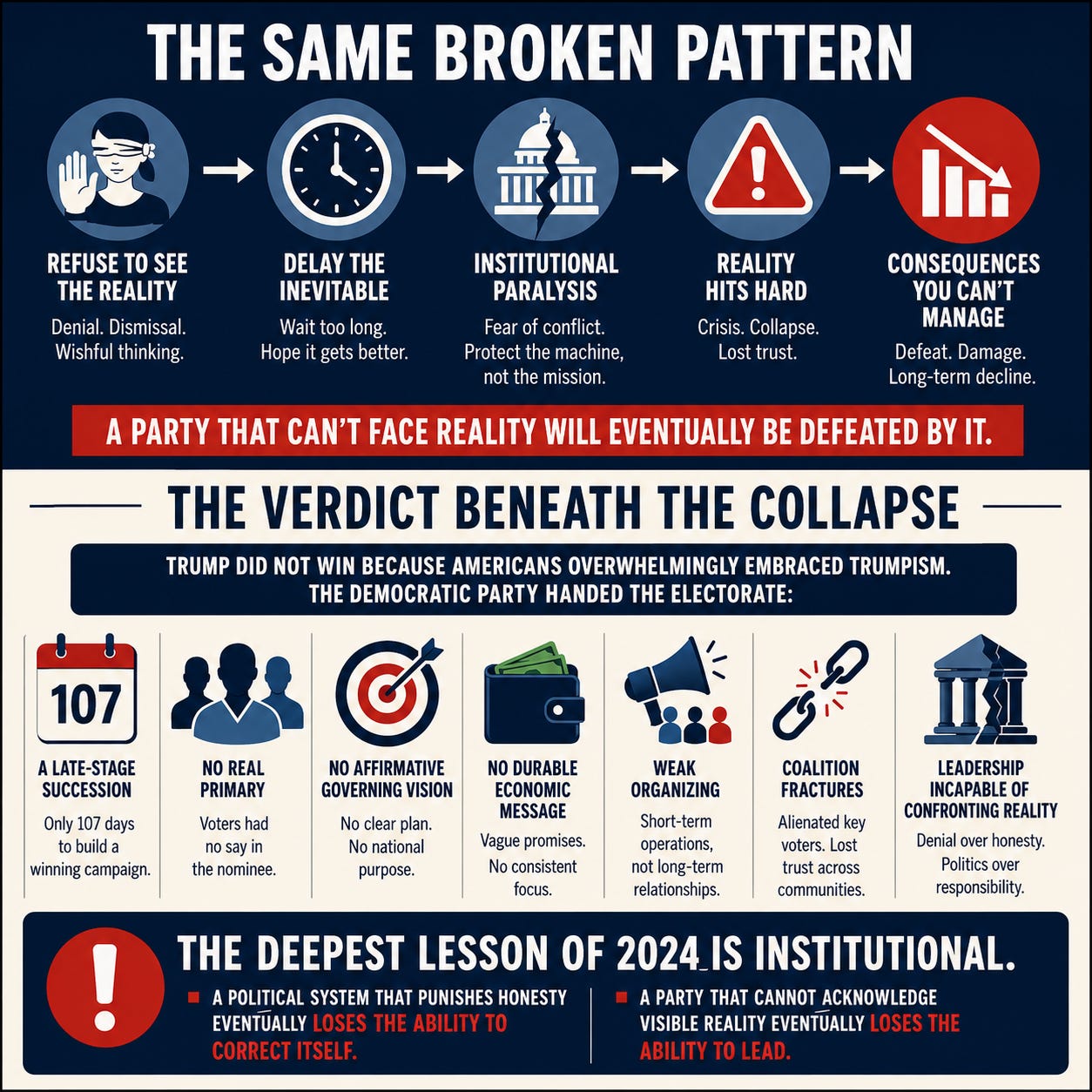
Each reflected the same underlying pattern:
A political institution increasingly unable to confront reality until reality imposed consequences it could no longer manage.
a
The Verdict Beneath the Collapse
Trump did not win because Americans overwhelmingly embraced Trumpism.
The Democratic Party handed the electorate:
a late-stage succession,
no real primary,
no affirmative governing vision,
no durable economic message,
weak organizing,
coalition fractures,
and institutional leadership incapable of confronting obvious reality until it was too late.
The deepest lesson of 2024 is institutional.
A political system that punishes honesty eventually loses the ability to correct itself.
A party that cannot acknowledge visible reality eventually loses the ability to govern.
A coalition that fears internal dissent eventually becomes fragile, defensive, and disconnected from the people it claims to represent.
That is what happened to Democrats in 2024.
The same institutional instincts are increasingly visible inside the Republican Party as well.
The danger extends beyond losing elections.
The danger is producing institutions too fearful, too performative, and too exhausted to confront national problems at the scale they now exist.
The 6.8 million voters who withdrew in 2024 are still there.
The question is whether either party is still capable of deserving them.
If this work matters to you, consider subscribing or pledging support for the future paid version of The Fourth Turning Point.
The paid side will not launch without warning and it will not launch without clarity about exactly what subscribers are receiving. Full details on the research products, reports, deep dives, and long-form analysis being developed will be released before launch.
The first rollout is planned for this summer.
Next: The Politics of Institutional Fear
E.J.M
The Fourth Turning Point
Memory. Markets. Meaning.
Great analysis! Most of these failures are well known but you put them together concisely and clearly. It was painful and frustrating to read. If the democrats do not learn from these failures and get it together, God knows what will happen to our country. We may not survive if this denial and in some cases outright stupidity resumes in 2028.
Excellent work 👏