
The Cyrus Doctrine
A Framework for Replacing Permanent Confrontation

This doctrine was written during the 104th day of a war that nobody planned to end this way.
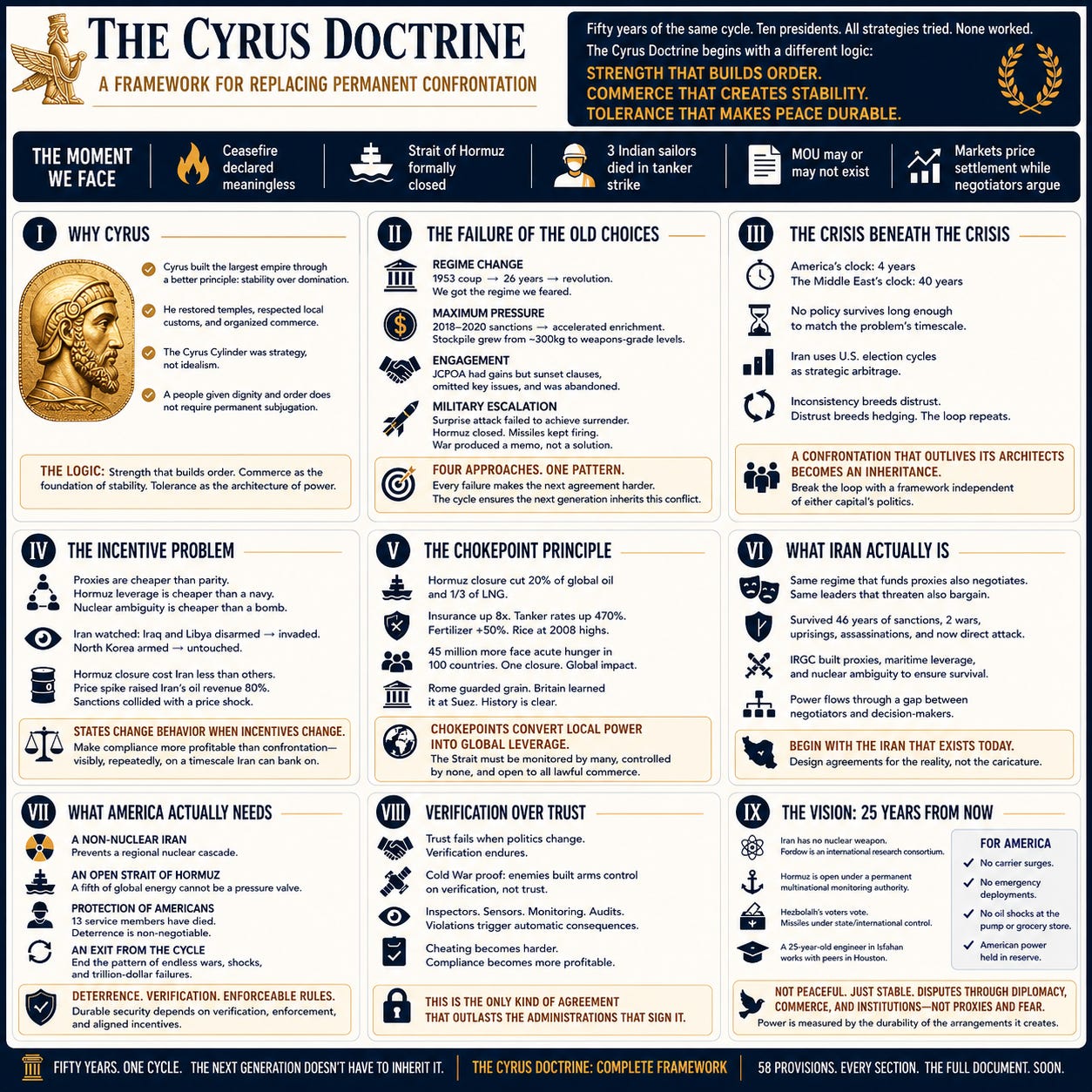
The ceasefire has been declared meaningless.
The Strait of Hormuz is formally closed.
Three Indian sailors died this week when an American warship struck the tanker carrying them.
A memorandum of understanding may or may not exist.
Markets are pricing a settlement while the people negotiating it argue over whether it exists at all.
Strip away the dates and the details, and the moment is familiar.
A confrontation nobody fully controls.
A diplomatic track nobody fully trusts.
An energy shock nobody fully priced.
The immediate crisis is the latest expression of a pattern that has now run for five decades, under ten presidents, through every available strategy.
The framework that follows emerged from months of analysis, around a single conviction:
The approaches the United States has tried for fifty years produced the conditions currently visible from satellite.
Something different is required.
The Cyrus Doctrine begins with a different strategic logic.
I. Why Cyrus
Cyrus the Great did not build the largest empire in the ancient world through conquest alone.
He built it through a principle most conquerors never understood:
Stability is more valuable than domination, and people who have reason to cooperate do not require permanent subjugation.
When Cyrus entered Babylon in 539 BCE, the temples were restored rather than destroyed. Local customs and faiths were largely permitted to continue. Commerce was organized alongside administration, making cooperation more profitable than resistance.
The Cyrus Cylinder, often called the first declaration of human rights, was not idealism. It was strategy.
A conquered people given dignity and order does not require a garrison on every corner.
The name describes an operating logic.
Strength that builds order.
Commerce as the foundation of stability.
Tolerance as the architecture of durable power.
That logic is what the Cyrus Doctrine applies to the 21st-century Middle East.
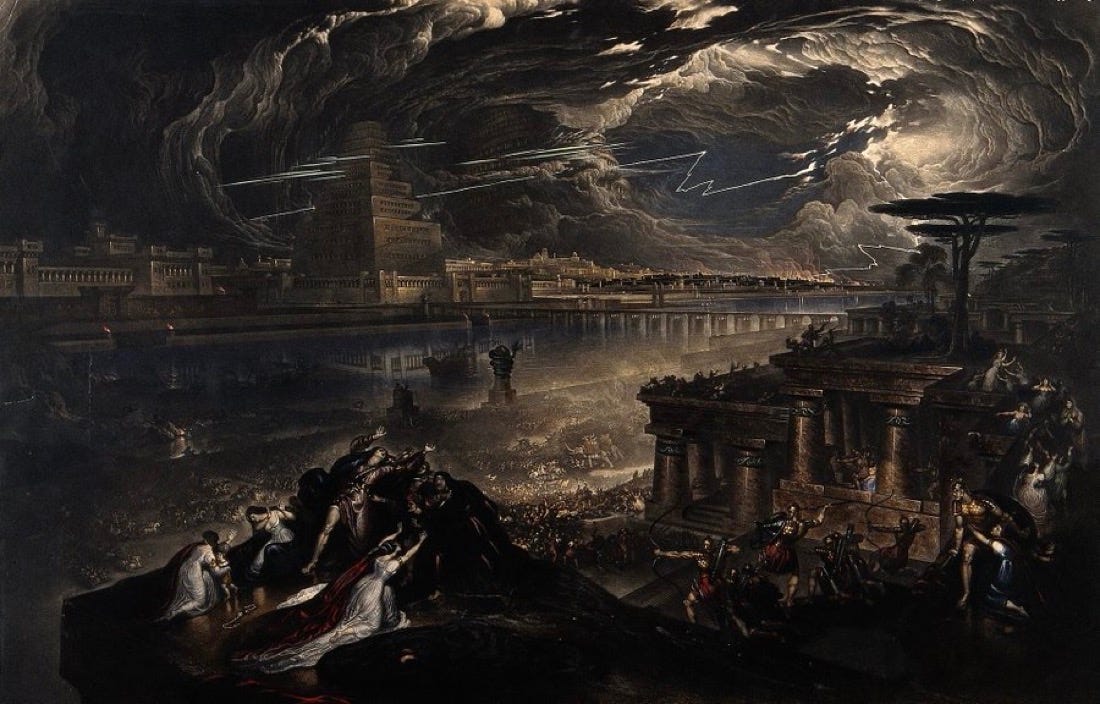
II. The Failure of the Old Choices
The United States has tried every available approach to Iran.
An honest accounting requires naming each one.
Regime Change
The 1953 coup that removed Mosaddegh and restored the Shah produced a government that lasted 26 years before ending in revolution.
The attempt to choose Iran’s leadership produced the regime America most feared.
The bill arrived a generation later.
Every administration since has paid installments on it.
Maximum Pressure
The 2018–2020 campaign imposed the most comprehensive sanctions in history.
The result was accelerated enrichment.
Between the U.S. withdrawal from the JCPOA and the start of the current war, Iran’s stockpile grew from roughly 300 kilograms to levels sufficient for multiple weapons.
Pressure without a credible pathway to relief changes calculations about survival.
Engagement
The JCPOA produced real constraints and real verification gains.
It also contained sunset provisions that functioned as a countdown clock, omitted missiles and proxies, and lacked an architecture capable of surviving a change of administration.
The withdrawal taught Tehran a lesson it has repeated in every negotiation since:
American signatures expire.
Military Escalation
Military escalation is failing in real time.
A surprise attack that killed the Supreme Leader, destroyed nuclear infrastructure, and triggered the most severe energy shock in modern history failed to achieve surrender.
Hormuz closed.
A fee regime emerged generating billions.
The missile force kept firing.
After 104 days, the war produced a memorandum that defers every hard question to sixty more days of argument.
Four approaches. One pattern.
And one cost that compounds beneath all of them:
Every failed agreement made the next agreement harder to sell.
Every collapsed ceasefire taught both publics that ceasefires collapse.
Every abandoned framework consumed credibility that took decades to accumulate and cannot be legislated back into existence.
Trust is spent faster than it is rebuilt, and after fifty years both nations are running on empty.
The graveyard of Middle East strategy is filled with tactical victories that produced worse incentives than the systems they overthrew.
Reproducing the cycle ensures another generation inherits the same conflict.
III. The Crisis Beneath the Crisis
The deeper question is why the cycle repeats.
Five decades. Ten administrations. Opposite parties, opposing ideologies, identical outcomes.
When every strategy fails the same way, the problem is not the strategies. The problem is the system producing them.
American foreign policy operates on a four-year clock. The problems it addresses in the Middle East operate on forty-year clocks.
Every administration inherits a confrontation it did not start, applies a strategy designed to show results before the next election, and hands its successor a worse position.
The JCPOA took twenty months to negotiate and three years to abandon.
Maximum pressure lasted one term.
No policy survives long enough to be tested against the timescale of the problem.
Tehran has built this asymmetry into its planning.
Iranian negotiators study American election calendars the way commodity traders study harvest schedules.
Why concede anything permanent to a counterparty whose commitments expire every four years?
The rational move is to wait, absorb pressure, and negotiate with the next administration from a stronger position.
Tehran treats American political turnover as arbitrage.
The result is a feedback loop.
American inconsistency teaches Iran to discount American promises.
Iranian hedging teaches Washington that Iran negotiates in bad faith.
Each side’s rational response confirms the other’s worst assumptions.
The loop has run for fifty years.
It has now run long enough to outlive the people who started it.
The men who planned the 1953 coup are dead.
The revolutionaries who seized the embassy are in their seventies.
The American officers who planned for war with Iran in the 1980s have grandchildren deploying to the same waters, against the same adversary, under the same assumptions.
A confrontation that survives its own architects stops being a policy. It becomes an inheritance, passed down by two governments that have each forgotten they had a choice.
Breaking the loop requires a framework that does not depend on the politics of either capital.
That is the design problem this doctrine exists to solve.
IV. The Incentive Problem
Iran did not wake up one morning and decide to build a proxy network.
The proxy network emerged because conventional parity with the United States was impossible, and proxies were cheaper than parity.
Hormuz became leverage because leverage was cheaper than a navy.
Nuclear ambiguity became attractive because ambiguity was cheaper than an arsenal and almost as effective as one.
Watch what the regime watched.
Iraq disarmed and was invaded.
Libya disarmed and its leader died in a drainage pipe.
North Korea armed and has never been touched.
For a state whose first priority is survival, the incentive structure of the last thirty years has pointed in exactly one direction.
Iran followed it.
Every capability Washington wants Iran to abandon is a capability the international system taught Iran to build.
The same logic runs through this war.
Iran closed Hormuz because the closure cost Iran less than it cost everyone else.
Then the price spike the closure produced raised the value of the oil Iran was still selling.
The country fighting the world’s largest military is earning 80 percent more per day than it did before the war began.
Sanctions designed to starve the regime collided with a price shock that fed it.
States rarely change behavior because they are persuaded.
They change behavior because the incentive structure changes.
Any framework that demands Iran surrender its leverage while preserving the conditions that made the leverage necessary will fail the way every previous framework failed.
Leverage follows incentives. Change the incentives and the leverage changes with them.
This doctrine is designed around that reality.
Compliance must pay more than confrontation, visibly, repeatedly, on a timescale the regime can bank on.
Peace has to become the more profitable position.
V. The Chokepoint Principle
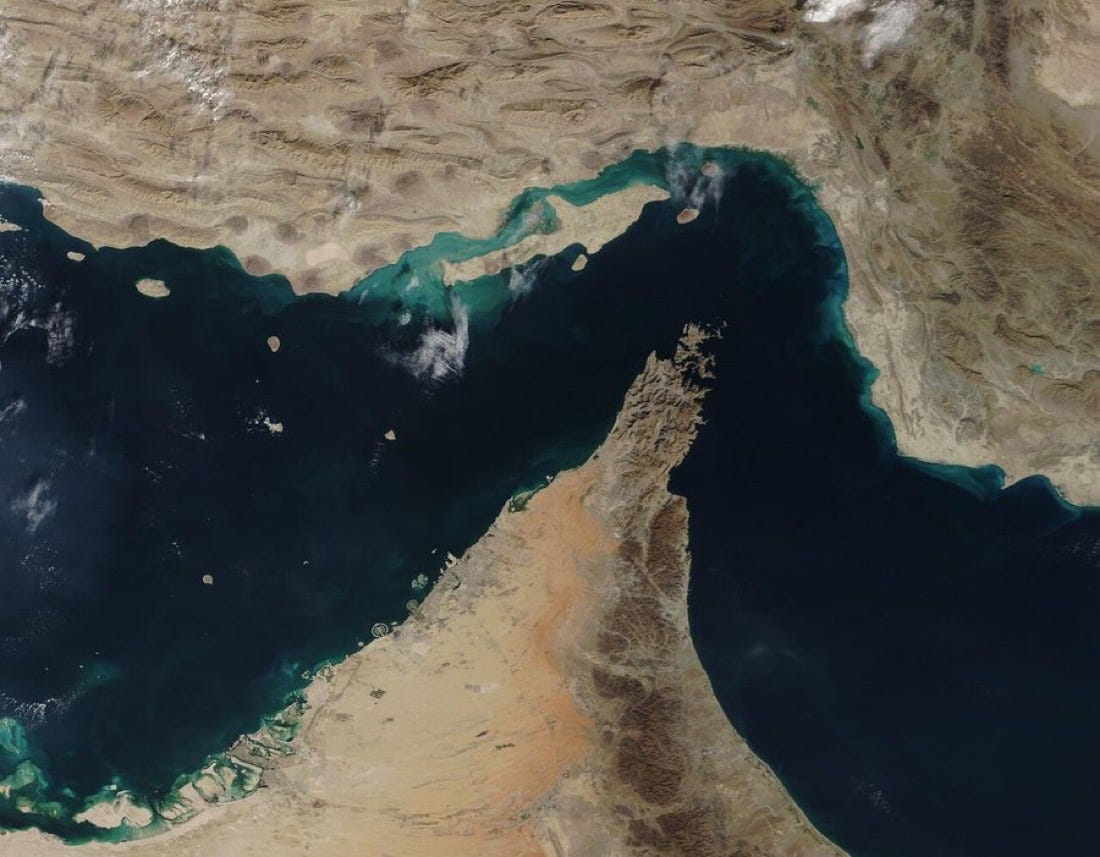
Every major geopolitical crisis eventually becomes a supply chain crisis.
The current war proved it again, and the transmission chain explains why a regional confrontation became a global event.
Hormuz closed.
Twenty percent of the world’s oil and a third of its liquefied natural gas lost their primary route.
Shipping insurance rose to eight times normal.
Tanker rates jumped 470 percent.
Fertilizer plants, which run on natural gas, raised prices fifty percent across Asia.
Farmers planted with reduced inputs.
Rice posted its largest monthly increase since 2008.
Forty-five million additional people now face acute hunger, with the price peak arriving in February 2027, in a hundred countries, among populations who could not find Hormuz on a map.
One waterway. One closure.
A harvest decided on the other side of the planet.
Rome understood this.
The empire did not garrison Egypt for prestige. It garrisoned Egypt because Egyptian grain fed Roman cities, and whoever controlled the grain route controlled Roman politics.
Britain learned the same lesson at Suez in 1956, the hard way.
Two thousand years of history compress into one rule:
Chokepoints convert local power into global leverage, and any state that controls one can tax the world.
The doctrine’s maritime architecture exists because of this rule.
The Strait cannot remain an asset one government weaponizes whenever its incentives shift.
It must be monitored by many, controlled by none, and open to all lawful commerce, with enforcement that triggers automatically when anyone threatens the artery.
A fifth of the world’s energy cannot depend on the mood of any single capital.
VI. What Iran Actually Is
Every failed approach began from a caricature.
Iran is somehow always either the apocalypse state, irrational and undeterrable, or the misunderstood neighbor, one good-faith gesture away from moderation.
Five decades of policy built on those two cartoons produced five decades of failure.
The record describes something else.
The same government that funds proxies negotiates shipping corridors.
The same leadership that threatens to close Hormuz spends months bargaining over the mechanics of sanctions relief.
The same regime that chants death to America has quietly honored prisoner exchanges, ceasefire technicalities, and back-channel arrangements when the terms served it.
Iran behaves the way most states behave when survival is the first priority and the toolbox is asymmetric.
The Islamic Republic has survived 46 years of sanctions, two major wars, internal uprisings, assassination campaigns against its leadership, and now a direct US-Israeli assault.
Irrational states do not survive at that rate.
The IRGC built four decades of proxies, maritime leverage, and nuclear ambiguity, engineered specifically to deter the pressure that would otherwise make the regime vulnerable.
That architecture is the survival strategy.
One more feature matters.
Iran’s internal power structure routes decisions through a gap between the diplomats who negotiate and the institutions that decide.
That gap has broken every framework Iran’s own negotiators produced.
Any agreement that ignores it will join the list.
Every provision of this doctrine begins with the Iran that exists today.
VII. What America Actually Needs
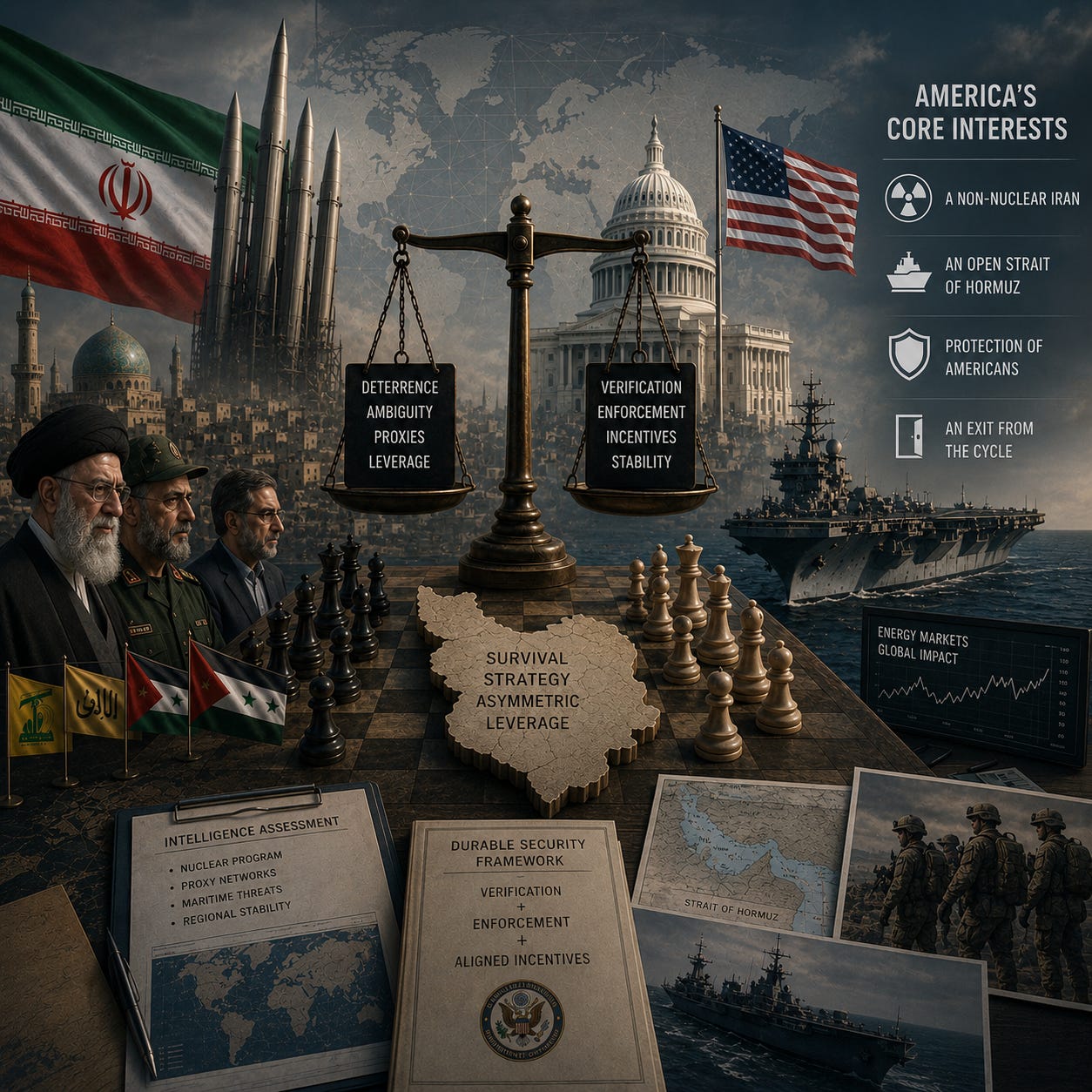
American interests in this conflict are narrower, more durable, and more achievable than the ambitions that have repeatedly drawn Washington into escalation.
What it needs is specific.
A Non-Nuclear Iran
Proliferation in the Middle East does not produce a balance of terror. It produces a cascade.
A nuclear Iran triggers Saudi, Turkish, and Egyptian programs, and every additional arsenal raises the probability that one gets used.
This interest outranks every other consideration, because failure here makes every other failure permanent.
An Open Strait of Hormuz
The chokepoint chain is the argument.
A waterway carrying a fifth of global energy cannot function as one government’s pressure valve.
Protection of Americans
Thirteen service members have died in this war.
The life of an American service member is not a bargaining chip.
Any framework without credible deterrence behind that sentence cannot sustain itself.
An Exit From the Cycle
Four major military engagements in 35 years, each producing the conditions for the next.
Another generation of carrier groups surging to the Gulf every eighteen months.
Another round of fuel shocks transmitted into every grocery aisle in America.
Another trillion dollars of borrowed money converted into outcomes nobody can name.
The pattern ends when the structural incentives for confrontation are replaced.
The Requirement
These interests require deterrence, verification, and enforceable rules.
Durable security depends on verification, enforcement, and aligned incentives.
VIII. Verification Over Trust
The central argument of this doctrine focuses on the design of agreements that last.
Every framework that relied on trust failed when the politics that produced the trust changed.
The JCPOA did not collapse because Iran violated it.
It collapsed because an American administration calculated that withdrawal paid better than compliance.
The April ceasefire did not collapse because both sides wanted war.
It collapsed because nothing in its design could absorb the pressure points everyone knew were coming.
Trust is a function of present political conditions.
Verification is a function of designed systems.
Political conditions change.
Designed systems endure.
The Cold War offers the proof.
Washington and Moscow held thousands of warheads pointed at each other and trusted nothing.
Yet arms control held for decades, because the agreements never asked either side to trust.
They asked both sides to accept satellites, sensors, inspection teams, and counting rules that made cheating visible and expensive.
Reagan compressed the entire philosophy into four words borrowed from a Russian proverb:
“Trust, but verify.”
Two adversaries who believed the worst about each other built treaties that outlasted the Soviet Union itself.
That standard is the standard here.
Inspectors can see the centrifuges.
Sensors track the stockpiles.
The monitoring authority publishes what moves through the Strait.
Financial auditors follow the money that sustains armed groups.
Violations trigger predetermined consequences automatically.
No committee can bury them.
No single government can veto them.
Cheating becomes harder than compliance.
Compliance becomes more profitable than confrontation.
That is the only kind of agreement that outlasts the administrations that sign it.
IX. The Vision
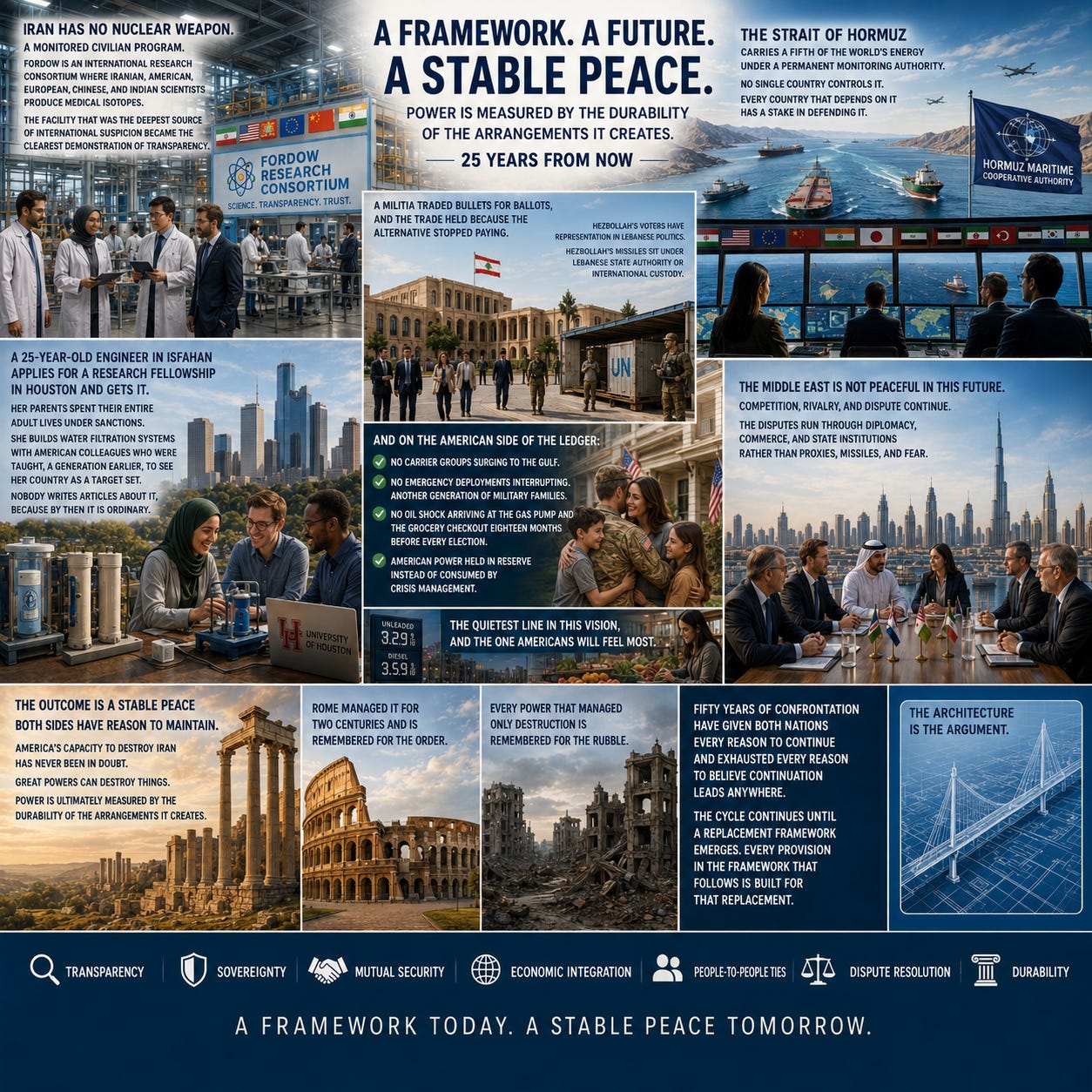
Twenty-five years from today, if this framework holds, the region looks like this.
Iran has no nuclear weapon. It has a monitored civilian program. Fordow is an international research consortium where Iranian, American, European, Chinese, and Indian scientists produce medical isotopes.
The facility that was the deepest source of international suspicion became the clearest demonstration of transparency.
The Strait of Hormuz carries a fifth of the world’s energy under a permanent monitoring authority.
No single country controls it.
Every country that depends on it has a stake in defending it.
Hezbollah’s voters have representation in Lebanese politics.
Hezbollah’s missiles sit under Lebanese state authority or international custody.
A militia traded bullets for ballots, and the trade held because the alternative stopped paying.
A 25-year-old engineer in Isfahan applies for a research fellowship in Houston and gets it.
Her parents spent their entire adult lives under sanctions.
She builds water filtration systems with American colleagues who were taught, a generation earlier, to see her country as a target set.
Nobody writes articles about it, because by then it is ordinary.
And on the American side of the ledger:
No carrier groups surging to the Gulf.
No emergency deployments interrupting another generation of military families.
No oil shock arriving at the gas pump and the grocery checkout eighteen months before every election.
American power held in reserve instead of consumed by crisis management.
The quietest line in this vision, and the one Americans will feel most.
The Middle East is not peaceful in this future.
Competition, rivalry, and dispute continue.
The disputes run through diplomacy, commerce, and state institutions rather than proxies, missiles, and fear.
The outcome is a stable peace both sides have reason to maintain.
America’s capacity to destroy Iran has never been in doubt.
Great powers can destroy things.
Power is ultimately measured by the durability of the arrangements it creates.
Rome managed it for two centuries and is remembered for the order.
Every power that managed only destruction is remembered for the rubble.
Fifty years of confrontation have given both nations every reason to continue and exhausted every reason to believe continuation leads anywhere.
The cycle continues until a replacement framework emerges.
Every provision in the framework that follows is built for that replacement.
The architecture is the argument.
The Cyrus Doctrine: Complete Framework
All 58 provisions. Every section.
The full document.
Soon.
Impressive work, no doubt…
Until you consider the unfortunate realities of 1) just how easily gaslit, manipulated, brainwashed, apathetic and divided much if not most of the US population really is, 2) the bipolar nature of our media and election cycles, and 3) the type of people/personalities attracted to big-time politics (those most fit to selfless service are also far too humble and intelligent to get involved in the zero-sum bloodsport it has become).
Still, thoroughly enjoyed the optimism for a brief moment, then remembered how often we’ve been burned by it. 👍🏼
I'm impressed with the speed, oh and quality!