
Colombia’s Final Choice
Everything documented between the earthquake and the runoff. The forecast. Where this publication stands.

The Fourth Turning Point — June 20, 2026
The Twenty-One Days That Changed the Election
On June 1, this publication argued that Colombia had twenty-one days to decide whether May 31 was a first-round shock or the start of a new political era.
The twenty-one days are over.
Sunday brings the answer.
What followed exceeded every analytical framework used in this series.

The doctrine did not slow after the first round.
It accelerated.
The external pressure campaign surrounding Colombia’s election became more explicit, more visible, and more thoroughly documented than at any previous point.
This piece examines four questions: the accountability record, the forecast, the evidence, and where The Fourth Turning Point stands.

The Accountability Check
Forecasting without a public record is opinion with a timestamp.
The Pre-Vote Forecast (May 30)
This publication projected a Cepeda-Valencia runoff.

The final call placed Cepeda first at 39.6 percent, Valencia second at 27.3 percent, and Abelardo third at 25.2 percent, giving Valencia a 51 percent probability of reaching the runoff against Abelardo’s 49 percent.
The model assigned Abelardo a 23 percent chance of winning the presidency and rated a first-round victory an “extreme surprise.”
What Happened (May 31)
Abelardo de la Espriella finished first with 43.75 percent and 10,361,499 votes, the largest first-round presidential vote total in modern Colombian history.
Cepeda finished second with 40.90 percent and 9,688,361 votes.
Valencia collapsed to 6.92 percent and 1,639,685 votes, finishing fourth in Medellín, the symbolic capital of Colombian conservatism.
The forecast correctly identified Cepeda’s coalition and partially identified the runoff structure. It missed the winner and the second finalist.
The Two Errors
The Abelardo Earthquake, published June 1, documented both.

The first was overweighting institutional coalition signals, treating six party endorsements and Uribe’s mobilization behind Valencia as a reliable turnout mechanism when those endorsements measured elite alignment more than voter behavior.
The second was discounting prediction markets too aggressively. This publication argued that Polymarket’s 63 percent probability for Abelardo reflected international participants misreading Colombian geography.
The market was right.
The model was wrong.
The lesson was straightforward: systematically discounting market signals because they diverge from polling consensus creates its own analytical bias.
The First Runoff Projection
The June 1 runoff forecast projected Cepeda 52 percent, Abelardo 48 percent, with Cepeda holding a 56 percent probability of victory.
The forecast incorporated Abelardo’s first-round victory without fully incorporating what it revealed.
He was still being modeled as a challenger seeking to consolidate the institutional right.
The first round had already answered that question.
A candidate who had just won by 673,000 votes was not trying to build a national turnout coalition.
He had already built one.
The first round was evidence.
The forecast did not weight that evidence heavily enough.
That projection requires revision.
This piece provides it.
The lesson remains the same:
Do not bet against a disruption coalition that continues mobilizing voters beyond the reach of institutional models.
Where the Race Stands
The Transfer Math
Paloma Valencia’s 6.92 percent consolidated almost entirely behind Abelardo within 72 hours. Centro Democrático activated, Cambio Radical endorsed before midnight, and the institutional right delivered the votes of its own candidate to the man who ran against it, without being asked.
The transfer is structurally complete.
Fajardo’s 4.25 percent split roughly 55–45 toward Abelardo, according to CELAG and La Silla microanalysis, with a portion staying home.
López’s 0.94 percent went to Cepeda near-completely.
The Vote Map
La Silla Vacía produced the most rigorous quantitative runoff analysis published this cycle, identifying 2.3 million contested votes across three channels: unmobilized machine votes from March’s legislative elections, persuadable abstentionists, and the center bloc from eliminated candidates.
Their Monte Carlo simulation, 10,000 elections varying each candidate’s capture rate, produced a clear finding.
At equal mobilization, Abelardo wins approximately 73 percent of scenarios.
For Cepeda to exceed 60 percent probability, he needs strong mobilization combined with Abelardo underperforming his own available territory.
If Cepeda mobilizes hard and Abelardo captures very few remaining votes, Cepeda exceeds 95 percent.
The math is not impossible.
It requires specific conditions aligning at once.
Cepeda’s largest unmobilized pools sit in Bogotá (397,000 abstentionists) and Valle del Cauca (278,000).
Abelardo’s sit in Antioquia (313,000) and Bogotá’s Centro Democrático base (306,000).
The Polling
AtlasIntel-Semana: Two June samples totaling more than 6,600 respondents. Abelardo 54%, Cepeda 46%.
Guarumo-EcoAnalítica: 54–46.
CNC: 52–48.
CB Global Data: 53–47.
The critical outlier is CELAG, whose large-sample in-person methodology, historically superior at reaching rural and lower-income voters often missed by digital surveys, shows a technical tie with Cepeda leading by one point.
Final Runoff Prediction
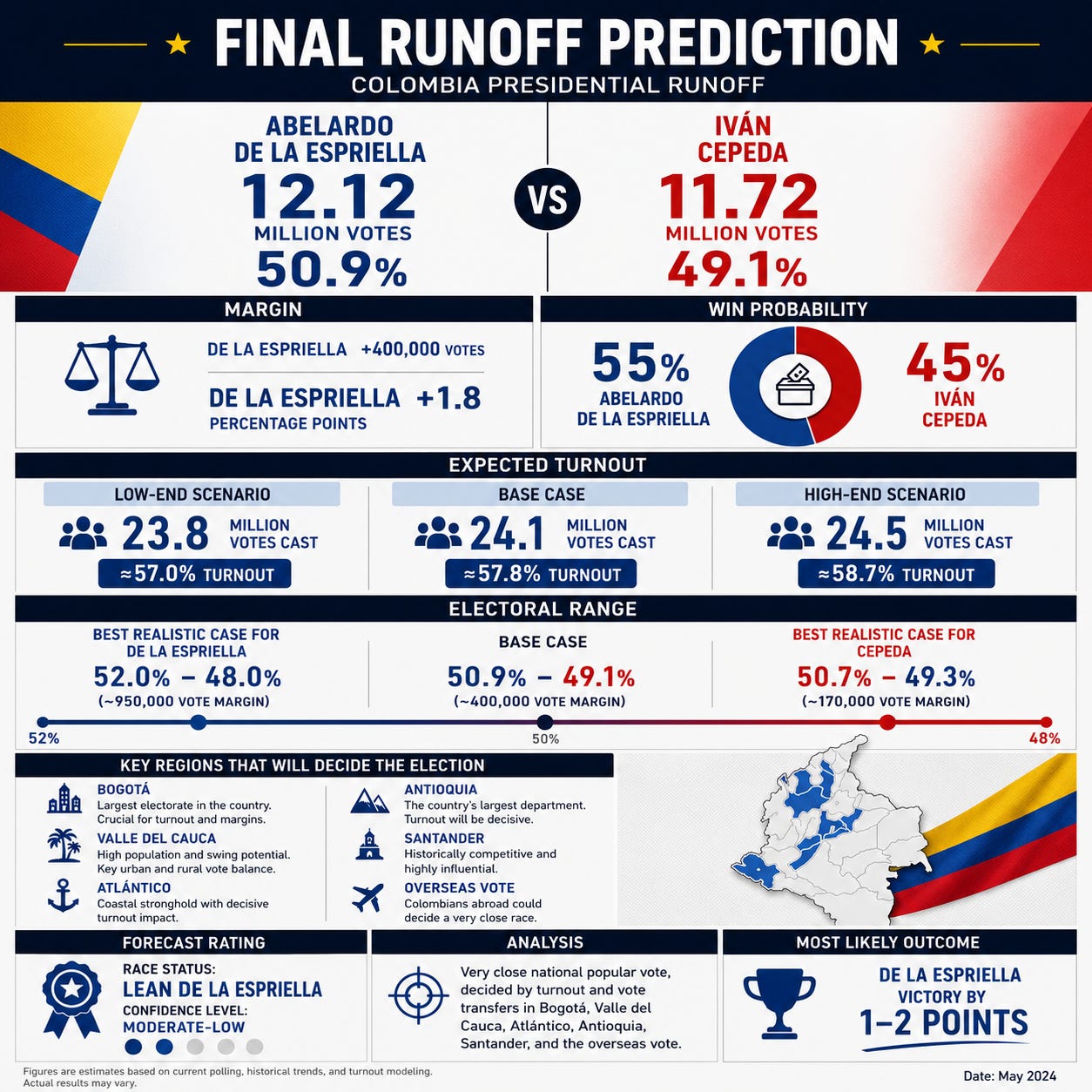
Abelardo de la Espriella
12.12 million votes
50.9%
Iván Cepeda
11.72 million votes
49.1%
Margin
De la Espriella +400,000 votes
De la Espriella +1.8 percentage points
Win Probability
Abelardo de la Espriella: 55%
Iván Cepeda: 45%
Expected Turnout
Low-End Scenario
23.8 million votes cast
≈57.0% turnout
Base Case
24.1 million votes cast
≈57.8% turnout
High-End Scenario
24.5 million votes cast
≈58.7% turnout
Electoral Range
Best realistic case for De la Espriella
52.0% – 48.0%
(~950,000 vote margin)
Base case
50.9% – 49.1%
(~400,000 vote margin)
Best realistic case for Cepeda
50.7% – 49.3%
(~170,000 vote margin)
Forecast Rating
Race Status: Lean De la Espriella
Confidence Level: Moderate-Low
Expected Result: Very close national popular vote, decided by turnout and vote transfers in Bogotá, Valle del Cauca, Atlántico, Antioquia, Santander, and the overseas vote.
Most Likely Outcome: De la Espriella victory by 1–2 points.
Why My Forecast Differs From the Market
Polymarket prices Abelardo at 89 percent.
This publication forecasts 55 percent.
That is a 34-point gap, and it deserves an explanation.
Four factors widen the uncertainty the market is not pricing.
First, CELAG’s in-person methodology shows a technical tie, and CELAG’s structural strength is precisely the rural and highland populations that every firm underweighted in the first round.
Second, internal Abelardo campaign tracking, circulated in Colombian media this week, reportedly shows the gap closing and characterizes the race as a possible technical tie, the campaign’s own analysts noting their instrument underestimates Cepeda due to geographic vote distribution.
As of June 20, that same AtlasIntel tracking reportedly showed the margin compressing from +16 on June 5 to +5, the steepest two-week narrowing of the campaign.
Third, youth and new-voter turnout is the single largest unmodeled variable, and the 2022 runoff added nearly 760,000 net Petro votes above what legislative results predicted.
Fourth, the first-round polling miss is recent enough that the entire Colombian polling industry’s confidence interval should be treated as wider than the market assumes.
The market is pricing the central case correctly.
It is underpricing the tail.
Abelardo is the favorite.
He is not an 89-percent favorite.
What Would Make This Forecast Wrong
Three conditions, any one of which would move this toward a Cepeda win:
Youth and new-voter turnout reaches or exceeds 2022 levels, particularly in Bogotá’s southern zones and Cali.
CELAG is closer to reality than AtlasIntel and Guarumo, meaning the digital-weighted firms are systematically overstating Abelardo.
Cepeda’s Bogotá margin substantially overperforms his first-round result, signaling the unmobilized 397,000-vote pool activated.
If none of these materialize, Abelardo wins by two to four points.
The Conduct Record
One documented fact about De la Espriella belongs before the geopolitical analysis.
What Happened
On a national radio program, de la Espriella stated that he won female support because of the size of his genitals and directed a female journalist to look at a photograph emphasizing them.
A Colombian judge subsequently declared his comments toward journalist Laura Rodríguez “deeply violent” and ordered a public retraction and apology within 48 hours, citing harassment and machismo.
FLIP has documented 109 press-harassment complaints filed by de la Espriella against journalists investigating him.
These facts form part of the public record surrounding a candidate seeking the presidency.
The Election-Night Risk Environment
A separate issue is the security environment surrounding the result itself.
What Happened
Defense Minister Pedro Sánchez publicly acknowledged intelligence on possible post-result violence across 38 municipalities, concentrated in Bogotá, Medellín, Cali, and Barranquilla.
Control Risks assessed two scenarios: immediate street response following a de la Espriella victory, and slower organic discontent if spending cuts are implemented.
The Alcaldía of Chaparral, Tolima declared an election-night curfew.
On the morning of June 20, Petro ordered the land and river borders with Venezuela closed from 6:00 a.m. Saturday, stating that the purpose was to ensure Colombians vote inside Colombia. The order affects the border departments of Norte de Santander, La Guajira, and Arauca.
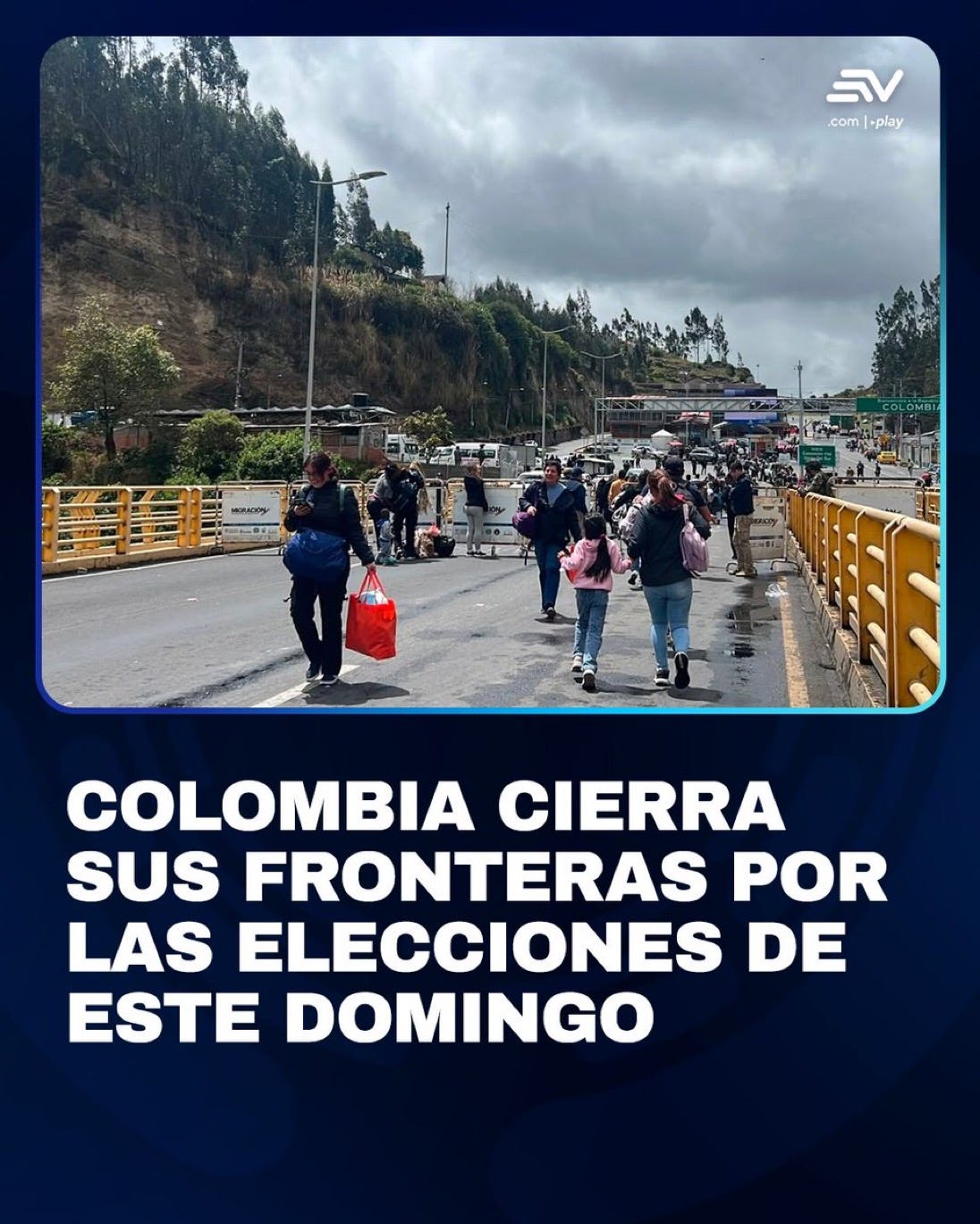
The government framed the move as a Plan Democracia 2026 security measure.
Critics viewed it as an attempt to control a specific cross-border voting flow.
Either interpretation places the decision within the broader legitimacy contest that has defined the campaign.
These measures reflect concern among security officials that the result could trigger unrest regardless of the winner.
The External Pressure Record
What Happened
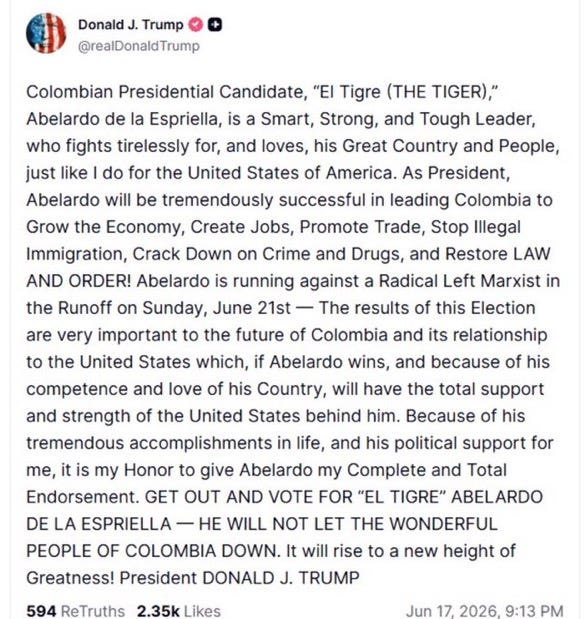
June 2 and June 17 — Trump endorsed Abelardo on Truth Social, calling him “El Tigre,” calling Cepeda “a Radical Left Marxist,” and linking Abelardo’s victory to the future of U.S.-Colombia relations.
U.S. Deputy Secretary of State Christopher Landau posted on X warning that those “tempted to undermine or manipulate the democratic process, whether by BUYING VOTES or otherwise,” risk losing their visas and their families’ visas.
June 17 — ICE detained Colombian activist Beto Coral outside his Arizona home as he arrived with his young son. Coral held a pending asylum claim and a work permit.
On June 20, The New York Times and El País reported that Secretary of State Marco Rubio personally signed the detention order.
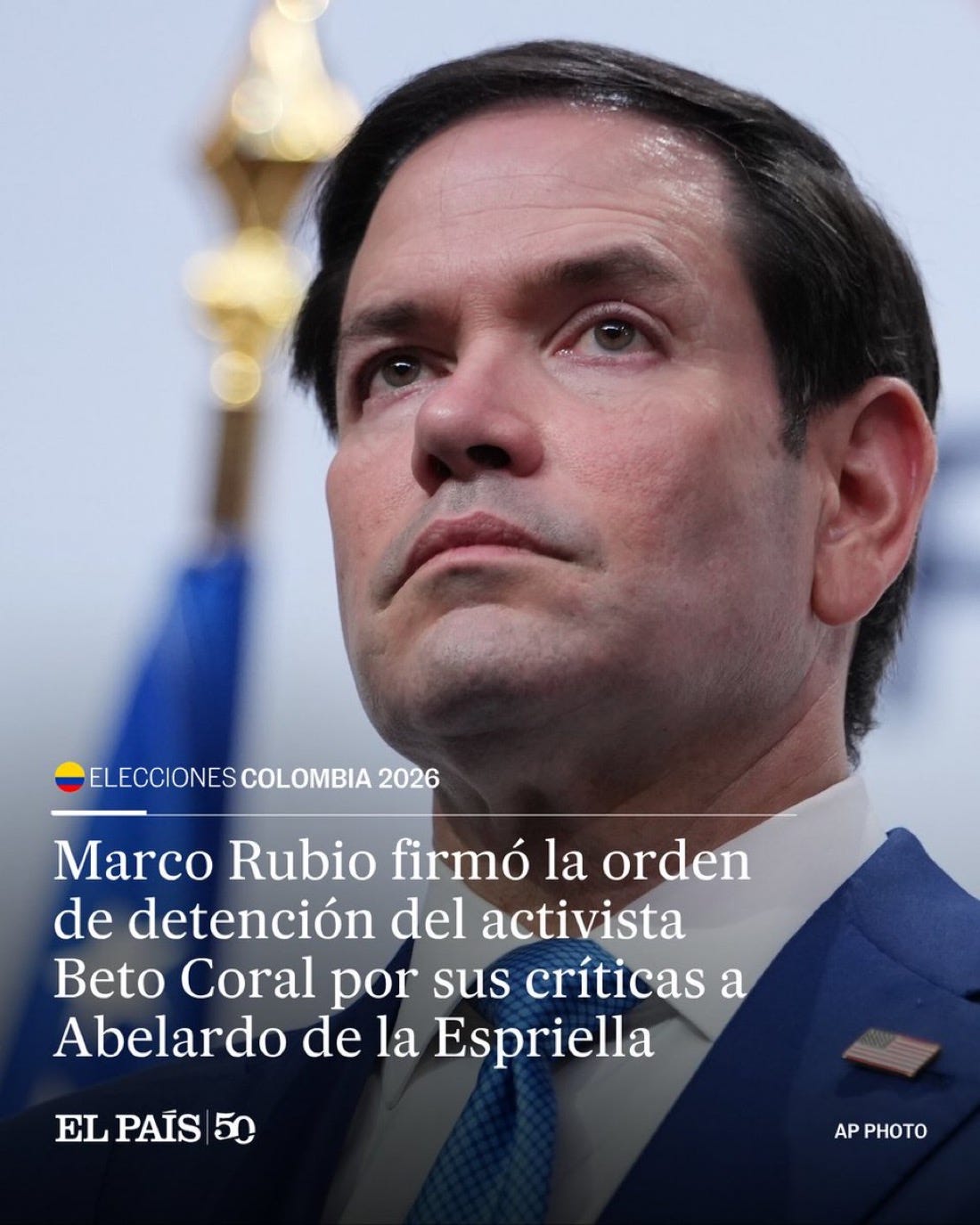
According to a memorandum obtained by the Times, Rubio determined that Coral’s presence in the United States “undermines the foreign policy interests” of the country “in the democratic processes of Colombia.”
Coral, who arrived in 2015 and holds a pending asylum claim, is the son of a police officer who participated in the 1993 operation that killed Pablo Escobar.
Hours before the arrest became public, de la Espriella posted:
“There will be good news for Colombia and for patriotic Colombians abroad. Dura lex, sed lex… Coming soon.”
Senator Bernie Moreno responded:
“Have a nice life back in Colombia Beto!”
By June 19, Coral had been moved from Arizona to Texas to Louisiana, his name no longer appearing in the ICE Locator system.
Petro’s government stated authorities were “pressuring him in every way to self-deport.”
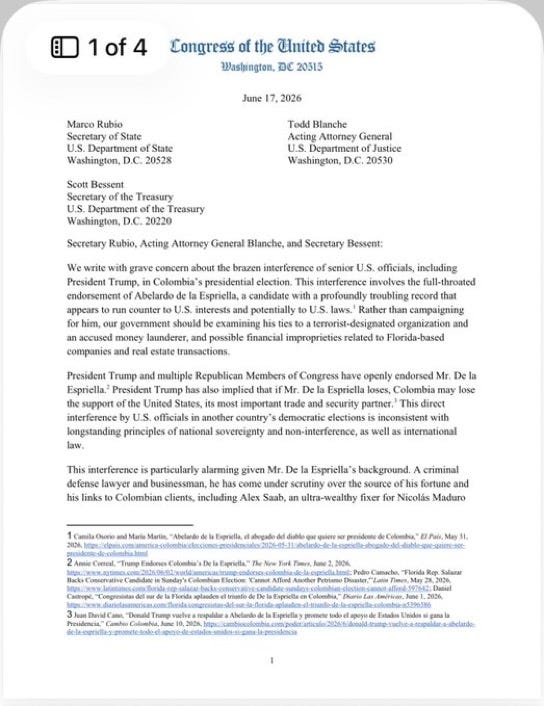
June 18 — Eleven Democratic members of Congress led by Chuy García wrote to Rubio, Bessent, and Blanche requesting an investigation into de la Espriella’s AUC ties, fourteen Florida shell companies, and possible Alex Saab-linked real estate.
June 19 — Republican Representatives Salazar, Giménez, Smith, and Huizenga sent a counter-letter calling the Democratic concerns “slanderous,” describing Cepeda as “the communist,” and urging continued support for Abelardo.
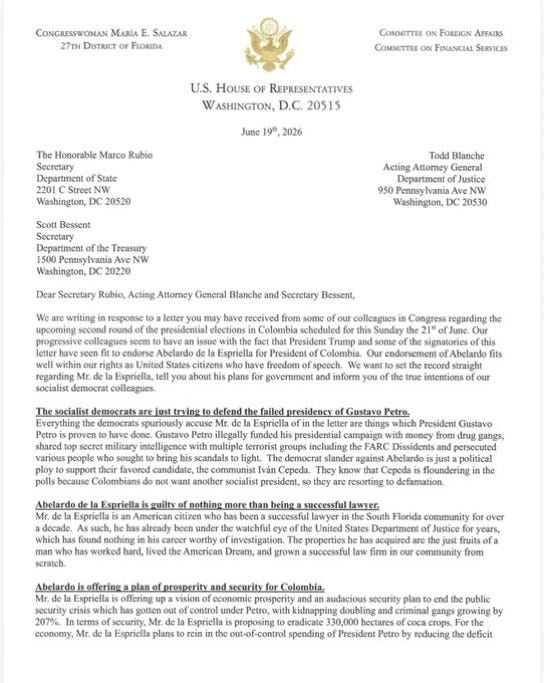
Colombia’s Foreign Ministry received two contradictory U.S. congressional letters about its election during the final week of the campaign.
El Tiempo published and then deleted coverage of the Democratic letter the same day.
CEPR requested restoration.
The article remains available through MSN and the Internet Archive.
Cepeda filed an ICC and Attorney General complaint over FIPAZ, the foundation that Salvatore Mancuso’s 2024 JEP testimony and a Supreme Court ruling identified as an AUC-financed political vehicle.
Colombia sent a formal diplomatic protest to Argentina over Milei’s endorsement.
Ecuador’s Daniel Noboa tied a trade concession to Abelardo’s candidacy.
June 20 — Senator Bernie Moreno, who celebrated Coral’s arrest, arrived in Bogotá to observe the runoff in person, posting that Colombia’s future “rests, as it has for decades, in your own hands.”
What It May Mean
Taken together, these events represent among the most concentrated documented examples of foreign electoral involvement examined in this series.
The series’ evidentiary standard remains unchanged.
Convergence without demonstrated centralized command is convergence, not proof of a single coordinating hand.
But the density of documented involvement, two endorsements from a sitting president, a deputy secretary’s visa threats, the arrest and interstate transfer of a critic, competing congressional letters, and diplomatic protests involving two neighboring governments, exceeds anything previously cataloged in the eleven-country record.
What to Watch Sunday
Turnout is decisive.
The La Silla Monte Carlo indicates that Abelardo wins most equal-mobilization scenarios, while Cepeda requires differential mobilization.
Watch youth and new-voter participation in Bogotá’s southern zones and Cali, the geographies where Cepeda’s unmobilized pool is largest.
Watch whether Cepeda’s Bogotá margin improves on the first round.
Watch the legitimacy signal.
The Registraduría delivered first-round results in under an hour.
CNE President Quiroz identified disinformation, rather than fraud, as the primary risk.
The largest international observer mission in Colombian history, 1,500 delegates, more than triple the 2022 level, is in place.
Whether that containment holds depends on the final margin.
Any Cepeda win or narrow Abelardo win will face legal challenge regardless.
A Personal Note
What follows is not a forecast.
It is where this publication stands.
I disagree with Iván Cepeda on almost every major policy question: his economic model, his fiscal assumptions, his view of the state, and his energy approach.
That should place me on the other side of this election.
It does not.
Because this election is about more than policy.
Countries are rarely damaged by disagreements over tax rates. They are damaged when leaders convince citizens that hatred is a governing philosophy and fellow citizens are enemies.
I reject that whether it comes from the left or the right, in Washington, Budapest, or Bogotá.
The pattern is familiar enough to treat as evidence.
Perón left Argentina fighting battles his movement institutionalized for decades. Chávez left a system more polarized than the one he inherited.
The rhetoric changes.
The ideology changes.
The leader becomes the story.
Conflict becomes the fuel.
Institutions become obstacles.
Nobody improves schools with outrage.
A country can survive bad tax policy. What becomes dangerous is an endless cycle of political resentment.
Then there is the conduct beyond policy.
I have a mother. I have a sister.
I cannot dismiss comments a judge declared “deeply violent” as a personality quirk.
When a presidential candidate boasts about female support by referencing his genitals, and a court orders him to apologize for harassing a journalist, that reveals more about character than any policy paper.
A society reveals itself by how it treats women.
You do not have to be progressive to believe women deserve respect.
You have to be decent.
I disagree with Cepeda on policy.
I disagree with de la Espriella on something deeper: the way he sees people, and the culture his candidacy has normalized.
I can see what Cepeda is trying to build, even where I believe he is wrong.
Too often, I see a campaign built around grievance and conflict rather than a vision of what comes next.
I would rather lose an argument about economic policy than win an election built on division.
After the Vote
If this forecast is right, the accountability record will be published.
If it is wrong, the accountability record will still be published.
The purpose of forecasting is not prediction alone.
It is measurement.
History will render its verdict.
I know where I want to stand when it does.
Colombia deserves better than what the last twenty-one days produced.
— E.J.M.
The Fourth Turning Point
June 20, 2026
Runoff results Sunday.
https://substack.com/@tlionel/note/c-280988221?r=1jsoye&utm_medium=ios&utm_source=notes-share-action
https://www.bbc.com/news/articles/clye4ky2yzpo